
Solid Hardwood Floor Installation in Atlanta
Classy Flooring ATL installs unfinished solid hardwood floors across metro Atlanta and North Georgia, then sands them flat and finishes them in the home. Over plywood subfloors the floor is nailed down, with wide plank installed by nail-assisted glue-down; on concrete slabs it is glued down. We work with homeowners, interior designers and builders. The owners of a Hoschton home whose solid white oak floors we installed and finished about 20 years earlier called us back in 2025 to refinish them.
Classy Flooring ATL is led by Claudiu Toma, an NWFA Certified Installer, NWFA Certified Sand & Finisher and NWFA Certified Sales Advisor, who completed NWFA Precision Patterns: Parquet Flooring and NWFA Precision Patterns: Medallions. Every project is carried out by our in-house crew.
For projects of 1,000 sq ft and up, installation starts at $3.50 per square foot, and sanding and finishing the new floor starts at $6.00 per square foot, dustless sanding included; smaller projects are priced by the job. The $3.50 rate is for installation labor; material is purchased separately by the client.
What are the steps involved in installing wooden flooring?
A solid hardwood floor finished on site is installed in seven steps: moisture readings, acclimation, subfloor preparation, installation, a stabilization period, sanding and finishing. NWFA’s installation guidelines treat wood flooring as one of the last jobs completed on a project, delivered once the house is enclosed and the HVAC has been running for at least five days.
- Moisture readings. We record the room’s temperature and relative humidity and measure the moisture content of the flooring and the subfloor. NWFA’s guidelines call for readings on at least 40 boards for the first 1,000 sq ft of flooring, plus 4 for each additional 100 sq ft, and at least 20 locations across a wood subfloor for the first 1,000 sq ft, plus 4 for each additional 100 sq ft; a concrete slab is tested with in-situ relative humidity probes.
- Acclimation. We acclimate solid flooring in the home with the HVAC running and confirm its moisture content before installation; how long new hardwood should acclimate before installation is answered on our Buckhead lace-in project.
- Subfloor preparation. The subfloor is made flat to the tolerance of the installation method. For a nail-down with fasteners 1½ inches and longer, NWFA’s guidelines call for 3/16 inch in 6 feet or 1/4 inch in 10 feet; for a glue-down, 1/8 inch in 6 feet or 3/16 inch in 10 feet, unless the flooring manufacturer specifies otherwise. The guidelines place solid hardwood on or above grade, and below grade only when its manufacturer allows it. How we prepare plywood subfloors and concrete slabs, and how that work is priced, is on our subfloor preparation service page.
- Installation. Over plywood, solid hardwood is nailed down on NWFA’s fastening schedule unless the flooring manufacturer specifies otherwise: for 3/4-inch boards 3 inches and wider, a staple or cleat at least 1½ inches long every 6 to 8 inches, and every 8 to 10 inches for narrower boards. On a concrete slab, the floor is glued down with the trowel the adhesive manufacturer specifies and full adhesive transfer to the back of each board. Either way, the boards are racked from several bundles in random lengths, end joints are staggered at least twice the board width, and an expansion space generally equal to the flooring’s thickness is left at the walls.
- Stabilization. NWFA’s guidelines give unfinished solid flooring 5 to 7 days after installation before sanding, when scheduling allows. A glue-down may need longer while the adhesive cures and off-gasses, and it is sanded only once the adhesive has cured.
- Sanding. We sand with a belt sander and an edger, then with an FG Floortec Discus planetary sander at 100 and 120 grit, under HEPA vacuum extraction; 120 is our standard final grit. NWFA’s sanding guidelines start with the finest grit that flattens the floor, skip no more than one grit and end at a fine grit or finer.
- Finishing. The floor is finished in place with a water-based system, such as LOBA 2K Duo or Bona Traffic HD, or with Rubio Monocoat hardwax oil, in satin unless the client chooses another sheen. A stain color is sampled on the floor before the whole floor is stained. NWFA’s guidelines have the other trades finish their work before the final coat, so sanding and finishing are usually the last work in the house.
On the 21st floor of a Buckhead high-rise, we installed 1,600 sq ft of 4-inch by 3/4-inch Select solid white oak, unfinished and in random lengths, from Millwood Flooring in Ellijay, Georgia. The boards acclimated in the unit for 5 days, stacked and stickered with the HVAC running. The slab read 55% relative humidity by in-situ probe, and the floor was glued over 6 mm Roberts Natural Cork with WAKOL MS 260. Installation took 5 days in September 2025. The floor then stayed unfinished for about a month while the general contractor completed the renovation, with the traffic paths covered in protective cartons and the HVAC running. In October 2025 our crew of three sanded and finished it in 4 days, the last surface completed in the unit: a Lägler Hummel belt sander and a Super 7 edger at 40, 60 and 80 grit, the FG Floortec Discus at 100 and 120, then LOBA EasyPrime and two coats of LOBA 2K Duo in satin.
At a Buckhead home where a new addition joined the original floor, about 600 sq ft of new solid white oak was tied into about 700 sq ft of the existing floor with no transition strip. We measured the humidity before delivery, acclimated the boards for 4 days and confirmed their moisture content before installation. The new boards stayed unfinished for about 3 weeks while the builder painted, and the whole floor was sanded and finished last as one surface: one coat of DuraSeal Jacobean, the color the owners chose to match the original floor, then LOBA EasyPrime and two coats of LOBA 2K Duo in satin.


Is it cheaper to buy unfinished hardwood floors?
Yes. For the same species, grade and width, unfinished solid hardwood costs less to buy than prefinished, because a prefinished board carries a finish applied at the factory. Across the 2026 retail listings we compared for 3/4-inch Select oak, prefinished cost on average about $2.80 per square foot more than unfinished of the same species and width, before sales tax: from about $1.90 to $3.25 depending on the product, or about $2,800 more on 1,000 sq ft. Prices vary by supplier, species and width.
An unfinished floor is then sanded and finished on site, so the installed total is a separate comparison; our post on site-finished and prefinished floors explains how the installed costs of prefinished and site-finished floors compare.
What are the downsides of wide plank flooring?
A wide board moves more than a narrow one, so wide plank calls for tighter moisture control and an installation method that adds adhesive, and it usually costs more per square foot. Solid wood swells and shrinks across its width as its moisture content changes, and the movement grows with the width of the board. With the movement coefficient NWFA’s species publication gives for plainsawn white oak, a 4% change in moisture content moves a 3-1/4-inch board about 0.05 inch and a 7-inch board about 0.10 inch. Across a wide plank floor, the same seasonal change shows as fewer gaps between boards, each one wider; NWFA treats seasonal gaps as normal. Quartersawn boards move less across their width than plainsawn boards of the same species.
Because of that movement, NWFA’s installation guidelines hold solid plank 3 inches and wider to a tighter general rule of thumb: the subfloor should read no more than 2% higher in moisture content than the flooring, compared with 4% for narrower boards.
For solid and engineered boards wider than 5 inches, NWFA’s guidelines recommend a glue-assisted nail-down when site conditions allow, unless the flooring manufacturer recommends otherwise: the boards are nailed on the regular schedule, with adhesive added under them. Over plywood, we install wide solid plank with a nail-assisted glue-down, a different method NWFA also recognizes: a full spread of adhesive carries the bond, and the nails hold the boards tight to the subfloor while it cures. The flooring manufacturer’s instructions come first in either case, and either way, adhesive and the work of spreading it are added to a nailed floor.
Solid wide plank is also harder to find in stores. National flooring retailers sell unfinished solid oak up to about 5 inches wide; solid boards 7 inches and wider come mainly from specialty mills, often milled to order, and many mills offer their widest boards in rift and quartered or live sawn cuts.
Wide plank usually costs more per square foot to buy. Across the 2026 retail listings we checked, unfinished Select white oak, 3/4 inch thick, averaged about $4.75 per square foot in a 3-1/4-inch width and about $5.75 per square foot in a 5-inch width, before sales tax. The cut, the grade and the board lengths move the price as well.
Our wide-plank projects with pages of their own are engineered floors: 7-inch white oak at Chateau Elan, glued to the slab and finished on site, and 7-1/2-inch prefinished white oak in Canton, installed over plywood with a nail-assisted glue-down.
What grade of white oak flooring is best?
No grade is stronger than another, so the best grade is the one whose look fits the room. NWFA’s grading standard for unfinished solid flooring states that appearance alone sets the grade, because all grades are equally strong and serviceable. Select gives a more uniform floor; No. 1 Common and No. 2 Common show more color variation and more natural character.
NWFA’s oak grades, from the most uniform to the most character:
- Clear: mostly heartwood, with a minimum of character marks and discoloration.
- Select: color variation from the natural difference between heartwood and sapwood, with a limited number of small, tight knots and pin worm holes.
- No. 1 Common: prominent color variation and natural characters such as knot holes, streaks, checks and worm holes, admitted when they are sound and fill readily.
- No. 2 Common: the sound natural variations of the wood along with manufacturing imperfections, for floors where character marks and contrast are wanted.
Each grade down the list also has a shorter minimum average board length in NWFA’s standard, and no board-length standard applies to boards wider than 5 inches. Grades are often sold combined, such as Select & Better, a mix of Select and the grades above it, held to the standard of the lowest grade named. In every grade, NWFA’s standard aims for 100% of the pieces on grade and allows up to 5% below it. The open characters a grade admits, such as knot holes and checks, are filled before the final sanding cut, as NWFA’s sanding guidelines call for.
Grade moves the price. Across the 2026 retail listings we checked, unfinished 3-1/4-inch white oak averaged about $4.75 per square foot in Select and about $3.10 per square foot in No. 1 Common, before sales tax.
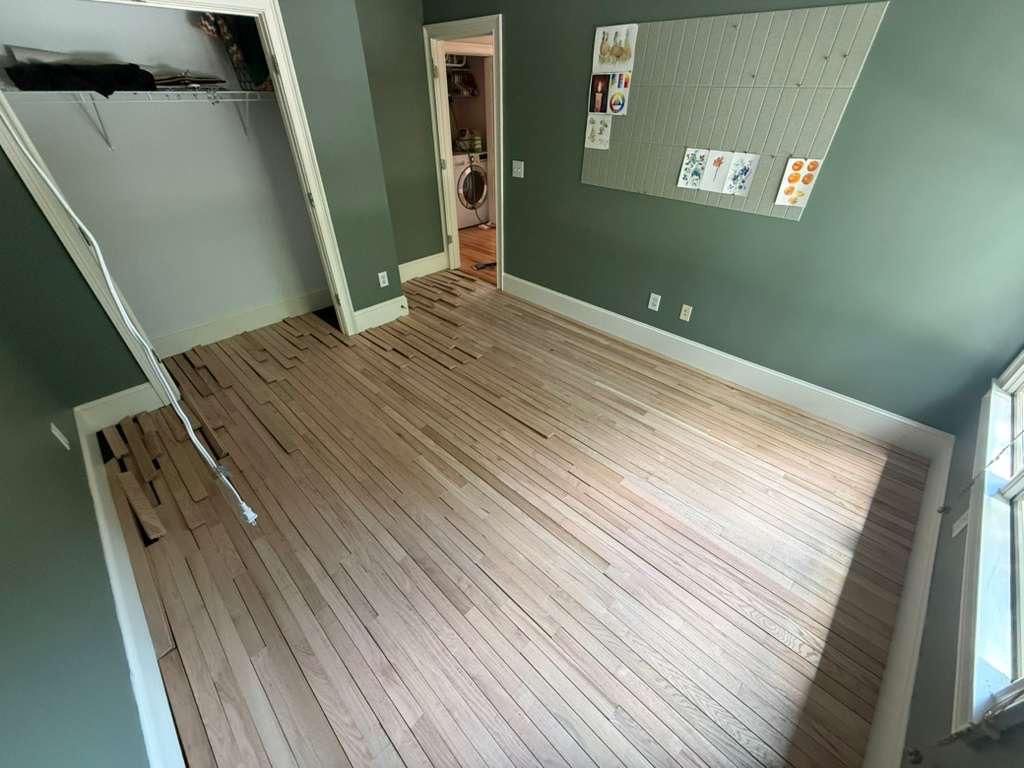
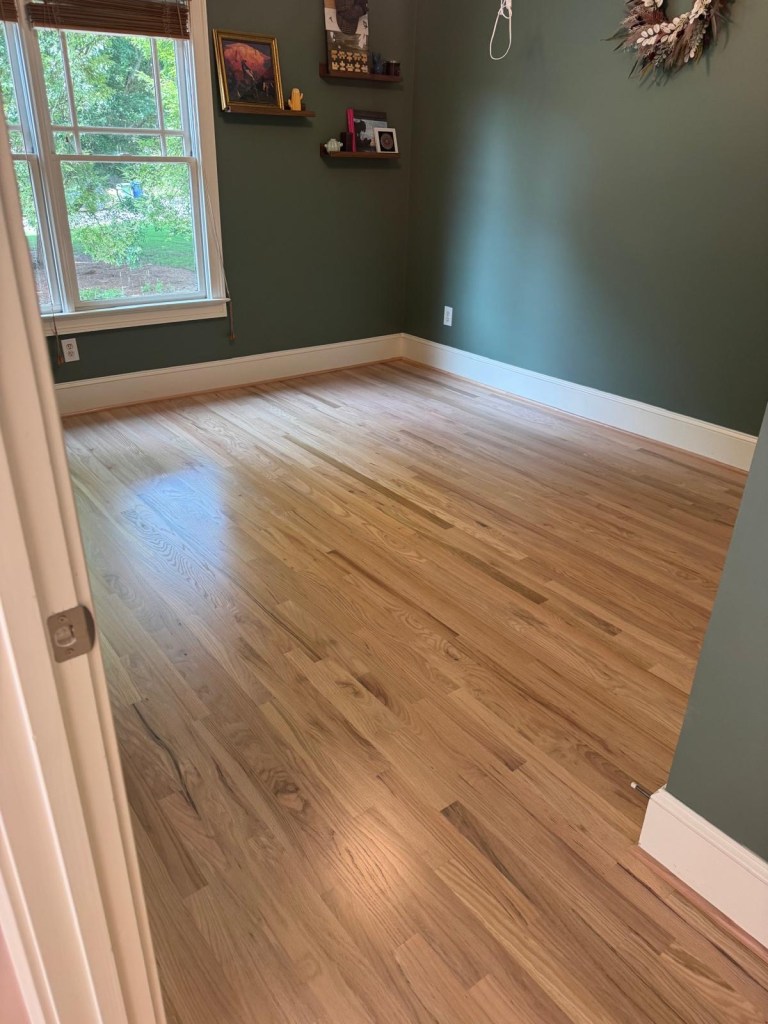
On the 21st floor of a Buckhead high-rise, we installed 4-inch Select solid white oak, and in an Atlanta home, the 160 sq ft of new red oak we installed in a former carpet room was No. 1 Common, sanded and finished together with the existing floors.
How much does it cost to install 1000 sq ft of hardwood flooring?
For 1,000 sq ft of unfinished 2-1/4-inch solid hardwood nailed down over a plywood subfloor, our work starts at $9,500: installation from $3.50 per square foot ($3,500) and sanding and finishing from $6.00 per square foot ($6,000), dustless sanding included. For boards 3-1/4 inches and wider, the installation rate depends on whether the floor is nailed down or glued down. Projects under 1,000 sq ft are priced by the job.
The flooring is purchased separately by the client. Across the 2026 retail listings we checked, unfinished 2-1/4-inch Select white oak averaged about $5.30 per square foot before sales tax, so 1,000 sq ft of material comes to about $5,300, plus the extra boards ordered to cover cuts. Georgia sales tax on the material runs from 6% to 9% across metro Atlanta in 2026, and 8.9% at most Atlanta addresses, which brings 1,000 sq ft of material to about $5,620 to $5,780.
Four items can add to that total, each priced by what the house needs:
- Removing an existing floor starts at $4.00 per square foot.
- Subfloor correction is priced according to the condition of the subfloor, up to $4.00 per square foot.
- Self-leveling compound, where the floor needs it, is $110 per bag, material and labor included.
- WAKOL PU 280 is $1.00 to $2.00 per square foot: one coat on plywood, two coats on concrete.
Frequently asked questions
Is red oak good for flooring?
Yes. Red oak is easy to source, and its open, porous grain absorbs stain, so a red oak floor can be finished in a wide range of colors, from pale and natural to deep brown. NWFA’s species guide describes red oak as easily available, with a reddish tone in most pieces, a plumed or flared grain in plainsawn boards and a flake pattern in quartersawn boards.
The color is the part to plan: red oak carries a pink undertone that deepens under most clear finishes, so its color is set by the finish system and sampled on the floor before the whole floor is coated. In an Atlanta home, the 160 sq ft of new red oak we installed in a former carpet room was sanded and finished together with the existing red oak floors, in two coats of Bona NaturalSeal and two coats of Bona Traffic HD satin. The white pigment in NaturalSeal counteracts the pink undertone, and the new room carries the same pale, neutral color as the rest of the house. How red oak and white oak compare, and how to tell them apart, is covered in our Dunwoody color-matching project.
What are the disadvantages of white oak flooring?
White oak’s drawbacks are three things to plan for: how it moves with humidity, the tannins in the wood, and how its color changes over time. NWFA’s species publication rates white oak’s in-use stability as below average, so the boards swell and shrink across their width as the humidity in the house changes. Moisture readings are taken on the flooring and the subfloor, and the boards are acclimated, before installation, as NWFA’s installation guidelines describe, and the house is held at 30–50% relative humidity and 60–80°F, NWFA’s range when the flooring manufacturer doesn’t give one.
White oak also contains tannic acid, which NWFA notes can react with some liquids and finishes, so stains and finishes are tested on the floor before the whole floor is coated. The wood itself lightens with age and exposure; when an older white oak floor turns yellow, the color is usually in an aged oil-based finish, as our Hoschton project explains in why white oak floors turn yellow and how it is fixed.
On the 21st floor of a Buckhead high-rise, the 4-inch Select solid white oak acclimated for 5 days before we installed it over a concrete slab tested at 55% relative humidity. In Hoschton, the solid white oak floor we installed about 20 years earlier had taken on a yellow-amber tone from its oil-based finish; sanded to bare wood and finished with two coats of Bona NordicSeal and two coats of Bona Traffic HD satin, it now reads cool and neutral.
Is white oak more expensive?
Usually, yes, to buy. Across the 2026 retail listings we checked, unfinished 3-1/4-inch Select white oak averaged about $4.75 per square foot and unfinished 3-1/4-inch Select red oak about $3.50 per square foot, before sales tax, a difference of about $1,250 on 1,000 sq ft. Grade and width move both prices, so compare the two species in the same grade and width. Our published installation and sanding-and-finishing rates are the same for both species, so at those rates the difference in the installed floor is the material.
Should flooring be vertical or horizontal?
The structure under the floor decides first. Over a wood subfloor, NWFA’s installation guidelines run the boards perpendicular or diagonal to the floor joists; to run them parallel to the joists, the subfloor is stiffened first, with an added layer of panels at least 15/32 inch thick or with bracing between the joists by a qualified professional. Over an older subfloor of solid boards, NWFA ties the direction to those boards as well. On a concrete slab there are no joists to work with, so the direction is a design choice.
How we prepare subfloors, and how that work is priced, is on our subfloor preparation page.
Is it a good idea to leave hardwood floors unfinished?
Not as the final floor. Unfinished hardwood is made to be sanded and finished after it is installed: bare wood has no coating, so it absorbs spills and dirt, and traffic wears the wood itself. It can wait for a while before finishing. NWFA’s installation guidelines give unfinished solid 5 to 7 days to stabilize before sanding when scheduling allows, and wood flooring is one of the last jobs completed in a building, with the final coat applied after the other trades finish. For the look of raw wood, a sealer made for that look keeps it under the finish; Bona designs NaturalSeal to retain the appearance of unfinished wood.
On the 21st floor of a Buckhead high-rise, our 4-inch Select solid white oak stayed unfinished for about a month while the general contractor completed the renovation, then was sanded and finished as the last surface. In a Buckhead home, about 600 sq ft of new solid white oak laced into the existing floor waited about three weeks while the builder painted, then was sanded and finished with the existing floor as one surface.
Client reviews
The owners of the Hoschton, Atlanta red oak and Buckhead lace-in projects on this page wrote about the work.
★★★★★ 5-star review — Source: Google Business Profile
“We hired Classy Flooring ATL about 20 years ago to install and finish our hardwood floors, and we’ve loved them ever since. When it was time to refinish and refresh everything, we didn’t even think twice — we called the same team again.
We wanted a lighter, more modern look, and Claudiu walked us through several samples before we landed on Nordic Seal. The difference was exactly what we hoped for. They refinished our floors using a dustless process, and it made a big difference in keeping the house much cleaner than I expected during the work. They also refinished our stairs, and now everything flows together beautifully.
What I appreciate most is how professional and respectful they are in the house and how easy they are to communicate with. They explained the steps, showed up when they said they would, and the final result looks amazing. After working with them 20 years ago and again now, I can confidently recommend Classy Flooring ATL.”
— Ovidiu Dobrin, Hoschton GA
★★★★★ 5-star review — Source: Google Business Profile
“We had such a wonderful experience with Classy Flooring! Of course the floors turned out beautifully, with so much attention to detail; totally modernized our home. More importantly, the company’s owner, Claudiu, is extremely easy to work with; prompt, clear, and very knowledgeable about his craft. We felt confident leaving our house for them to work on while out of the country on a vacation.
Communication was fantastic through the whole process, and we were thrilled to arrive home to completely refinished floors, and newly installed matching oak floor in a room.
I highly recommend Classy Flooring of Atlanta!”
— Aaron Norlund, Atlanta
See the Atlanta red oak project
★★★★★ 5-star review — Source: Google Business Profile
“We used classy flooring to assist on our renovation. They did excellent work on our white oak which matched our design, lace in pattern, and matched our previous stain color. They were able to match the old and new to include changing a pattern in our hallway from an old renovation. We would definitely use them again!”
— J R, Buckhead
Our hardwood flooring services
A solid hardwood floor draws on the same services we offer across metro Atlanta and North Georgia. Each service has its own page, with the projects behind it and its price.
Condo and high-rise hardwood floor installation
Solid hardwood in a condominium is glued over the acoustic underlayment the building’s HOA approves, like the 4-inch solid white oak on the 21st floor of a Buckhead high-rise. Our condo and high-rise hardwood floor installation page covers HOA approval, acoustic underlayment and slab preparation. For projects of 1,000 sq ft and up, installation starts at $3.50 per square foot for solid hardwood and $4.00 per square foot for engineered and prefinished hardwood; smaller projects are priced by the job. The building’s requirements, from freight elevator time to corridor protection and work hours, are included in the installation price.
Engineered and prefinished hardwood installation
Our wide-plank projects at Chateau Elan and in Canton are engineered floors, and our engineered and prefinished hardwood installation page covers how we install engineered and prefinished hardwood over concrete slabs and plywood. For projects of 1,000 sq ft and up, installation starts at $4.00 per square foot for engineered and prefinished hardwood; smaller projects are priced by the job.
Custom hardwood pattern installation
Solid hardwood can also be installed in a pattern and finished on site, as on the 24th floor of a Buckhead high-rise, where we installed about 1,500 square feet of white oak herringbone with a 7-inch border. Our custom hardwood pattern installation page covers herringbone, chevron and custom borders. Custom pattern installation starts at $7.00 per square foot for projects of 1,000 sq ft and up; smaller projects are priced by the job.
Subfloor preparation
The subfloor under a solid floor is checked for moisture, flatness and soundness, and corrected where it needs it. Our subfloor preparation page covers how we prepare slabs and plywood for hardwood and how that work is priced. Subfloor correction is priced according to the condition of the subfloor, up to $4.00 per square foot; self-leveling compound, where the floor needs it, is $110 per bag, material and labor included.
Hardwood floor refinishing and restoration
A solid hardwood floor can be sanded and refinished when its finish wears or its color is changed: in Hoschton, the white oak we installed about 20 years earlier was sanded to bare wood and refinished in 2025. Our hardwood floor refinishing and restoration page covers dustless sanding and finishing of existing floors. Refinishing is $6.00 per square foot for projects of $4,500 and up; smaller projects are priced by the job, with dustless sanding included.
Our Services page lists every service with its price, and our Gallery shows the finished floors from our Buckhead high-rise and Hoschton projects.
Plan your solid hardwood floor
Planning a solid hardwood floor in metro Atlanta or North Georgia? Tell us about the rooms, what is on the floor now, and the species, width and grade you have in mind through our contact form; we typically reply within one business day.