White Oak Floor Refinishing with New-Floor Lace-In and Custom Color Match — Buckhead, Atlanta
Classy Flooring ATL refinishes existing hardwood floors and integrates new hardwood into them as a single continuous floor. On this Buckhead, Atlanta project, Classy Flooring ATL laced new white oak into an existing white oak floor where a kitchen had been removed, installed approximately 600 square feet of additional white oak to tie into approximately 700 square feet of existing floor, and sanded and finished the combined floor as one surface — color-matched to the client’s original floor with DuraSeal Jacobean stain and a LOBA finish system.
The work spanned three things that are usually treated as separate jobs: board repairs where cabinetry had been removed, a new-floor installation tying into an existing floor, and a full sand-and-refinish with a custom color match. They were done as one continuous floor so that the result reads as a single space, not a renovation seamed onto an older room.
Project Summary
Location: Buckhead, Atlanta, GA Scope: White oak refinishing, new white oak installation, lace-in repair, and custom color match Total Area: Approximately 1,300 sq ft Existing Floor: Approximately 700 sq ft of existing white oak New Floor: Approximately 600 sq ft of new white oak Stain Color: DuraSeal Jacobean Finish System: One coat of LOBA EasyPrime followed by two coats of LOBA 2K Duo Satin Dust Containment: FG Floortec system with DUSTIN cyclonic pre-separator connected at the source Main Challenge: Integrating new white oak into the existing floor so the finished surface reads as one continuous floor
This type of work is especially relevant during remodels, additions, and kitchen renovations where new hardwood needs to be integrated into existing flooring without leaving a visible transition.
The Project
The client built an addition and removed the kitchen. That left two conditions on the floor: an open run where the kitchen cabinets had stood, and a new addition with no flooring. Classy Flooring ATL laced new white oak into the cabinet run, installed roughly 600 square feet of new white oak across the addition to connect to the roughly 700 square feet of existing floor, then sanded the full floor and finished it in one color so the new and existing areas became one surface.
Both the new and existing flooring are white oak. Using the same species is what makes a single stain color read consistently across old and new — different species take stain differently and would show as two areas even under one color.
Lace-In Repairs Where the Kitchen Was
Removing the cabinets left a gap in the floor about 21 inches wide where the cabinet run had covered the subfloor. Rather than cutting the new boards to fill only that 21-inch gap, Classy Flooring ATL cut the existing floor back to over four feet before lacing in the new white oak.
The reason is structural to how the repair disappears. A lace-in repair (also called a weave-in) staggers the ends of new boards into the existing field so the board joints do not line up in a straight line across the floor. If the repair is cut only to the width of the gap, the new and old boards meet on one straight seam, which the eye reads as a patch. Cutting back further opens enough room to stagger the joints across the boards, so once the floor is sanded and finished in one color, the repaired area is integrated into the field rather than framed as a rectangle.
Integrating New White Oak with the Existing Floor
The new white oak across the addition was installed to tie directly into the existing floor, with no transition strip between the new and old areas — the goal being one floor, not two rooms with a threshold.
Before the new wood was brought into the home, Classy Flooring ATL measured the humidity inside the house. The new white oak was then acclimated on site for four days, and its moisture content was confirmed before installation. Wood expands and contracts with moisture, so installing boards at a moisture content close to the conditions they will live in reduces seasonal movement and gapping after the floor is in service. Measuring the site humidity first, and confirming the wood’s moisture content against it, is how that match is made before the boards go down rather than discovered afterward.
After the new white oak was installed, work paused for about three weeks while the builder completed painting. Sanding and finishing were scheduled after the painting was done, so the floor was sanded clean and sealed as the last surface finished in the space — protecting it from the painting work above it.
Sanding the Whole Floor as One Surface
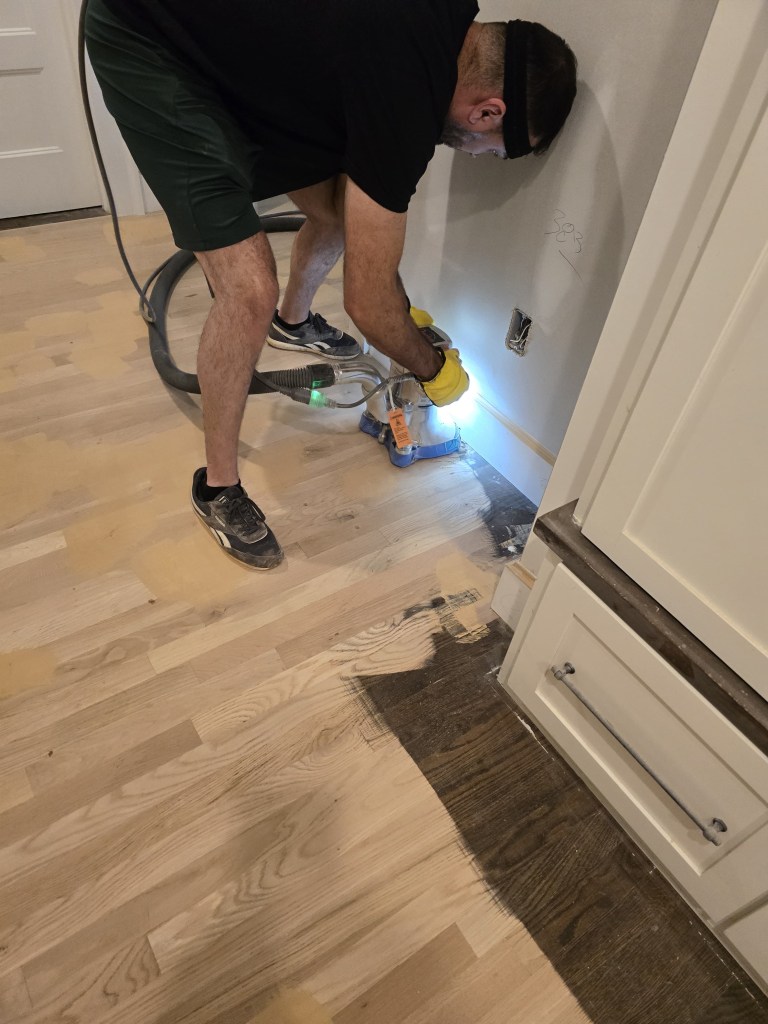
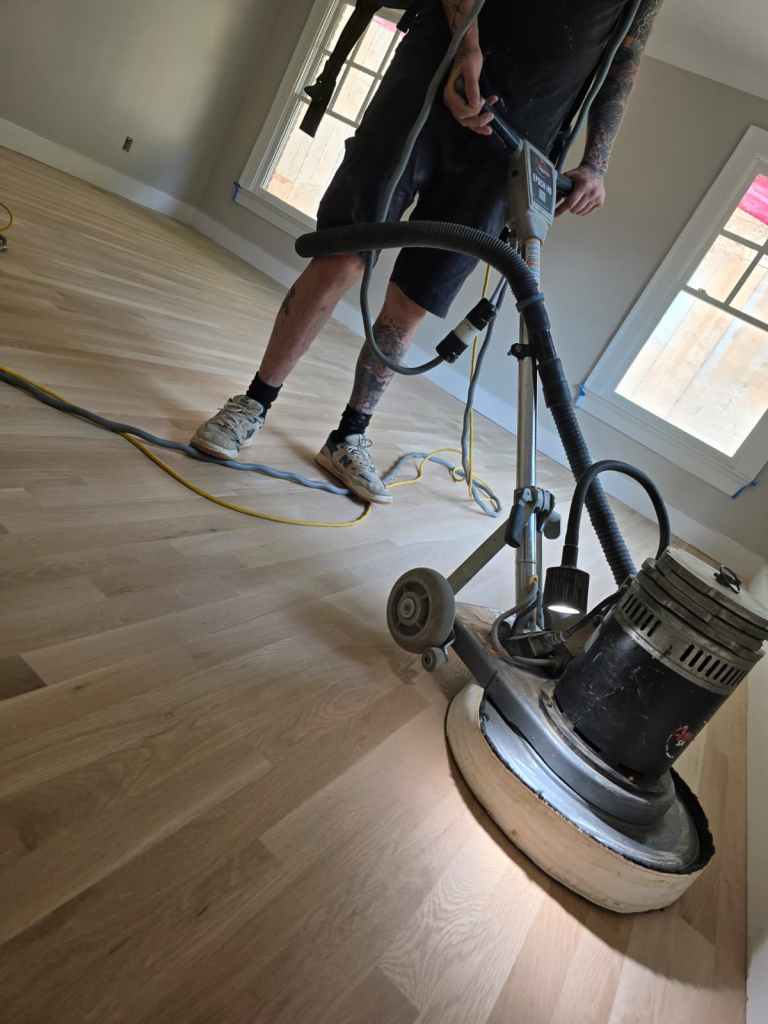
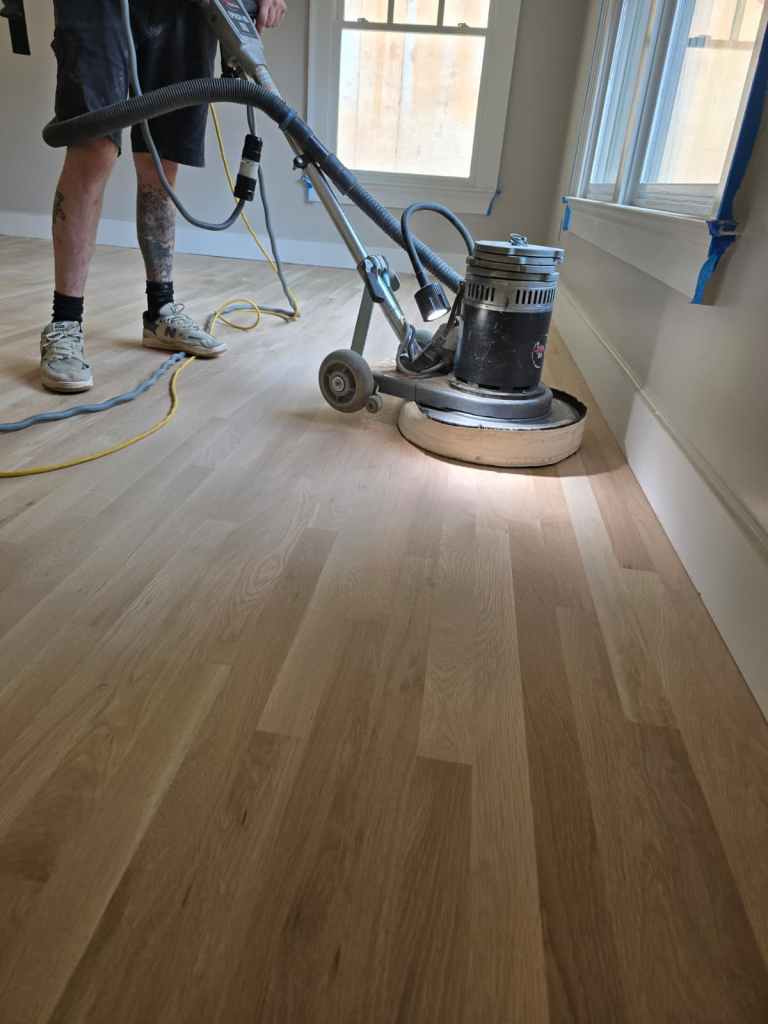
Classy Flooring ATL sanded the existing floor, the lace-in repairs, and the new white oak together as one floor. Sanding everything at the same time produces a single uniform surface that takes one stain coat and one finish system, which is what makes the new and existing areas read as one floor. Sanding the new area separately, or at a different time, would risk a visible line between old and new.
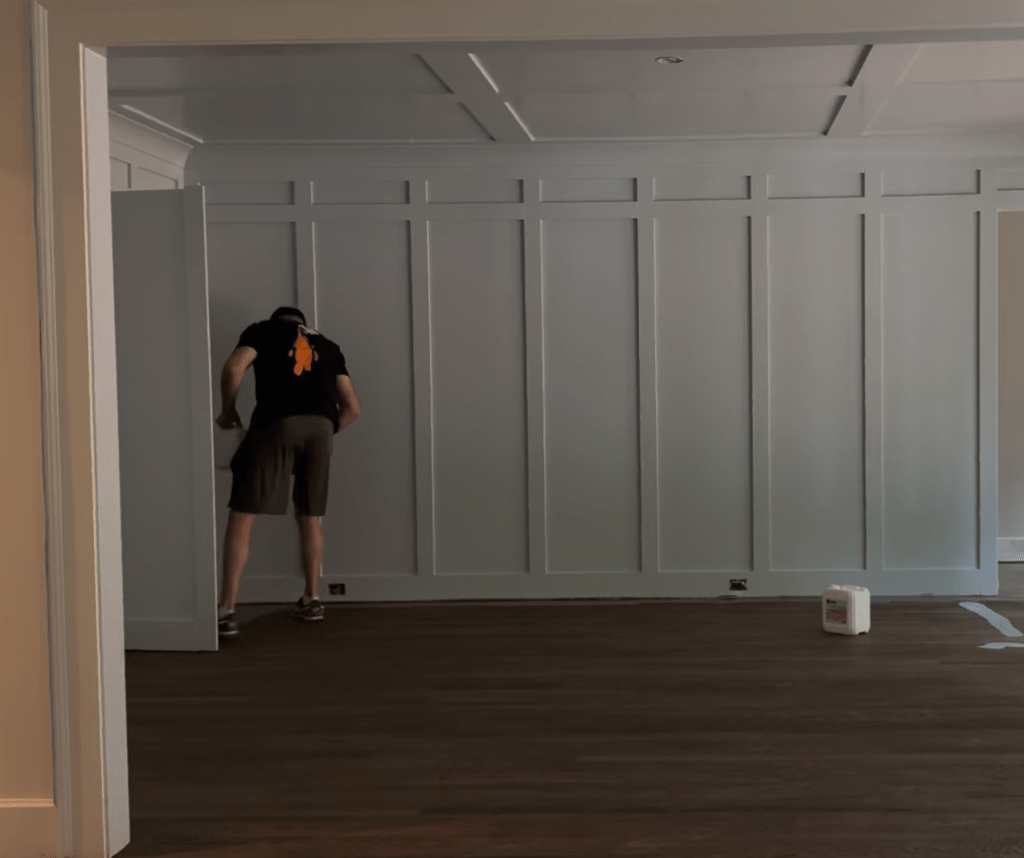
The sanding sequence followed Classy Flooring ATL’s standard progression. A belt sander made the initial cutting passes at 40, 60, and 80 grit to take the floor to bare wood and remove the existing finish. An edger worked the perimeter and the cabinet and wall lines a belt sander cannot reach. An FG Discus planetary sander then refined the surface at 100 and 120 grit; its multi-directional motion levels the scratch pattern left by the earlier passes so stain absorbs evenly. Dust was contained with an FG Floortec system using a DUSTIN cyclonic pre-separator connected at the source during sanding, so the work ran as a dust-contained process inside an occupied home.
Color Match — DuraSeal Jacobean, Sampled and Approved
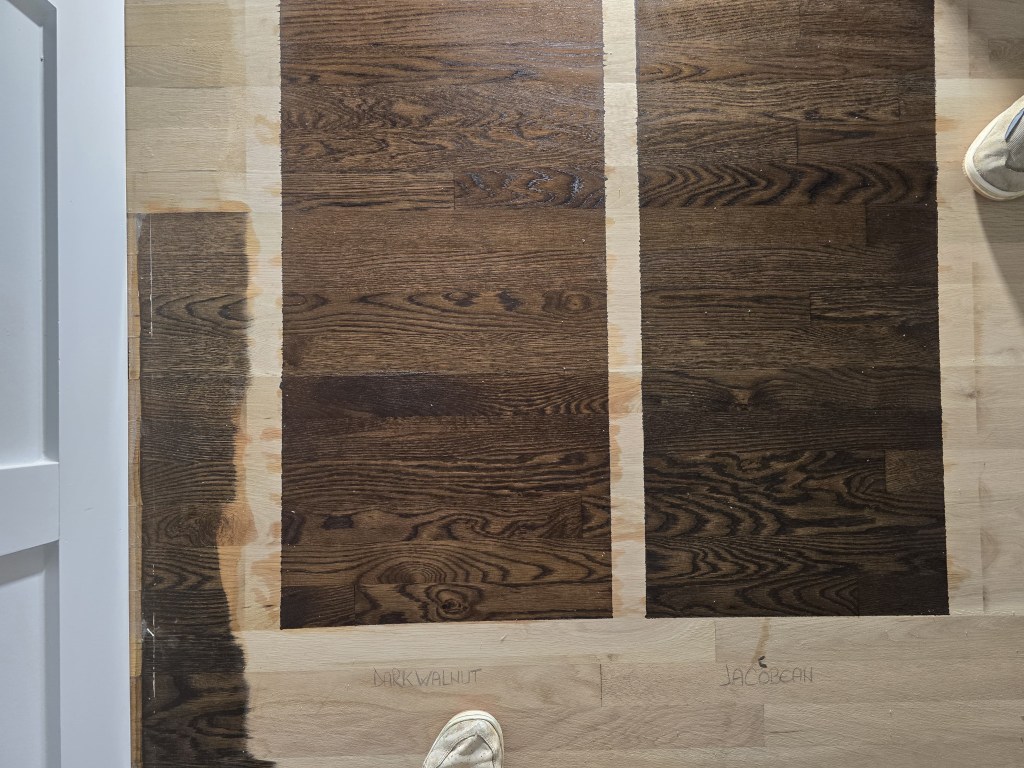
The client wanted to keep the color the floor had before. Stain reads differently from one board to another and changes under different lighting, so the only reliable way to match a color is to test it on the actual floor, in the actual room. DuraSeal Jacobean was selected as the stain color for this project. The color was sampled on the actual white oak floor so the client could review how the stain would read on both the existing flooring and the newly installed lace-in areas before final application. Two colors were sampled side by side and labeled on the floor — Dark Walnut and Jacobean — and the client selected Jacobean. One coat of DuraSeal Jacobean was then applied across the full floor — existing area, lace-in, and new addition — as a single color.
Finish — LOBA EasyPrime and LOBA 2K Duo Satin
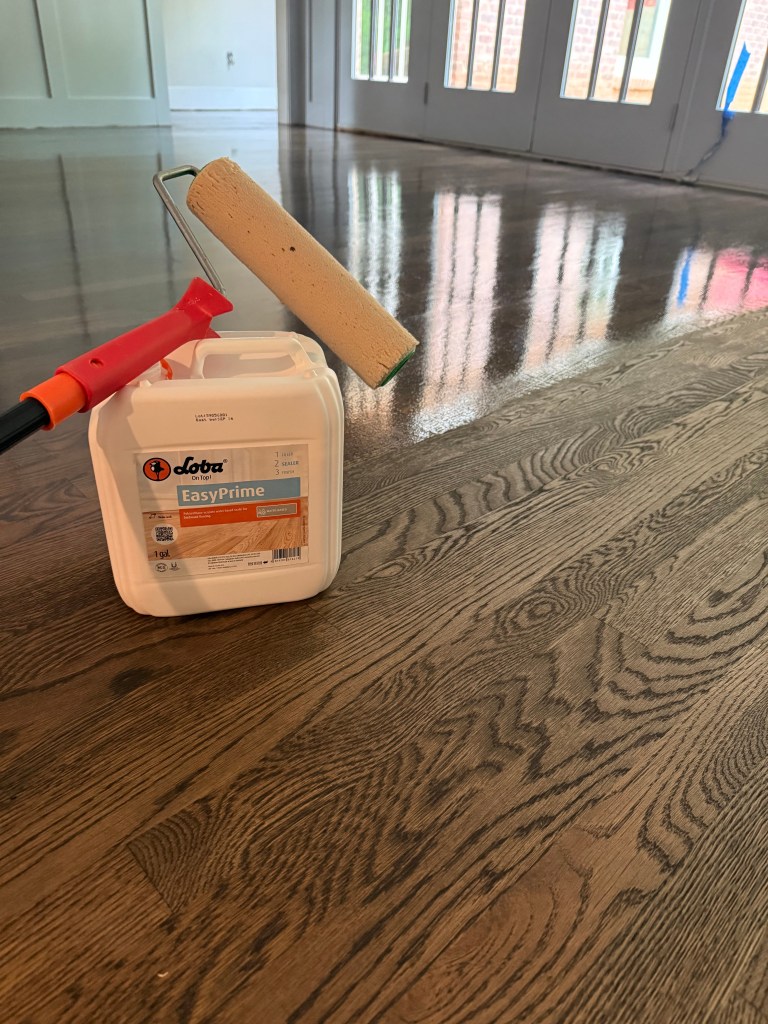
After the stain coat, the floor was left one day before finishing, so the stain was dry before any sealer went over it. The floor was then sealed with one coat of LOBA EasyPrime, followed by two coats of LOBA 2K Duo Satin. This water-based finish system provided a durable satin surface while preserving the depth of the DuraSeal Jacobean color selected for the white oak floor.
The Result
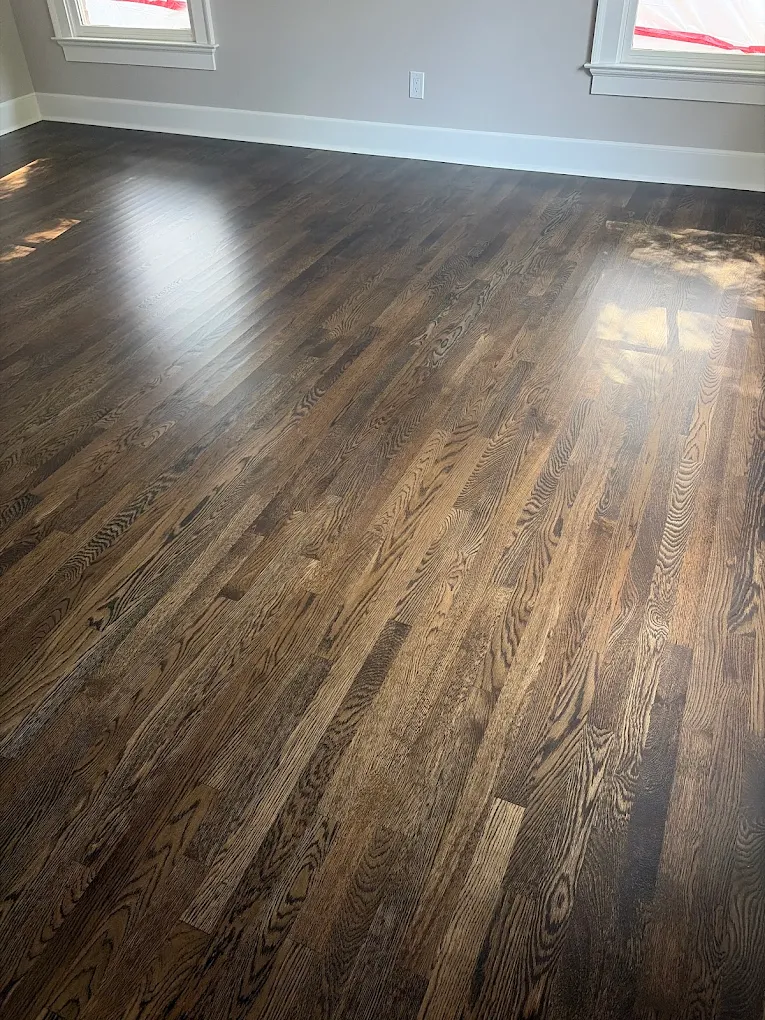
The finished floor reads as one continuous white oak floor in DuraSeal Jacobean across the original area, the former kitchen, and the new addition. The lace-in at the cabinet run and the new installation are integrated into the single sanded-and-finished surface rather than visible as separate work.
Project Details
| Location | Buckhead, Atlanta, GA |
| Scope | Refinishing + new-floor lace-in and integration — approximately 1,300 sq ft total (~700 sq ft existing + ~600 sq ft new) |
| Species | White oak (existing and new) |
| Repairs | Lace-in (weave-in) at the former kitchen cabinet run, cut back to over 4 ft for staggered integration |
| New floor | New white oak installed to tie into existing floor; site humidity measured before delivery, 4-day acclimation, moisture content confirmed before install |
| Sanding | Belt sander (40/60/80), edger at perimeter, FG Discus planetary refinement (100/120), FG Floortec system with DUSTIN cyclonic pre-separator connected at the source |
| Color | DuraSeal Jacobean — selected by the client from on-site samples (Dark Walnut and Jacobean) |
| Finish | One coat of LOBA EasyPrime followed by two coats of LOBA 2K Duo Satin |
Frequently Asked Questions
Can you match a new hardwood floor to an existing floor?
Yes. The most reliable match is achieved by using the same wood species as the existing floor, installing the new boards, and then sanding and finishing the new and existing areas together so they take one stain color and one finish. On this Buckhead project, Classy Flooring ATL used white oak to match the existing white oak, then sanded and finished the whole floor as one surface in DuraSeal Jacobean.
What is a lace-in (or weave-in) repair?
A lace-in repair is when new boards are woven into an existing floor with their end joints staggered, rather than cut to meet the old floor on a single straight line. The stagger is what lets the repair disappear once the floor is sanded and finished. It is the standard way to patch a floor where, for example, a wall or a run of cabinets has been removed.
Can you add new hardwood and refinish at the same time?
Yes, and combining them usually produces the best match. New unfinished wood is installed, then the new and existing floor are sanded, stained, and finished together. That is how the new area ends up the same color and sheen as the rest of the floor. On this project the new addition, the lace-in, and the existing floor were all finished in one pass.
Why sand the old and new floor together instead of separately?
Sanding everything at once creates a single uniform surface. One stain color and one finish system then go over the entire floor, so the new and old areas read as one. Sanding the new wood separately, or finishing it on its own, makes a color or sheen difference between the areas more likely.
How do you match the stain color to an existing floor?
By sampling on the actual floor. Stain absorbs differently across boards and looks different under different lighting, so Classy Flooring ATL applies stain samples directly on the sanded floor and lets the client compare them in their own space and light before choosing. On this project, DuraSeal Dark Walnut and Jacobean were sampled side by side, and the client selected Jacobean.
Does new wood need to acclimate before it’s installed?
Yes. Wood moves with the moisture in its environment. Installing it at a moisture content close to the conditions it will live in reduces movement and gapping after the floor is in service. Classy Flooring ATL measures the humidity inside the home before bringing the wood in, acclimates the wood on site, and confirms its moisture content before installation — on this project, a four-day acclimation.
How long does hardwood floor refinishing take, and when can the floor be used?
After the final coat of LOBA 2K Duo Satin, light foot traffic in socks is generally allowed after about 24 hours, with shoes and furniture introduced later depending on jobsite conditions. Because this project used one coat of LOBA EasyPrime and two coats of LOBA 2K Duo Satin, the floor should be treated carefully during the curing period. Rugs, heavy use, and cleaning products should be avoided until the finish has fully cured.
Is dustless sanding really dust-free?
“Dustless” means the sanding equipment is connected to a dust-containment system that captures dust at the source as the floor is sanded, rather than letting it settle through the home. It substantially reduces airborne and settled dust; no sanding system removes every particle. Classy Flooring ATL runs an FG Floortec / DUSTIN dust-separation system connected to the sanders throughout.
What color was used on this Buckhead white oak floor?
This floor was stained with DuraSeal Jacobean. Because stain can read differently depending on the wood species, existing floor age, sanding sequence, and lighting, Classy Flooring ATL sampled the color on the actual white oak floor before final application.
This Buckhead project is part of our hardwood floor refinishing and restoration service in Atlanta. That work covers sanding existing floors to bare wood, board repairs and lace-in work where sections are missing or damaged, custom color matching, and full finish systems — handled as one continuous process so the floor reads as a single surface. Whether a floor needs a straightforward refinish or a repair and new-floor integration like this one, the approach is the same: assess the existing floor and subfloor first, confirm the scope, and sand and finish the whole area together rather than in sections.
Planning a hardwood floor refinishing, lace-in repair, or new-floor integration project in Buckhead or North Atlanta? Classy Flooring ATL can review the existing floor, explain the practical options, and prepare a clear scope before work begins. Contact Classy Flooring ATL to start.