Hardwood Floor Refinishing & Restoration in Atlanta
We refinish and restore hardwood floors in Atlanta with dust-controlled sanding, planetary surface refinement, advanced color work, and professional finish-system selection based on the wood, the space, and the long-term goal of the project.
Refinishing and Restoration Requires More Than Sanding
Hardwood floor refinishing and restoration is about more than sanding off an old finish and applying a new one. It requires correct evaluation of the floor, controlled sanding, careful surface refinement, and a finish system selected for the wood, the home, and the long-term goal of the project.
Some floors need a straightforward resand. Others require a more restoration-focused approach because of uneven wear, old stain buildup, previous finish issues, repairs, water damage, or color goals that call for a more controlled process.
What This Service Can Include
Dust-Controlled Sanding
We use vacuum-connected sanding equipment, including an FG Floortec dust-control vacuum and DUSTIN separator system, to reduce airborne wood dust and improve containment during the job.
Color and Tinting Work
When a project needs more control than a standard stain color alone can provide, we guide color selection based on species, grain pattern, floor condition, lighting, and finish-system choice.
Restoration Judgment
Some floors need more than sanding. We evaluate repairs, prior coatings, damaged boards, and the most realistic path to the strongest final result.
Surface Refinement
We use additional refinement steps, including planetary sanding with the Epoch and FG Discus, to help create a flatter, more uniform final surface before finishing.
Finish-System Selection
We select professional finish systems based on the wood, traffic level, desired appearance, and long-term maintenance expectations.
Evaluation and Planning
The right process depends on the condition of the floor. We plan the sanding sequence, repair approach, color direction, and finish system based on the specific project.
How We Approach Dust Control and Surface Quality
Dust control is a major part of how we approach refinishing work. During sanding, we use vacuum-connected equipment throughout the sanding process, along with an FG Floortec dust-control vacuum and DUSTIN separator system, to reduce airborne wood dust and improve containment during the job.
That does not mean zero dust. No professional sanding process should be described that way. It means the sanding is handled with active dust collection and a more controlled setup than uncontrolled sanding methods.
We also pay close attention to surface refinement during the sanding process. In the refining stage, we use planetary sanding equipment such as the Epoch and FG Discus to help create a flatter, more uniform final surface before the finish is applied.
Color, Tinting, and Finish-System Selection
Color is one of the biggest decisions in a refinishing project because it changes how the entire space feels. When a project needs more control than a standard stain color alone can provide, we offer advanced color and tinting work guided by wood species, grain pattern, floor condition, lighting, and finish-system choice.
We have completed DuraSeal stain courses and advanced stain and tinting training that support this part of the work.
We also select finish systems based on the wood, the design goal, traffic level, and long-term maintenance expectations. Our refinishing work often includes professional systems such as Bona Traffic HD and LOBA 2K Duo. For select projects, we also offer specialty options such as Rubio Monocoat when a hardwax oil finish is the right fit.
When Restoration Requires More Than a Standard Resand
Some floors can be sanded and finished in a straightforward way. Others require a more restoration-focused process because of age, wear patterns, previous coatings, water damage, patching, color inconsistency, or surface irregularities.
In those cases, the work is not only about removing the old finish. It is about evaluating what should be repaired, what should be preserved, and which process will create the strongest final result for that specific floor.
Some projects may also require board replacement, lace-in repairs, or full-floor refinishing to create better visual consistency between repaired and existing material.
Featured Project — Red Oak Refinished to a Natural White Oak Look in Atlanta
Service: Whole-house refinishing, new room installation, and engineered hardwood refinishing
Wood: Solid red oak (existing and new); prefinished engineered hardwood in the basement
Stain: None — the color comes from the sealer
Finish: Two coats of Bona NaturalSeal followed by two coats of Bona Traffic HD Satin
Scope: Approximately 1,660 sq ft total — about 1,500 sq ft refinished, 160 sq ft new red oak in a former carpeted room, and 30 stair treads
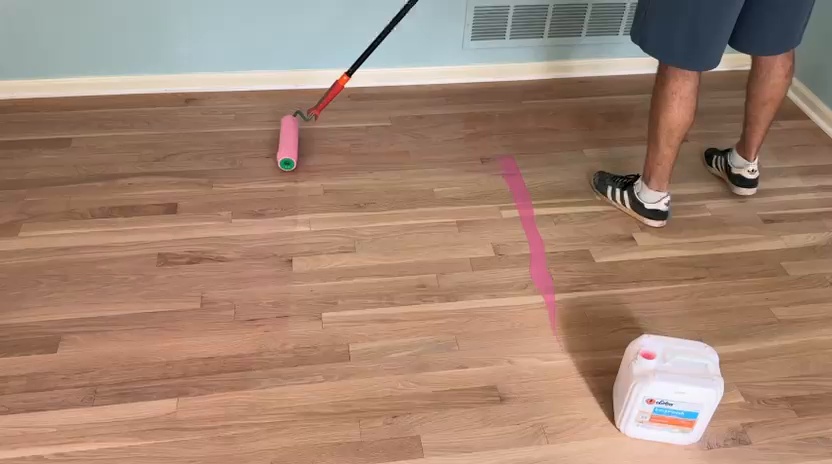
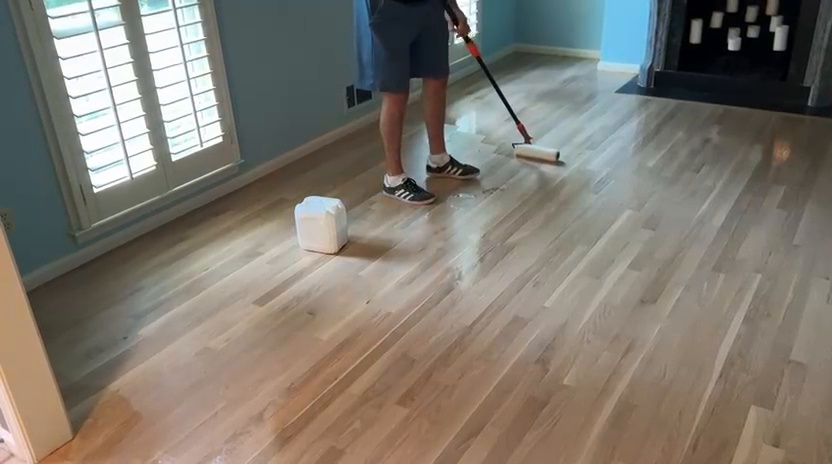
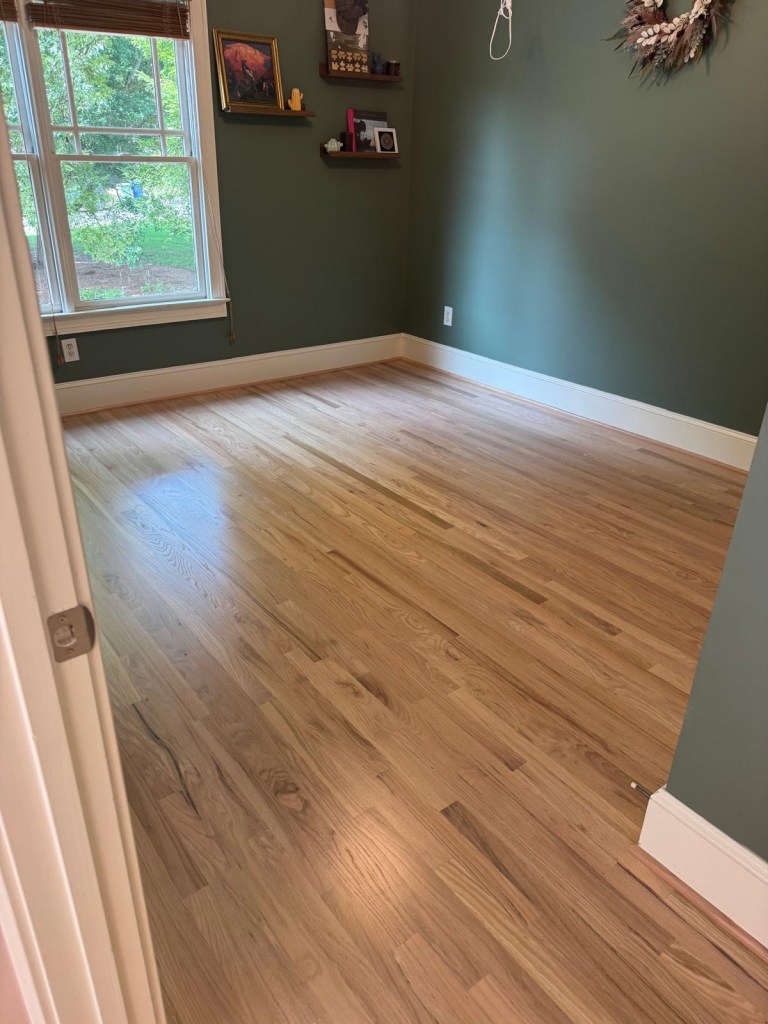
The client wanted red oak floors to read as natural white oak — pale and neutral, without red or amber tones, and without staining or bleaching. Bona NaturalSeal is a lightly white-pigmented waterborne sealer that counteracts red oak’s pink undertone and holds the boards at the color of freshly sanded wood. Bona Traffic HD does not amber over time, so the color the sealer establishes is the color the floor keeps.
The project also included two scopes that depend on getting one number and one sequence right. The basement’s 350 square feet of prefinished engineered hardwood could only be sanded because we verified a 4 mm wear layer on a leftover box of the original flooring before starting. And the former carpeted room received new red oak installed unfinished, then sanded and finished together with the existing floors — which is why the new room is indistinguishable from the boards beside it.
See the full project — including the side-by-side sealer sampling, the wear-layer verification, and the finish system — on our Red Oak Refinishing with a Natural White Oak Look project in Atlanta.
Featured Project — White Oak Refinishing with Lace-In Repair and New-Floor Integration in Buckhead, Atlanta
Service: Lace-in repair, new white oak installation, and full-floor refinishing
Wood: White oak (existing and new)
Stain: Jacobean by DuraSeal
Finish: One coat of LOBA EasyPrime followed by two coats of LOBA 2K Duo Satin
Scope: Approximately 1,300 sq ft — about 700 sq ft existing floor and 600 sq ft new
This project began when the client built an addition and removed the kitchen. That left a gap in the floor where the cabinet run had been, and a new addition with no flooring.
We laced new white oak into the cabinet run and installed roughly 600 square feet of new white oak across the addition to tie into the roughly 700 square feet of existing floor. Where the cabinets had been, we cut the existing floor back to over four feet rather than filling only the 21-inch gap, so the new boards could be staggered into the field and the repair would integrate instead of reading as a patch.
See the full project — including the lace-in repair, sanding sequence, color match, and finish — on our White Oak Floor Refinishing and Lace-In project in Buckhead.
Featured Project — Water-Damage Restoration and Full-Floor Refinishing in Atlanta
Service: Lace-in repair and full hardwood refinishing
Wood: Red oak
Stain: Early American by DuraSeal
Finish: LOBA 2K Duo
Scope: Large open-plan first floor
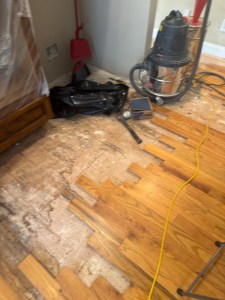
This project began with water damage. A section of the red oak floor had to be removed after the mitigation company completed the drying and remediation process.
We replaced the damaged area with a lace-in repair, installing new red oak boards piece by piece so the repair could integrate with the existing floor layout. Once the repair was complete, we sanded and refinished the full first floor as one continuous surface.
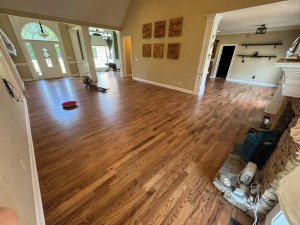
For a project like this, full-floor refinishing was the right solution for visual consistency. Refinishing only the repaired section would have increased the risk of a visible difference where new and existing material meet. Sanding and finishing the floor together with Early American by DuraSeal and LOBA 2K Duo created a more uniform color and surface across the main living areas.
Before


After


Featured Project — Full-House Refinishing with Color Correction, Hoschton GA
Service: Full hardwood floor refinishing including stairs
Wood: White oak
Finish system: 2 coats Bona NordicSeal + 2 coats Bona Traffic HD
Size: Approximately 2,000 square feet
Location: Hoschton, GA — near Château Élan
Scope: Whole house, multiple rooms and stairs
This client had their floors originally installed and finished by Classy Flooring ATL over 20 years prior. When it was time to refinish, the goal was a complete color change — away from the amber, oil-based look the floors had developed over time, toward a cleaner, more neutral modern tone with zero yellow.
Color correction of this kind requires more than a standard resand. To achieve a truly neutral result on white oak, the finish system selection matters as much as the sanding. We started by preparing samples with Bona NaturalSeal, but the client wanted an even more neutral tone. We then sampled 2 coats of Bona NordicSeal, which produced the clean, cool-neutral result he was looking for.
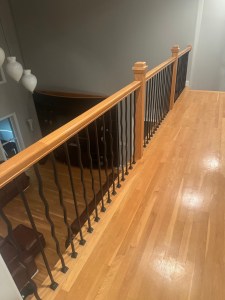
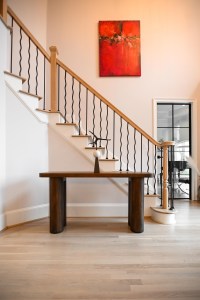
Once the color direction was confirmed, the floors were refinished using a dustless sanding process, 2 coats of Bona NordicSeal for the color base, and 2 coats of Bona Traffic HD for durability and long-term performance. The stairs and landing were refinished to match the main floor finish throughout the house.
The result is a floor that reads as clean, modern, and completely consistent across the entire home — with no amber, no yellow, and no residual warm tone from the previous finish.
Before


After


What our Clients Say
— Source: Google Reviews
Questions Homeowners Should Ask Before Hiring a Refinishing Contractor
How is dust controlled during sanding?
A contractor should be able to explain how the sanding equipment is connected to dust collection, what containment methods are used, and what “dust-controlled” actually means in practice.
How is the surface refined after the main sanding cut?
Not every refinishing process ends with the same level of surface refinement. Homeowners should understand whether the contractor uses additional refinement steps to improve surface consistency before finishing.
How do you help clients choose color?
Color selection should go beyond handing over a stain chart. It should account for wood species, natural light, desired tone, and how the finish system will affect the final look.
What finish system are you recommending, and why?
A contractor should be able to explain why a finish is being chosen based on durability, appearance, odor, maintenance, and project conditions.
Is this floor a good candidate for refinishing and restoration?
Some floors are excellent candidates. Others need a more careful conversation about thickness, previous work, damage, or whether restoration is the right investment.
Related Resources
Project Gallery
See examples of our completed hardwood flooring projects. View Gallery ->
Dustless Refinishing
Learn more about dust control during hardwood floor sanding. Read the Article →
Water-Based vs. Oil-Based Finishes
Compare finish types and understand how they affect appearance and maintenance. Read the Article →
Chateau Elan project
For a completed engineered hardwood installation with site finishing using Bona NordicSeal and Traffic HD, see the Chateau Elan project →
Buckhead Rubio Monocoat project
For a completed white oak floor refinishing project in Buckhead using Rubio Monocoat Oil Plus 2C in Linen, see the Buckhead Rubio Monocoat project →
Planning a Refinishing or Restoration Project?
If you are planning a hardwood floor refinishing or restoration project in Atlanta, we can help you evaluate the floor, the finish options, and the right approach for your home.