Classy Flooring ATL

Red Oak Floor Refinishing in Atlanta — Bona NaturalSeal for a Natural White Oak Look

Classy Flooring ATL completed this whole-house refinishing project in Atlanta in June 2026. The scope covered refinishing approximately 1,500 square feet of existing red oak and engineered hardwood, installing 160 square feet of new red oak #1 common in a former carpeted room, and resanding 30 stair treads — a total finished floor area of approximately 1,660 square feet. The finish system was two coats of Bona NaturalSeal followed by two coats of Bona Traffic HD in satin.

This Atlanta project is one of Classy Flooring ATL’s documented hardwood refinishing and restoration projects — whole-house sanding, finish-system color direction, and stair refinishing across metro Atlanta. See the full range of our work on our Our Work page.

Project overview

This project combined three separate scopes under one finish system: refinishing the existing red oak floors on the main levels, refinishing 350 square feet of prefinished engineered hardwood in the basement, and installing new red oak in a room that previously had carpet. All wood — existing, engineered, and new — was sanded and finished in the same sequence so the entire house carries one consistent color and sheen.

A crew of three completed the work in five days on site. Sanding followed our dustless sequence, and the home’s fixtures, cabinetry, and openings were covered with plastic containment before sanding began.

The clients approved the finish samples in person a week before work began, then left on an overseas trip for the duration of the project. We sent progress updates every day — photos and video of each stage as it happened — so they followed the job from the first sanding pass to the final coat without being in the house.

Starting condition

The main floors were solid red oak with a worn existing finish. One room had carpet over the subfloor and no hardwood. The basement had 350 square feet of prefinished engineered hardwood with a factory aluminum oxide finish and micro-bevel edges between boards. The 30 stair treads were worn and needed full resanding.

Plastic dust containment being installed over furnishings and light fixtures before sanding, red oak floor still carrying its worn amber finish, refinishing project in Atlanta
Day one, before any sanding: furnishings sheeted, light fixtures bagged, equipment staged. The floor still carries the worn amber finish — this is the color the whole project started from.
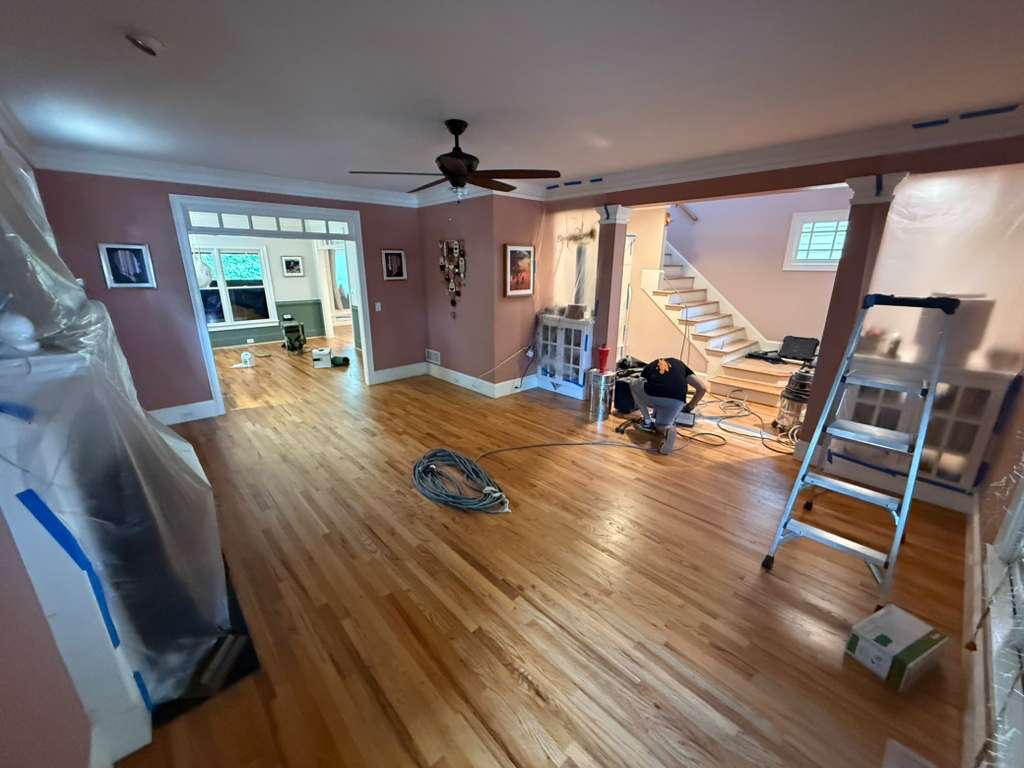
Open-plan living area with worn amber finish on red oak floors at the start of a refinishing project in Atlanta, crew preparing equipment and dust containment
The main living area at the start of the project: the red oak still under its worn amber finish, equipment being staged, containment going up. Roughly 1,600 square feet were sanded and finished from this starting point.
Red oak stairs with worn amber finish before resanding during a refinishing project in Atlanta, adjacent landing floor already sanded to bare wood
The stairs before resanding, still under the old amber finish. The landing beside them is already sanded to bare wood — the contrast shows the color the existing finish added and what the floors look like without it.

Design direction

The client wanted the floors to read as natural white oak — pale, neutral, without red or amber tones. The existing floors were red oak, which carries a pink undertone that deepens under most clear finishes.

The color was built through the finish system. Bona NaturalSeal is a lightly white-pigmented waterborne sealer designed to keep wood looking the way it does freshly sanded; applied in two coats over bare red oak, it counteracts the pink undertone and holds the boards at the pale, neutral appearance of unfinished white oak. Bona Traffic HD is a waterborne commercial-grade finish that does not amber over time, so the color the sealer establishes is the color the floor keeps. Satin is the sheen we use on nearly all of our finish work.

Sampling process

A week before the project started, we sanded a sample area directly on the existing floor and applied the two sealer systems under consideration side by side: Bona NaturalSeal and Bona NordicSeal. Both are white-pigmented waterborne sealers that counteract red oak’s pink undertone — NordicSeal carries more pigment and pushes the wood toward a whitewashed look, while NaturalSeal keeps it closer to the color of freshly sanded bare wood.

Sampling on the client’s own boards, in their own light, is the only way a finish decision means anything — the same product reads differently on different wood. The clients had a full week with the samples and approved their choice in person before leaving on their trip. They chose NaturalSeal, and the whole house was finished on that decision.

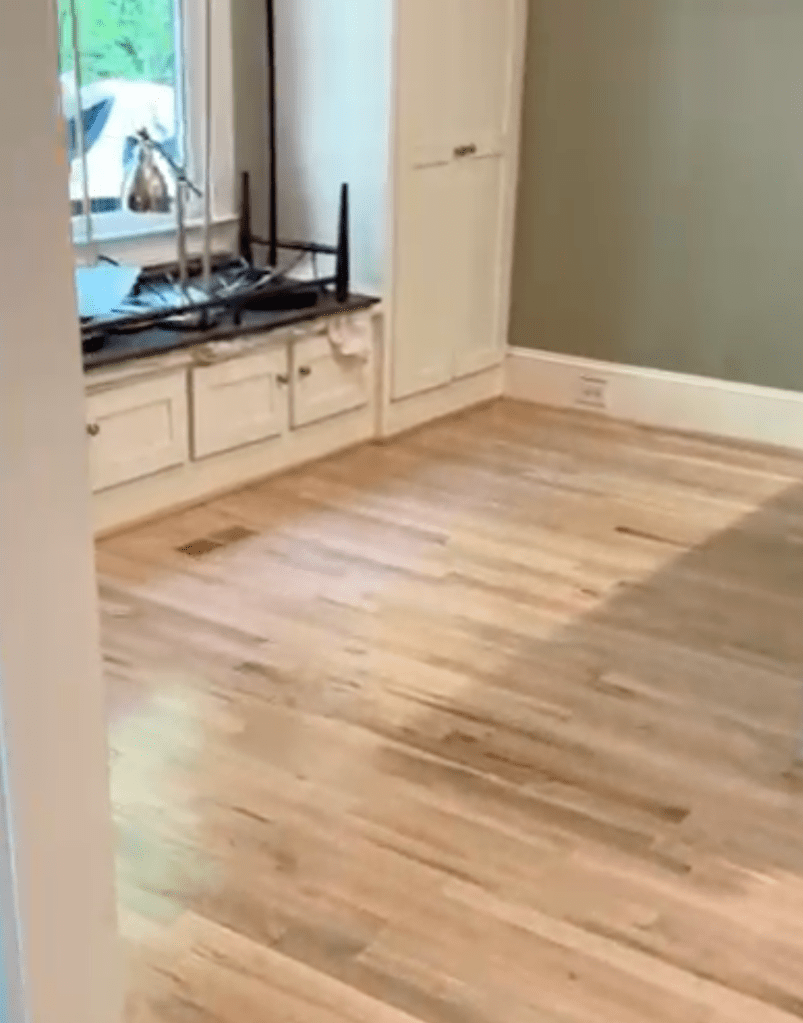
Sanded sample area on an existing red oak floor before refinishing in Atlanta, test patch lighter than the surrounding worn finish, kitchen under plastic containment
A sample area sanded directly on the existing floor before the project committed to a finish. Sampling on the client's own boards — not on a brochure or a loose plank — shows exactly how the color reads on this wood in this light.

Surface preparation

The floors were sanded with our standard equipment: the Lägler Hummel belt sander across the open field, edge sanders along the baseboards and into the corners the large machines can’t reach, and the FG Floortec Discus planetary sander for the refining passes, finishing at 120 grit. Sanding takes every board in the project — existing red oak, the new red oak in the former carpet room, and the engineered basement floor — down to bare wood on one plane.

After the initial sanding passes, wood filler was trowel-applied across the floors and stair treads to fill gaps and open grain. The final 120-grit pass sands the filler flush, leaving it only in the voids it filled. At the end of surface preparation, every surface in the project — approximately 1,660 square feet plus 30 treads — was level bare wood ready for sealer.

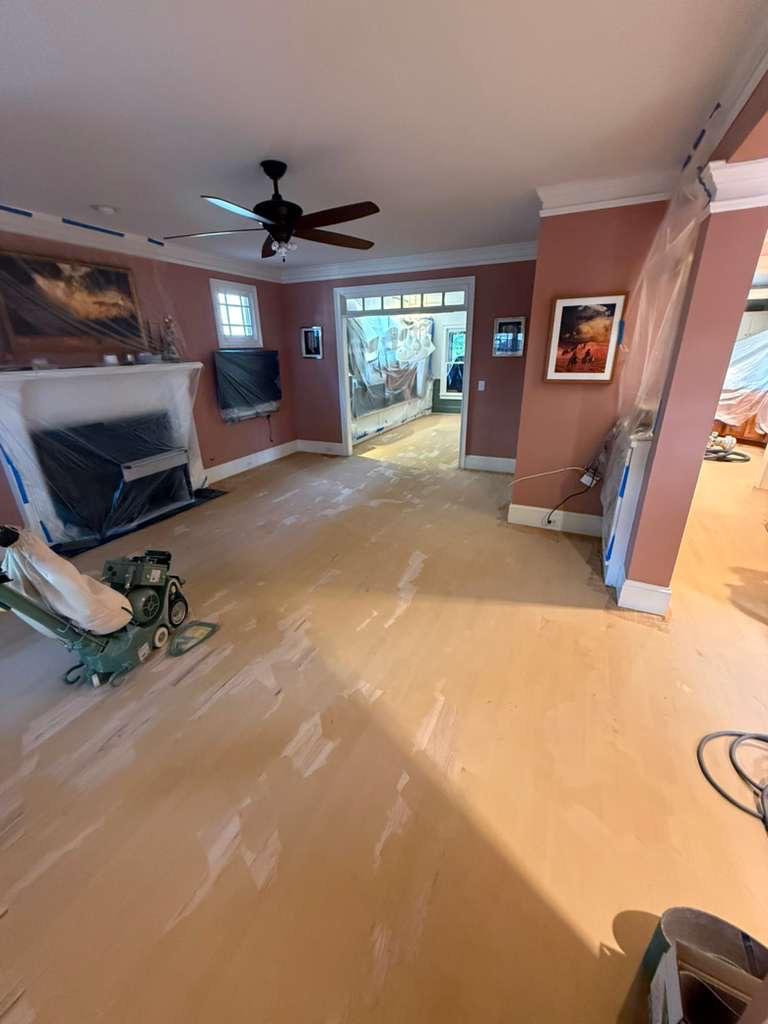
Red oak floor with trowel-applied wood filler during refinishing in Atlanta, fireplace and furnishings covered in plastic dust containment
Wood filler trowel-applied across the sanded red oak before the final sanding pass. The fireplace, TV, and room openings stay sealed under plastic for the full sanding phase.
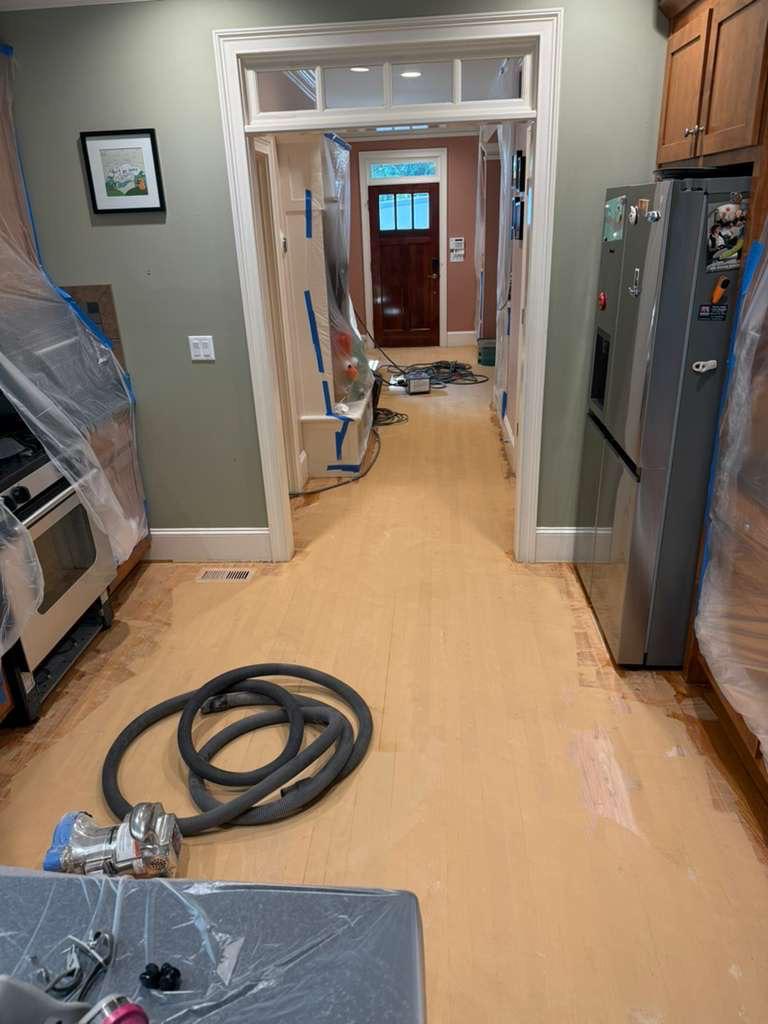
Kitchen and hallway red oak floor with wood filler applied, dust extraction hose on the floor and appliances sealed in plastic during dustless refinishing in Atlanta
Wood filler applied across the kitchen and hallway red oak. The extraction hose runs to the dust containment system, and the stove, refrigerator, and cabinetry stay sealed in plastic through the sanding phase.
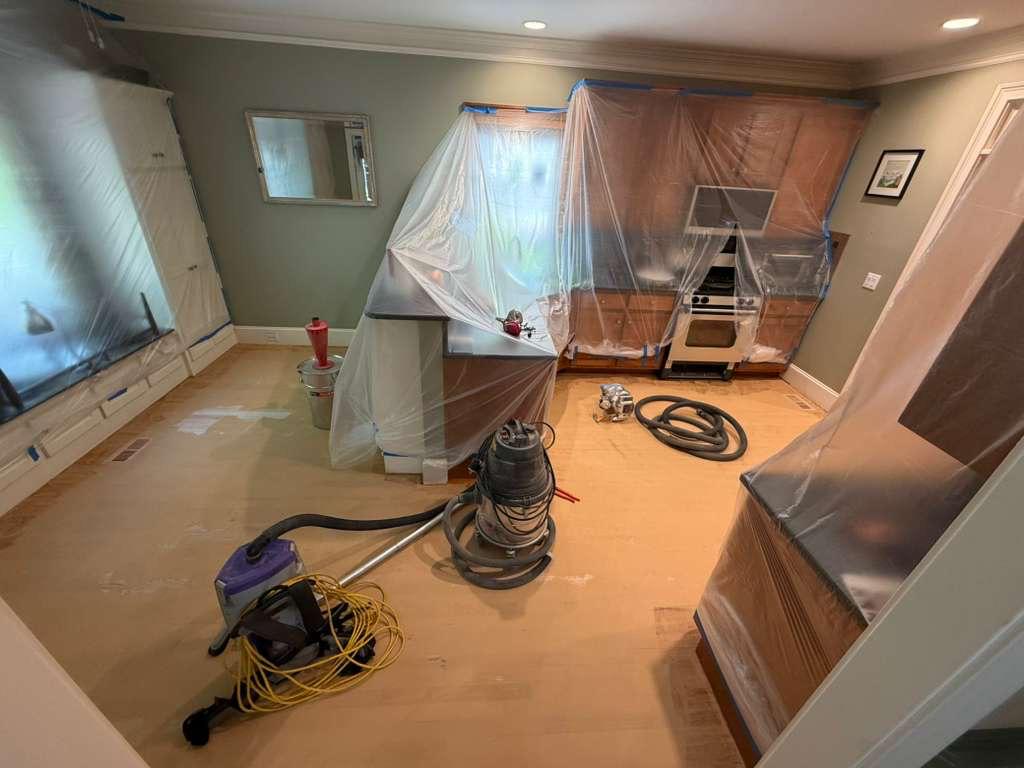
Dust extraction vacuum on a red oak floor with wood filler applied, kitchen cabinetry and appliances fully tented in plastic during dustless refinishing in Atlanta
The dust extraction vacuum that runs with the sanders during the dustless sequence. The kitchen cabinetry, stove, and countertops are tented in plastic from the upper cabinets down before any sanding starts.
Dining room red oak floor with wood filler applied during refinishing in Atlanta, light fixtures individually wrapped in plastic and furnishings covered
Wood filler applied across the dining room red oak before final sanding. The hanging light fixtures are individually wrapped and the wall-side furnishings sheeted — containment covers the fixtures, not just the floor level.
Engineered hardwood basement floor sanded bare during a refinishing project in Atlanta after a 4 mm wear layer was verified, built-in cabinetry masked in plastic
The basement engineered floor after sanding: factory aluminum oxide finish off, micro-bevels gone, one flat surface. This was only possible because the wear layer measured 4 mm — verified on a leftover box of the original flooring before any sanding started.
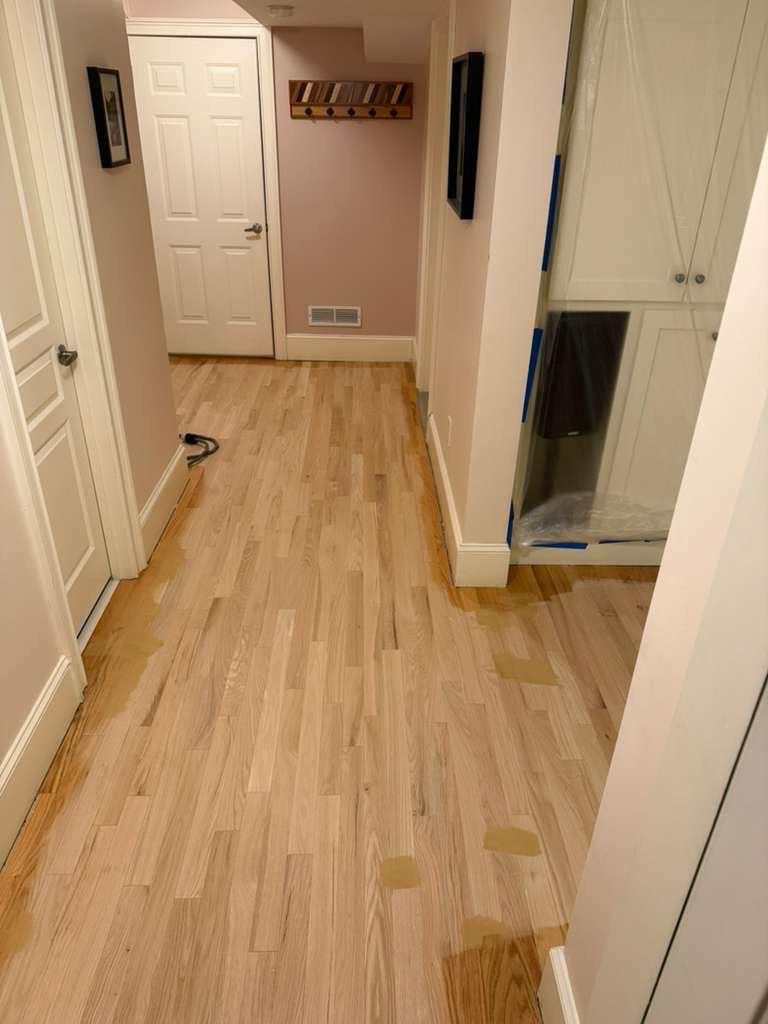
Red oak hallway floor sanded to bare wood during refinishing in Atlanta, wood filler visible in patches at board gaps, closet contents covered in plastic
The hallway sanded down to bare red oak. Filler shows in patches where gaps and board joints needed it — it gets sanded flush in the final pass, leaving only the filled voids. Closet contents stay sheeted through sanding.
Red oak stair treads resanded to bare wood viewed from the upper landing during a refinishing project in Atlanta, white risers, sanded floor at top and bottom
The same staircase as the before photo, after resanding. Every tread is taken down to bare red oak — the worn amber finish is gone, and the treads now match the sanded floors above and below them.
Wood filler applied on red oak stair treads and flared bottom steps during a refinishing project in Atlanta, work light and tools staged on the stairs
The treads get the same treatment as the floors: wood filler applied across the flared bottom steps and up the flight before the final sanding pass takes it flush. Stairs aren't a shortcut scope — they go through every step the floor does.

Protecting the home during sanding

Containment goes up before the first sanding pass and stays up until the last finish coat is dry. On this project that meant taped plastic sheeting over the kitchen cabinetry, stove, refrigerator, and island; the fireplace, television, and built-ins covered; closet contents sheeted; room openings sealed; and the hanging light fixtures individually bagged rather than left exposed above the work.

The sanding itself runs as a dustless sequence: every sander operates connected to dust extraction, so dust is captured at the machine instead of settling through the house. The plastic is the second layer of defense, not the first. On this project, the combination was put to its full test: the clients were away for the entire job, and the rooms they returned to were clean — the containment came down only after the final coat of finish was on the floor.

Kitchen cabinetry, appliances, and island fully covered in plastic sheeting during dustless red oak floor refinishing in Atlanta, Bona NaturalSeal container on the covered island
The kitchen sealed for sanding: cabinetry, stove, refrigerator, and island all under taped plastic sheeting. Bona NaturalSeal staged on the island — the sealer that shifts the red oak toward a natural white oak color.
Dining room red oak floor sanded to bare wood after the final sanding pass during refinishing in Atlanta, wood filler sanded flush, wrapped light fixtures and covered furnishings
The dining room after the final 120-grit pass. The filler that covered the boards in patches is sanded flush and the bare red oak is level, ready for the first coat of sealer. Fixtures and furnishings stay wrapped until finishing is done.

Finish application

The finish system was two coats of Bona NaturalSeal followed by two coats of Bona Traffic HD in satin, applied across every sanded surface in the project — floors, treads, and shoe molding — so the entire house carries one color and one sheen.

NaturalSeal does the color work: a lightly white-pigmented waterborne sealer that counteracts red oak’s pink undertone and holds the boards at the pale, neutral appearance of freshly sanded wood. Traffic HD does the protection: a commercial-grade waterborne finish that does not amber over time, so the color the sealer establishes is the color the floor keeps.

Red oak floor with finish applied during refinishing in Atlanta, Bona NaturalSeal and Bona Traffic HD products staged on the covered kitchen island
Finish going down on the sanded red oak. Bona NaturalSeal and Bona Traffic HD staged on the covered island — two coats of NaturalSeal to hold the pale, neutral color, two coats of Traffic HD satin over it.

New room installation

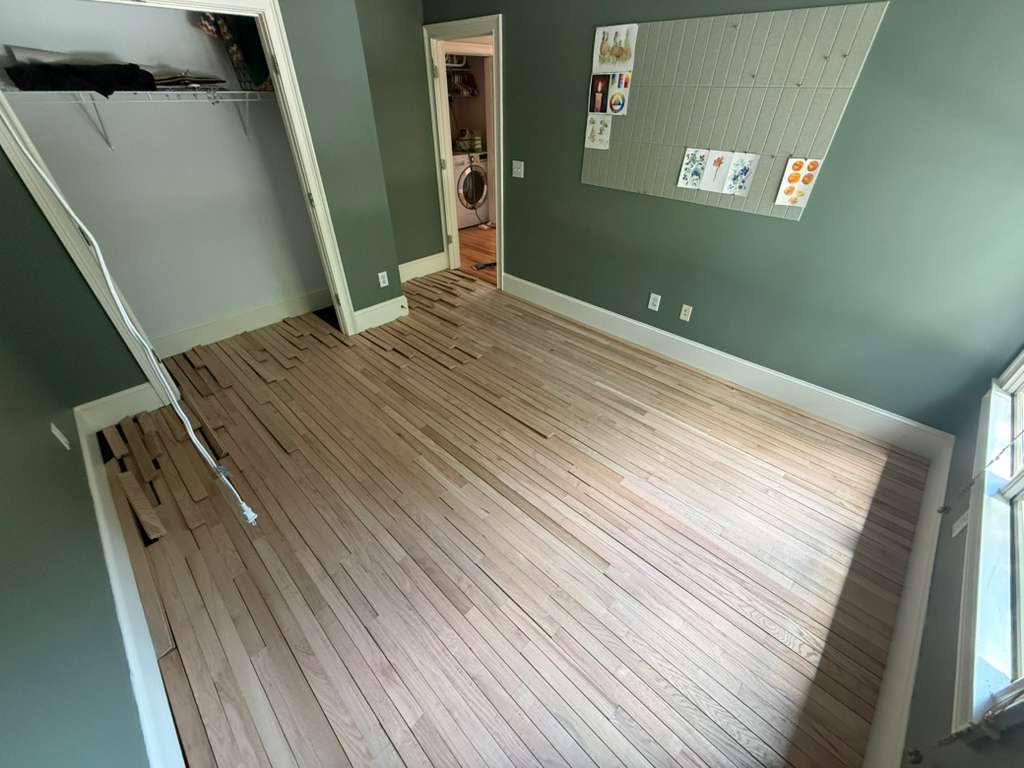
One room in the house had carpet instead of hardwood. We removed the carpet, the pad, and the tack strips, exposed the subfloor, and installed 160 square feet of new red oak #1 common — unfinished, deliberately.

Installing the new room bare is what makes the rest possible. Prefinished boards arrive with their color and sheen locked at the factory; they never quite match an existing floor, and they can’t be corrected on site. Unfinished boards have no color yet — they get sanded to the same plane as the existing floors and take the same sealer and finish coats at the same time. The result is a room that joined the house at a doorway transition and reads as if the hardwood had always been there.

Unfinished red oak boards racked and partially installed in a former carpeted bedroom during a flooring project in Atlanta, end joints staggered across the room
New unfinished red oak #1 common going into the room that previously had carpet. Boards are racked ahead of fastening with end joints staggered. The new floor was installed bare, then sanded and finished together with the rest of the house so the color matches.

Refinishing the engineered basement floor

The basement had 350 square feet of prefinished engineered hardwood with a factory aluminum oxide finish and micro-bevel edges between the boards. Whether an engineered floor can be refinished comes down to one number: the wear layer — the thickness of real wood above the core. Sand through it and the floor is destroyed.

The clients had a leftover box of the original flooring. We measured the wear layer on those boards at 4 millimeters, which confirmed the floor could be sanded safely — with enough material to remove the factory finish and the bevels and still leave wear layer behind. That measurement is the reason this floor was refinished instead of replaced.

The sanding took the boards past the aluminum oxide finish and removed the micro-bevels, leaving one flat, continuous surface. Finished with the same system as the rest of the house, the basement no longer reads as a prefinished product. It reads as site-finished hardwood, matching the floors two levels above it.

Engineered hardwood basement floor sanded bare during a refinishing project in Atlanta after a 4 mm wear layer was verified, built-in cabinetry masked in plastic
The basement engineered floor after sanding: factory aluminum oxide finish off, micro-bevels gone, one flat surface. This was only possible because the wear layer measured 4 mm — verified on a leftover box of the original flooring before any sanding started.

Stairs

The project included 30 stair treads across the house, including the flight down to the basement. The treads went through every step the floors did: resanded to bare wood, wood filler applied and sanded flush, then the same finish system as the floors. The flared bottom steps — wider treads that wrap the stringer with returned bullnose edges — were resanded and finished the same way.

Stairs connect every level of a house, which means they’re where a color mismatch shows first. Running the treads through the same sequence as the floors is what keeps the staircase from reading as a separate project.

Basement staircase with red oak treads sanded to bare wood during a refinishing project in Atlanta, white risers, sanded floor at the base
The basement flight resanded to bare wood. The stairs scope ran through the whole house — these treads connect the refinished engineered floor below to the main level above, and they go through the same sequence as every other tread.
Red oak stairs with worn amber finish before resanding during a refinishing project in Atlanta, adjacent landing floor already sanded to bare wood
The stairs before resanding, still under the old amber finish. The landing beside them is already sanded to bare wood — the contrast shows the color the existing finish added and what the floors look like without it.

Shoe molding

Claudiu prepared the red oak shoe molding personally in the shop, then finished it with the same system as the floors rather than staining it to approximate the floor color. Stained molding against a sealed floor always reads as two different surfaces; molding in the same species, carrying the identical sealer and finish, reads as part of the floor. Along every baseboard in the house, the transition is one color.

Flush-mount vents

The floor vents were replaced with new flush-mount wood vents — but unlike the floor, the vents never touch the sanding machines. They’re delicate pieces; machine sanding would destroy the edges and louvers. Claudiu finished them separately by hand, in the same system as the floor, and installed them after the final coat on the floor was done.

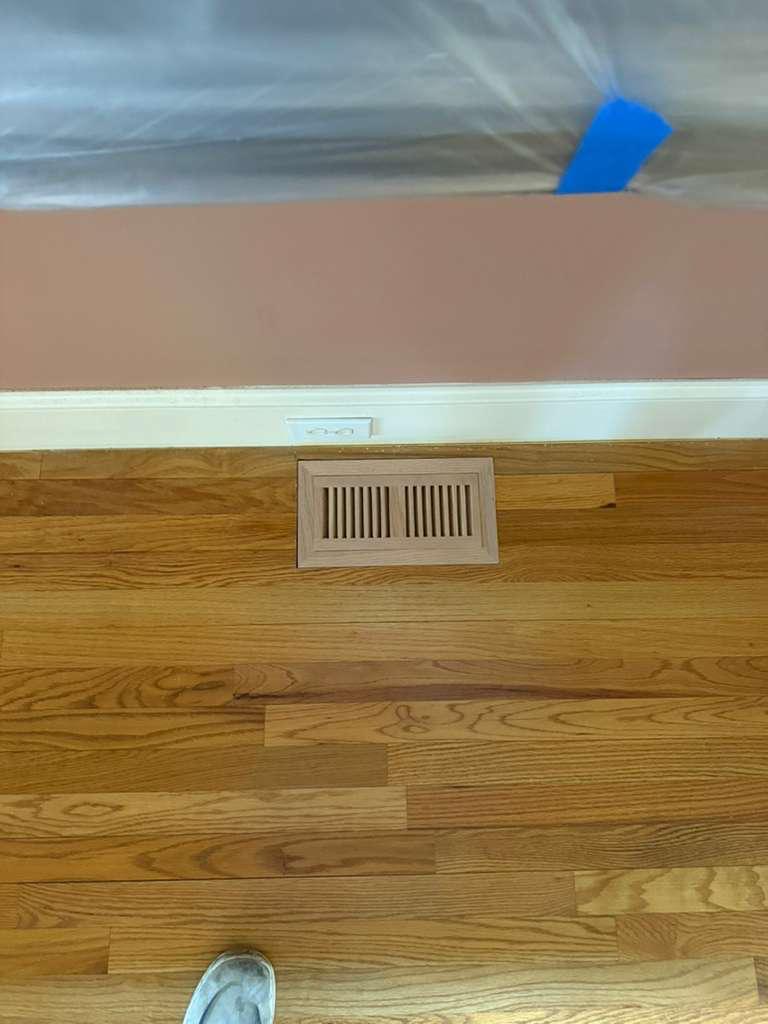
Before committing, we set the vents in place unfinished so the clients could see how the flush-mount profile looked in their floor. Finished apart but in the identical system, the installed vents match the floor in color and sheen while keeping the hand-detailed edges intact.

New unfinished flush-mount vent installed in an old red oak floor before sanding during a refinishing project in Atlanta, raw vent contrasting with the worn amber finish
A new unfinished vent test-placed in the old floor before the project committed — a preview for the clients of the flush-mount profile. The vent was then finished by hand, separately from the floor, and installed after the final coat.
Flush-mount wood floor vent sitting level in sanded bare red oak during a refinishing project in Atlanta, vent and boards at the same unfinished stage
A flush-mount vent test-placed in the sanded floor. The vents were finished by hand, separately from the floor — their edges and louvers can't take machine sanding — then installed once the floor's final coat was done.
New flush-mount wood vent installed in a sanded red oak floor during refinishing in Atlanta, sitting level with the surrounding bare boards
A new flush-mount vent test-placed in the floor so the clients could see the look before committing. The vents are too delicate for machine sanding — they were finished separately by hand in the same system as the floor and installed after the final coat.

Finished result

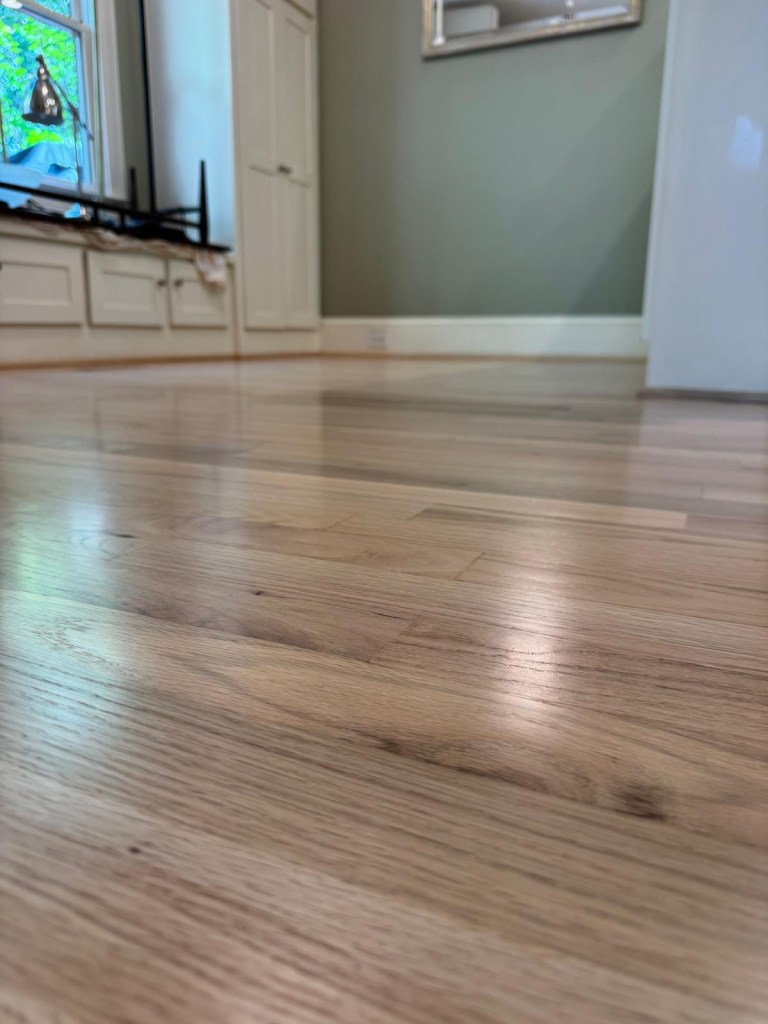
The finished floors hold a pale, neutral color — red oak’s pink undertone counteracted by the pigmented sealer, in daylight and under interior light. The grain and mineral streaks of the species stay fully visible; the pigment load is light enough that the wood still looks like wood, not a painted surface.

The photos on this page show the same floor under different light, and the color shifts with it. Under warm interior bulbs the boards pick up the amber cast of the light source; in daylight they show their actual pale, neutral tone. That isn’t a finish inconsistency — it’s how wood reads under different color temperatures, and it’s the reason we sample on the client’s own floor in their own light before committing to a system. The daylight photos are the closest reference for the true color.

The consistency is the result of the single sequence: the original floors, the new room, the engineered basement, the 30 treads, the shoe molding, and the vents all carry the same finish system. There is no transition in the house where the finish changes — the former carpet room is indistinguishable from the original floors beside it, and the basement reads as site-finished hardwood.

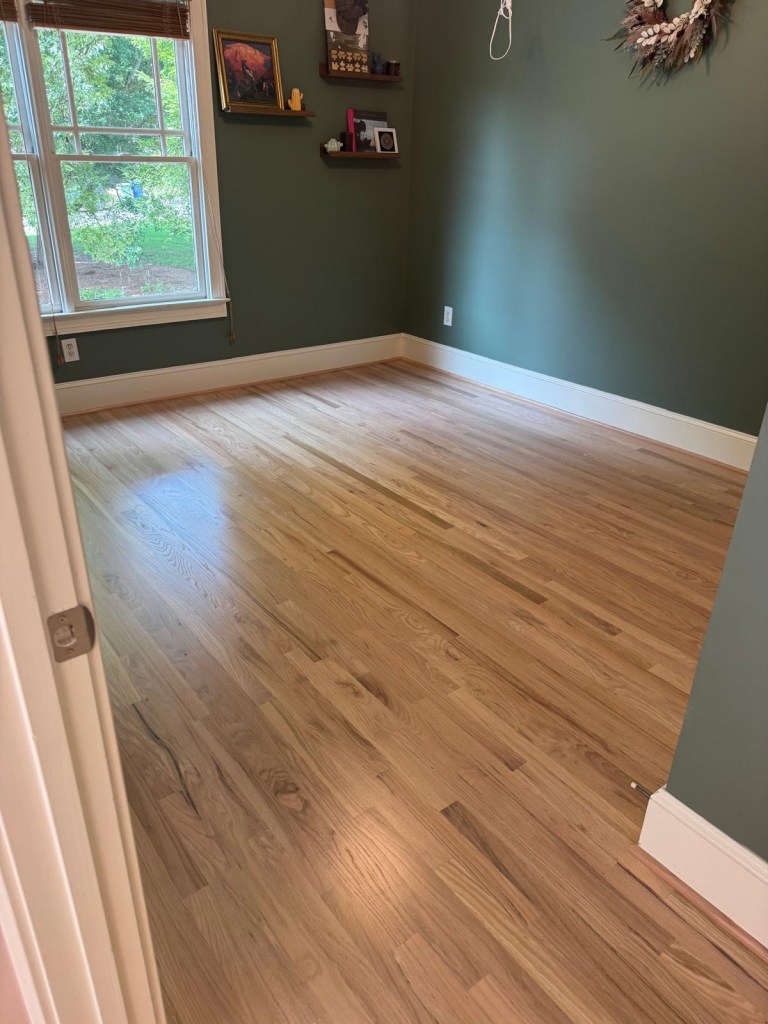
Finished red oak floor in a former carpeted room after new installation and refinishing in Atlanta, new boards matching the existing floors in the rest of the house
This room had carpet when the project started. The floor here is new red oak #1 common, installed bare and then sanded and finished together with the existing floors — which is why nothing about it reads as new. One sanding, one finish system, one color through the whole house.
Close-up of finished red oak floorboards in Atlanta showing grain and mineral streaks under a neutral satin finish, no pink undertone
The finished boards up close: red oak's grain and mineral streaks are fully visible, but the pink undertone is gone. The NaturalSeal coats hold the wood at a pale, neutral color without hiding the character of the species.
Close-up of a finished red oak floor in Atlanta showing the even satin sheen of Bona Traffic HD across flat sanded boards
Low-angle detail of the finished surface. The raking light shows what satin Bona Traffic HD looks like across boards sanded flat — an even, low-gloss reflection without ridges or sanding marks.
Finished red oak stair treads and landing after refinishing in Atlanta, two coats of Bona NaturalSeal and two coats of Bona Traffic HD satin
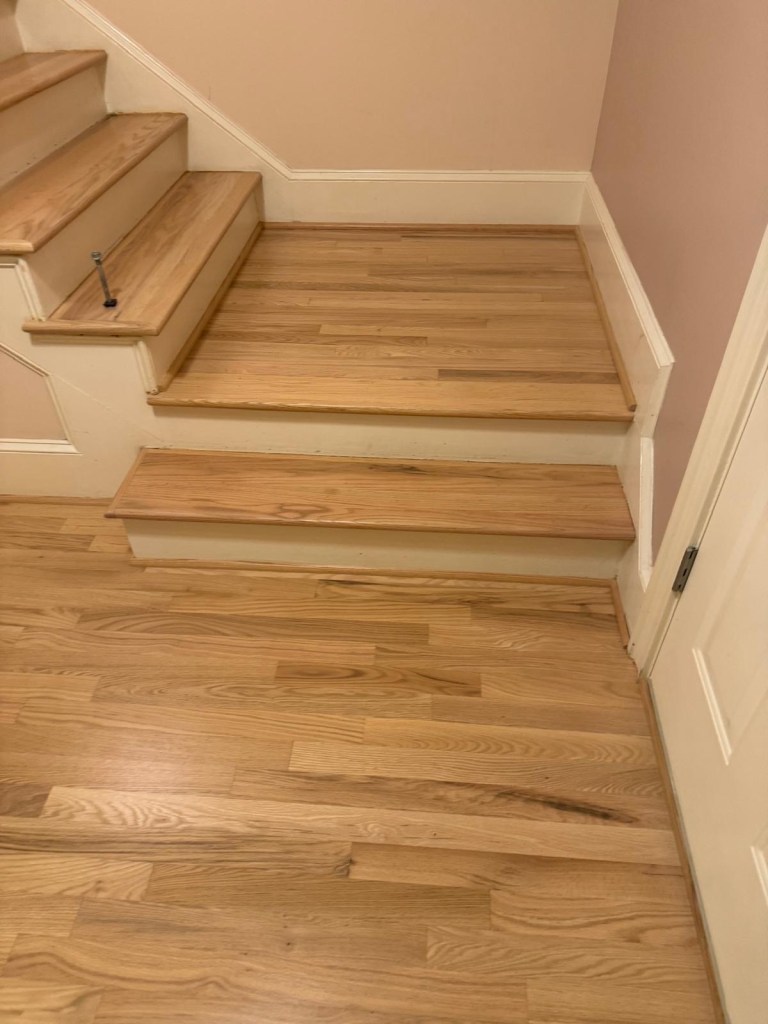
The lower treads and landing finished: two coats of Bona NaturalSeal under two coats of Bona Traffic HD satin. The treads were resanded bare and finished in the same sequence as the floors, so stairs and floor carry one continuous color.
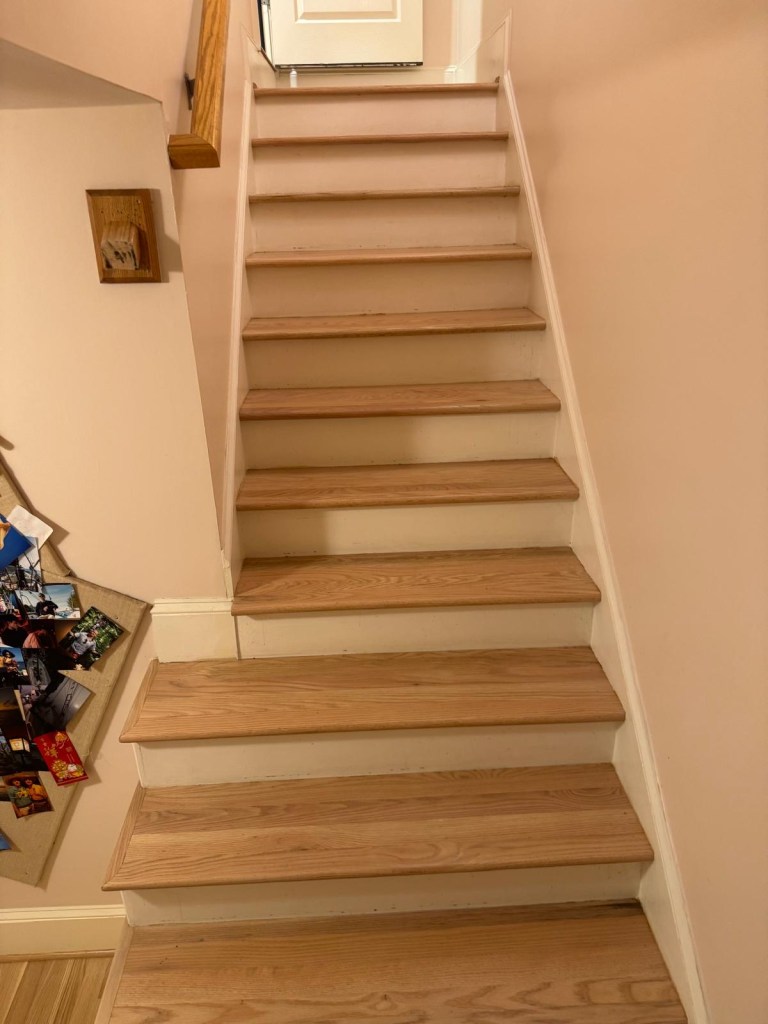
Red Oak Refinishing Atlanta — Finished Staircase, Full Flight
The full flight finished: every tread resanded to bare wood and finished with two coats of Bona NaturalSeal and two coats of Bona Traffic HD satin. The treads carry the same pale, neutral color as the floors above and below the staircase.
Finished red oak stair landing and shoe molding after refinishing in Atlanta, shoe molding finished with the same Bona NaturalSeal and Traffic HD system as the floors
The landing and lower steps finished, with the shoe molding finished in the same system as the floors — two coats of Bona NaturalSeal, two coats of Bona Traffic HD satin — instead of stained. Same wood, same finish, one continuous color along every baseboard.
Finished red oak staircase in Atlanta with flared bottom steps and returned bullnose edges, treads in a pale neutral finish, white risers
The finished flight from the base: the flared bottom steps widen and wrap with returned bullnose edges, and every tread — straight or curved — carries the same two coats of Bona NaturalSeal and two coats of Bona Traffic HD satin as the floors.
Finished engineered hardwood basement floor in Atlanta after refinishing, continuous surface with bevel edges sanded away, satin sheen, no visible board bevels
The basement engineered floor finished. The micro-bevels that ran between every board are sanded away and the surface is continuous under two coats of Bona NaturalSeal and two coats of Bona Traffic HD satin — the floor now reads as site-finished hardwood, not a prefinished product.

Ongoing maintenance

Floors finished with Bona Traffic HD need no wax, oil soap, or polish — those products leave residue that interferes with future recoats. Routine care is a dry dust mop or vacuum with a hard-floor attachment, and a waterborne hardwood floor cleaner such as Bona’s spray cleaner for actual cleaning. No steam mops and no wet mopping; standing water is the one thing hardwood finishes can’t protect against. Felt pads under furniture protect the satin surface. Years from now, when traffic areas begin to dull, the floor can be maintained with a recoat — a fresh coat of finish over the existing one — without another full sanding.

Project specifications:

  
LocationAtlanta, Georgia
CompletedJune 2026
ScopeWhole-house refinishing, new room installation, stair resanding
Refinished area~1,500 sq ft (including 350 sq ft engineered hardwood, basement)
New installation160 sq ft red oak #1 common, former carpeted room
Total finished area~1,660 sq ft + 30 stair treads
Existing speciesSolid red oak; prefinished engineered hardwood (basement)
Engineered wear layer4 mm, verified on a leftover box before sanding
Sanding equipmentLägler Hummel, edge sanders, FG Floortec Discus (final pass 120 grit)
Dust controlDustless sequence with dust extraction + full plastic containment
Finish system2 coats Bona NaturalSeal + 2 coats Bona Traffic HD, satin
Additional scopeShop-prepared red oak shoe molding; hand-finished flush-mount vents
Crew / duration3 crew, 5 days on site

Client Review From This Atlanta Red Oak Refinishing Project

This Google review was shared after the completion of this red oak floor refinishing project in Atlanta, including the Bona NaturalSeal finish and matching oak floor installation in one room.

“We had such a wonderful experience with Classy Flooring! Of course the floors turned out beautifully, with so much attention to detail; totally modernized our home. More importantly, the company’s owner, Claudiu, is extremely easy to work with; prompt, clear, and very knowledgeable about his craft. We felt confident leaving our house for them to work on while out of the country on a vacation.

Communication was fantastic through the whole process, and we were thrilled to arrive home to completely refinished floors, and newly installed matching oak floor in a room.

I highly recommend Classy Flooring of Atlanta!”

-Aaron Norlund – Google review

Frequently asked questions

Can engineered hardwood floors be refinished?

It depends on one number: the wear layer — the thickness of real wood above the plywood core. Below about 2 millimeters there isn’t enough material to sand safely; those floors are limited to a screen-and-recoat, which refreshes the finish but can’t remove scratches or change color. At 3 millimeters and above, a full sand and refinish is possible. The way to know your number is the manufacturer’s spec sheet, a leftover plank from the original installation, or pulling a floor vent to see the board edge in cross-section. On this project we measured 4 millimeters on a leftover box of the original flooring — enough to sand through the factory finish, remove the bevel edges, and still leave wear layer behind.

Can you refinish a floor with a factory aluminum oxide finish?

Yes. Aluminum oxide is the hardest coating used on factory-finished floors — it’s the same mineral used to make sandpaper — so removing it takes more aggressive sanding with coarser grit than a site-applied finish needs. Once it’s off, the bare wood underneath behaves like any sanded floor: it takes sealer and finish normally. The basement floor on this project carried an aluminum oxide finish and is now under the same waterborne system as the rest of the house.

Can red oak floors look like white oak without staining or bleaching?

Yes. Red oak’s pink undertone is what makes it read as “red,” and most clear finishes deepen it. A white-pigmented waterborne sealer counteracts that undertone optically: the light pigment load cancels the pink and holds the boards at the pale, neutral color of freshly sanded wood. Two coats of Bona NaturalSeal did that on this project — no stain, no bleach, and the wood still looks like wood, because the pigment is light enough to leave the grain fully visible. One honest limit: the grain pattern stays red oak grain. The color reads as white oak; the figure of the boards doesn’t change.

Is dustless refinishing really dust-free?

No — and it’s worth understanding what it actually does. Dustless means every sanding machine runs connected to a dust extraction system, which captures the overwhelming majority of dust at the source, at the machine, before it reaches the air. A small amount of fine dust still escapes. That’s what the second layer is for: plastic containment taped over cabinetry, appliances, furnishings, and light fixtures from before the first pass until after the final coat. Extraction handles the volume; containment handles what’s left.

Do I have to stay home — or move out — while my floors are refinished?

Neither. During sanding days the house is loud and the work areas are off-limits, but the rest of the home stays usable. The real constraint is the finish: floors take light, socked-foot traffic about a day after the final coat, and furniture goes back once the finish has cured — with waterborne finishes like Bona Traffic HD, a matter of days rather than weeks, and without the strong odor of oil-based finishes. The clients on this project chose to travel for the duration; we sent photos and video of every stage daily, so being away didn’t mean being out of the loop.

Will a newly installed floor match my existing hardwood? It can — if three things line up. Same species and grade, boards installed unfinished, and one finish sequence: the new wood and the old wood sanded to the same plane and coated together. Color in a finished floor comes from the species plus the finish system, so when both floors get identical coats at the same time, they end up identical. Prefinished boards can’t achieve this, because their color is locked at the factory and existing floors have aged in ways no factory run matches. The former carpet room on this project got new unfinished red oak #1 common for exactly this reason — it’s now indistinguishable from the floors around it.

Will the floors yellow or turn amber over time?

That depends on the finish chemistry, not the wood. Oil-based polyurethane ambers as it ages — that warm, increasingly yellow cast on older floors is the finish, not the boards. Waterborne finishes don’t do this. Bona Traffic HD, used on this project, stays clear, so the pale, neutral color the sealer establishes on day one is the color the floor keeps.

About this project

See all of our completed hardwood projects on our Our Work page →

Classy Flooring ATL is a hardwood flooring specialist serving Atlanta and the surrounding area, focused on refinishing, custom pattern installation, and technically demanding floor work. This project is part of our documented refinishing work — see our hardwood floor refinishing service page for the full scope of what we do, or contact us about your own floors.