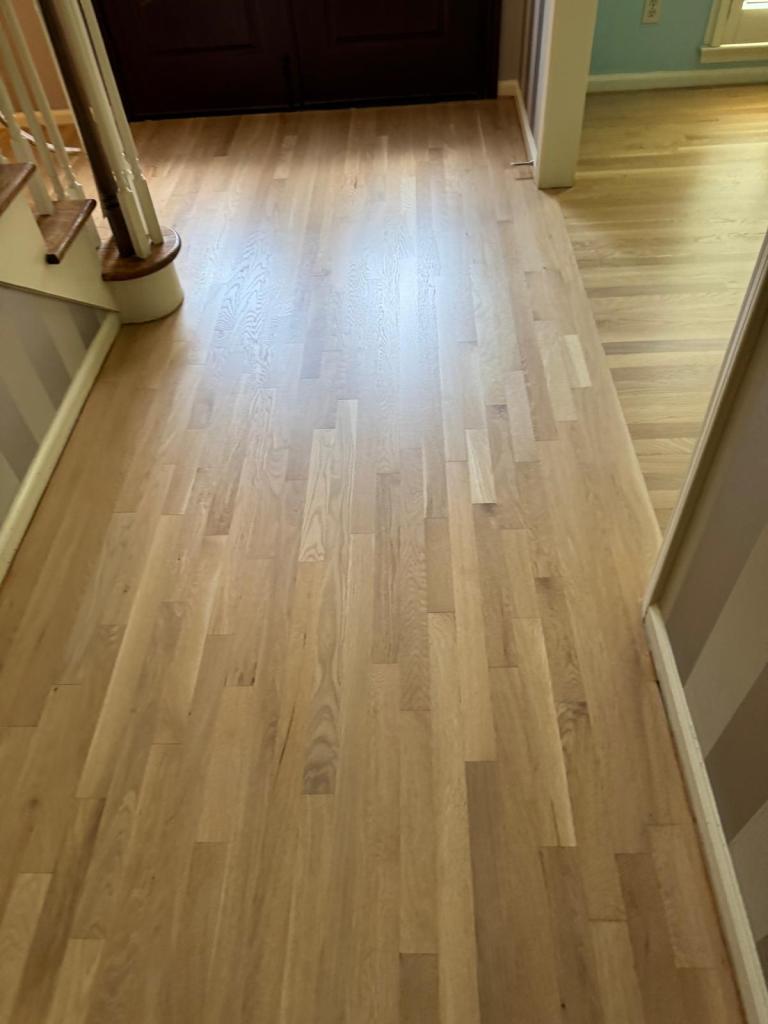
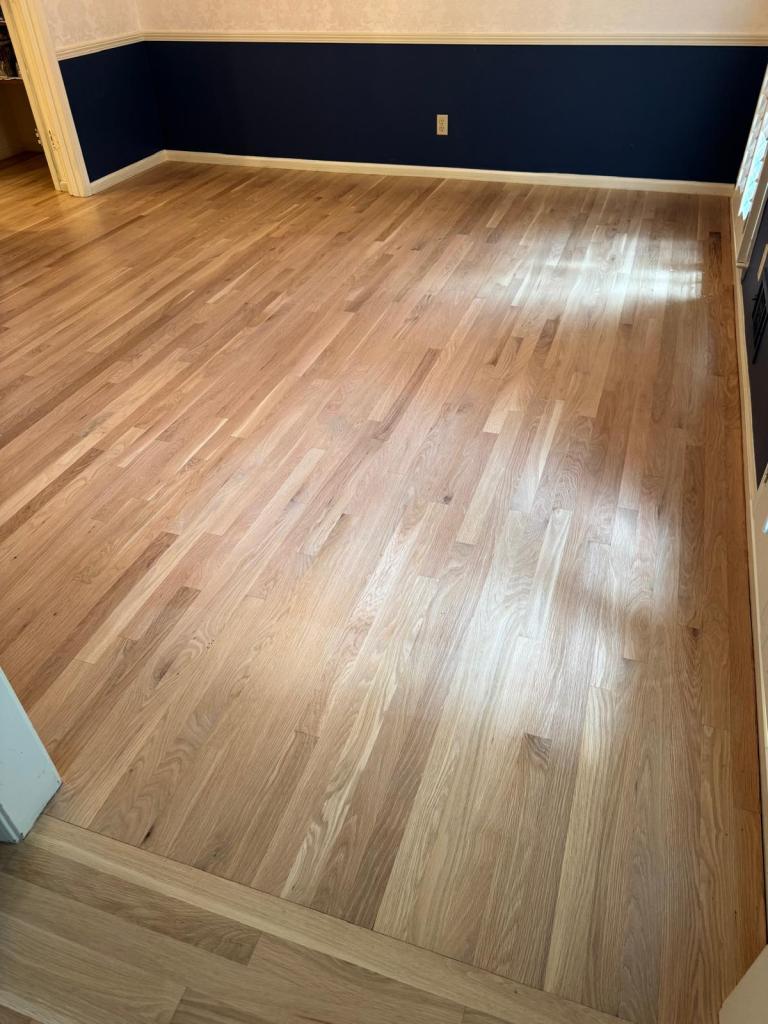
Color Matching a Refinished White Oak Floor to an Existing Red Oak Floor — Dunwoody, GA
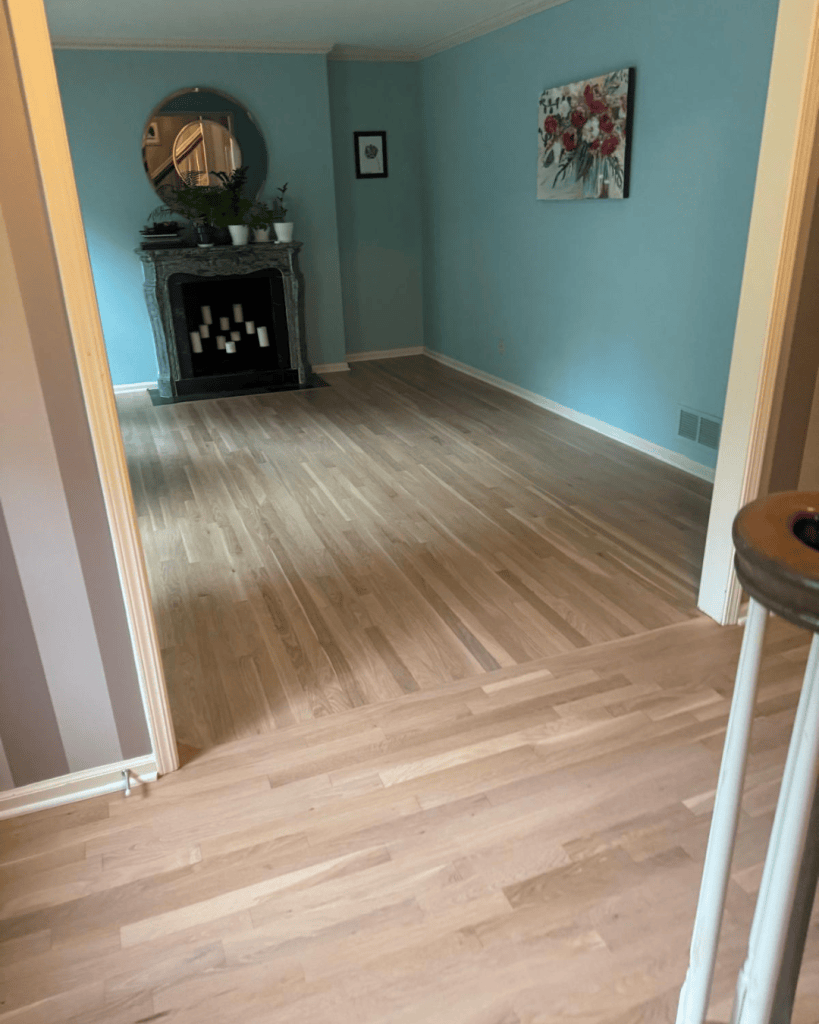
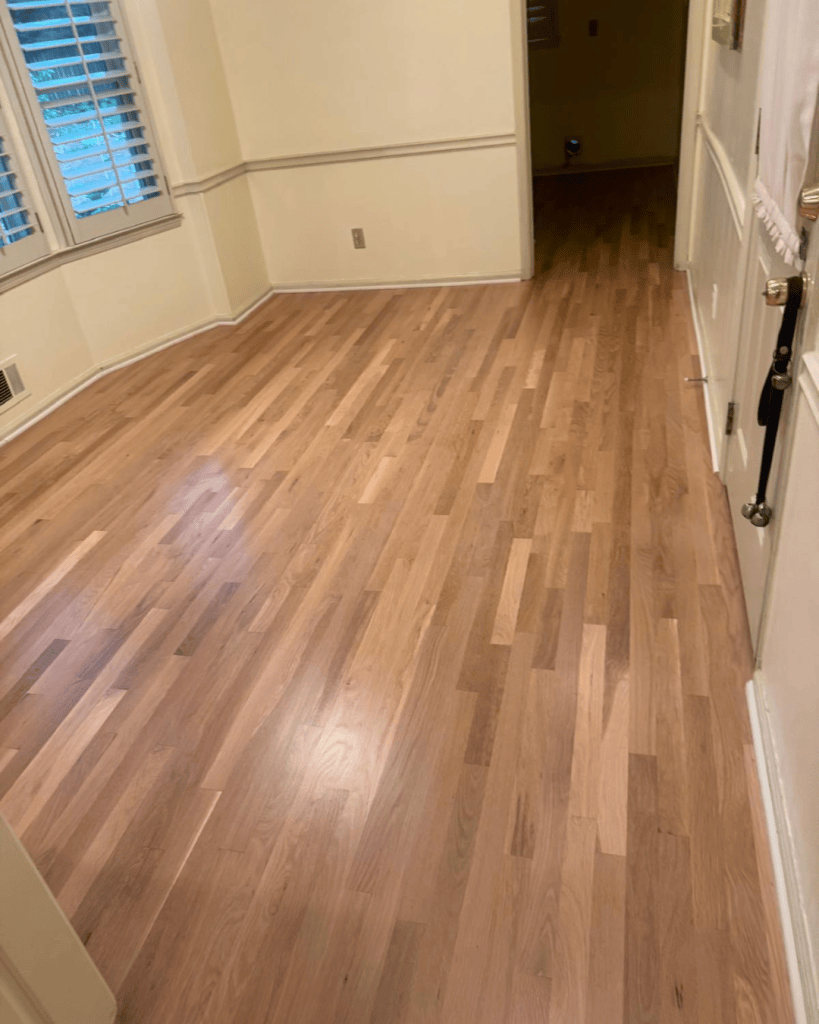
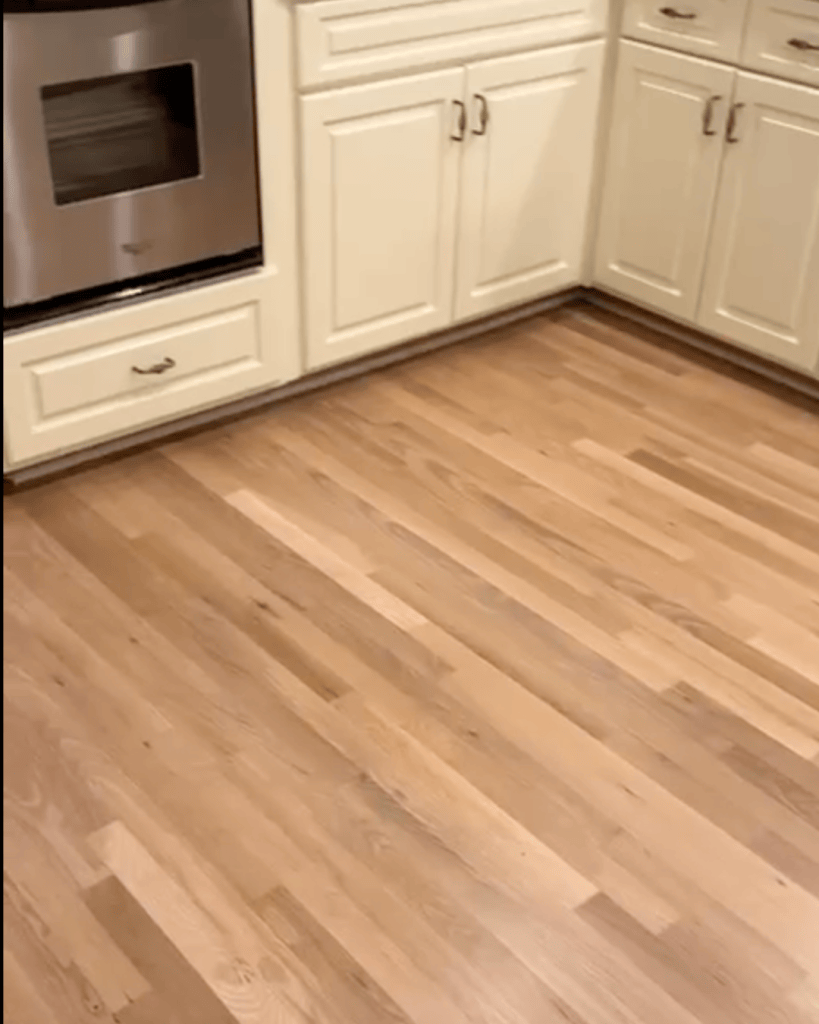
A refinished floor can be brought into match with an existing floor of a different species by correcting the color in the finish rather than in the wood. Classy Flooring ATL refinished 700 square feet of white oak in Dunwoody, Georgia, and matched it to 300 square feet of red oak in the adjoining living area, installed and finished a year earlier. The match was built in two stages: LOBA Whitener in the sealer to set the tone, and red pigment in one coat of LOBA 2K Duo to correct the undertone, with a clear coat over it so the color is not the wear surface.
Project overview
The home has roughly 1,000 square feet of hardwood on a single level. Classy Flooring ATL refinished 700 square feet of it. The remaining 300 square feet, in the living area, was installed and finished a year earlier in a natural color and was not part of this scope. That floor was left as it was and used as the reference for the rest of the house.
Crew of three. Three days on site, set by dry time between coats rather than by hours of labor. Satin sheen throughout.
Starting condition
The 700 square feet carried a dark finish. The client wanted it refinished to the same natural color as the living area, which meant sanding the dark finish off and finishing the floor light.
What the sanding revealed
Once the dark finish was sanded off, the wood underneath was white oak. The floor in the living area is red oak.
The two floors meet in the same sightline, and only the 700 square feet was in scope. Sanding and refinishing both floors as one surface produces the closest match, because both then take the same sealer and the same finish at the same time. That was not available here: the living area floor was a year old, already finished, and not part of this scope. The color correction had to be made on the white oak alone, in the finish.
Sampling before commitment
After sanding, we prepared three samples directly on the floor and compared each against the red oak in the living area, in the room’s own light.
The sample selected was LOBA EasyPrime with 2.7 ounces of LOBA Whitener per gallon — one 80 ml bottle, LOBA’s published maximum. Whitener is a LOBA additive for water-based sealers and finishes, and its strength is controlled by how many coats carry it. In the sealer alone it set the lightness the client wanted.
The client was out of town and asked us to make the color decision. We made it from the samples, on their floor, against the floor it had to match.
Surface preparation
The floor was sanded with a belt sander and edger at 40, 60 and 80 grit, then refined with the FG Floortec Discus planetary sander at 100 and 120, finishing at 120. Sanding was run dustless throughout, with the FG Floortec vacuum system and DUSTIN separator.
Sanding to a consistent 120 matters on a color-matched floor because variation in the scratch pattern shows as variation in how the finish reads, and that variation is visible where the two floors meet.
Finish application
Four coats: one sealer and three coats of LOBA 2K Duo in satin.
Day one — the floor was sanded and one coat of LOBA EasyPrime with Whitener was applied.
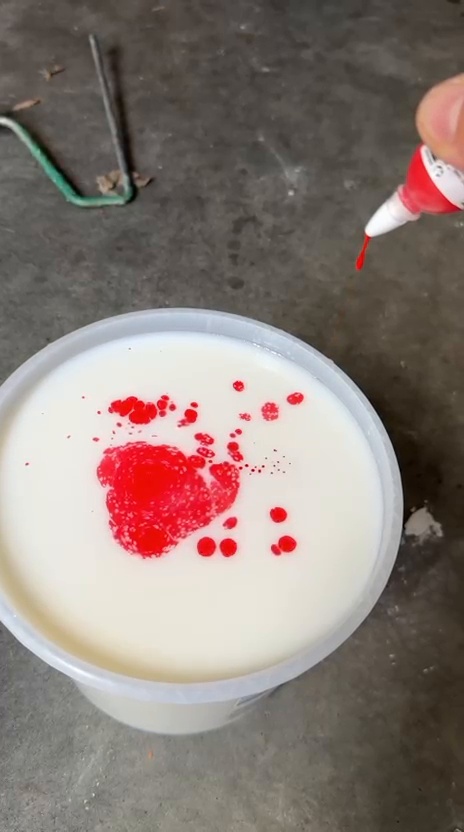
Day two — at twelve hours, the first coat of 2K Duo went on hot with no buff between. EasyPrime is not intermediate-sanded at all — LOBA’s data sheet says not to. It is coated within its window and the finish bonds to it directly. Three and a half hours later the floor was buffed at 240 grit and the tinted coat was applied: 2K Duo with MIXOL No. 10 Red.
Day three — the floor was buffed at 240 grit, vacuumed, and the final coat of clear 2K Duo was applied.
How the color match was made in the finish, not the wood
Color can go into a wood floor in one of two places: into the wood itself, or into the finish that goes over it.
Stain goes into the wood. It soaks into open grain, so it can only be applied to bare wood before anything is sealed, and it colors whatever it lands on. That is what rules it out for matching two species. White oak and red oak absorb stain differently — the same stain applied to both comes out as two different colors. Used across species, stain tends to widen the gap rather than close it.
Putting the color in the finish is a different discipline, and it has a name in professional wood finishing: tinting. A measured amount of pigment is mixed into a coat of finish, and that coat carries the color in a thin film above the wood rather than inside it. Because the pigment never touches raw grain, it is not reacting with the wood, and it is not amplifying the difference between two species. It lays a controlled amount of color over both. Tinting is used to move a floor that is already close — warmer, cooler, redder — which is what was needed here after the sealer had set the lightness.
This is not stain mixed into polyurethane. Stain contains its own binder, usually an oil, which is a second resin introduced into a coating designed to cure as a single film. That is where the familiar failures come from: the mixture separates or thickens, pigment clumps and dries blotchy, the coat bonds poorly, and the finish ends up less durable than the same finish would have been on its own. A tinting colorant is built differently. MIXOL is a binder-free concentrate — pigment and carrier, no resin of its own — so it disperses through the finish without introducing a second resin into the curing film.
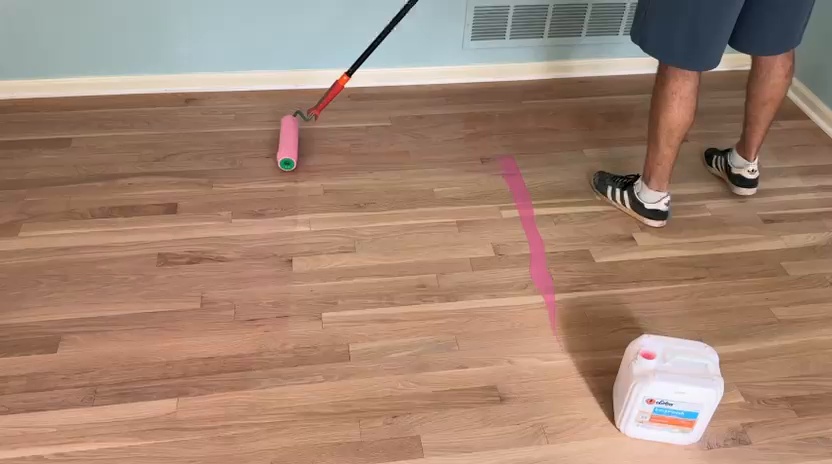
What makes tinting demanding is that the color arrives with the coat. In a clear coat, an uneven pass shows up later as a slight difference in sheen. In a tinted coat, it shows up as a difference in color, and the floor has no tolerance for it: the coat has to go down in one continuous application across the whole floor, with no stop in the middle and no lap where one pass meets the next. It also cannot be corrected afterwards. Abrading a toned coat cuts into the pigmented film unevenly, and there is no way to put color back — so the color is never adjusted after the coat is down. What follows a tinted coat is a clear coat. Where the floor is screened before that clear coat, it is for adhesion, not for color: LOBA’s data sheet requires an intermediate sanding once more than twenty-four hours have passed between coats, and recommends one before the final coat in any case. There is no touch-up on a tinted floor. There is the coat, or there is sanding the floor back to bare wood and starting again.
The amount of pigment is judgment. Too little and the floor stays where it was; too much and it reads as a color laid over the wood instead of the wood’s own. The rule is to move the floor as little as the match requires, then stop.
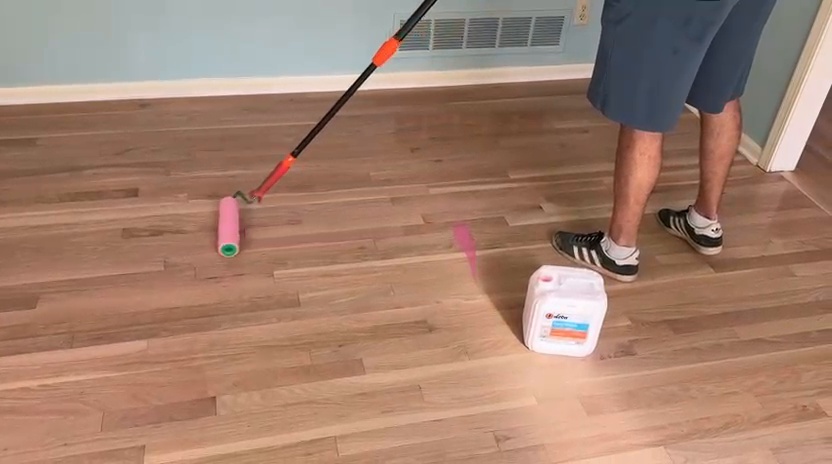
On this floor, MIXOL No. 10 Red was mixed into the second coat of LOBA 2K Duo — the third of the four coats — and rolled across the full 700 square feet in one continuous application. One tinted coat brought the white oak to where it needed to sit against the red oak. The floor was checked against the living area before the last coat went on, and a second tinted coat was not needed.
The fourth and final coat is clear. The tinted coat sits under a full coat of unpigmented 2K Duo, so the layer taking wear in a traffic lane has no color in it. The color cannot be walked through.
Cure and return to use
LOBA 2K Duo reaches full cure five days after the final coat, per the manufacturer’s technical data sheet. Until full cure the floor is not covered, rugs and carpets are not put back down, and it is not damp-mopped.
Additional scope
New white primed shoe molding was installed after the floor was finished. Existing shoe molding is removed before sanding, because leaving it in place leaves gaps at the wall, and new molding is installed after the finish is down. Classy Flooring ATL installs white primed molding as primed; the client’s painter finished it.
The result
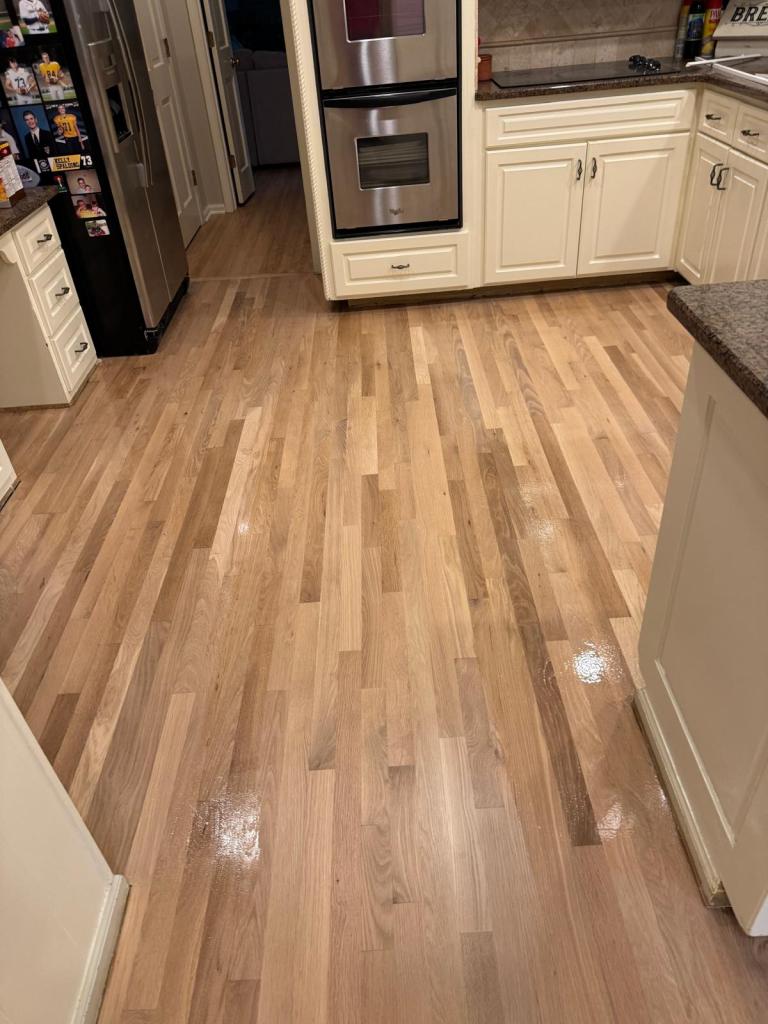
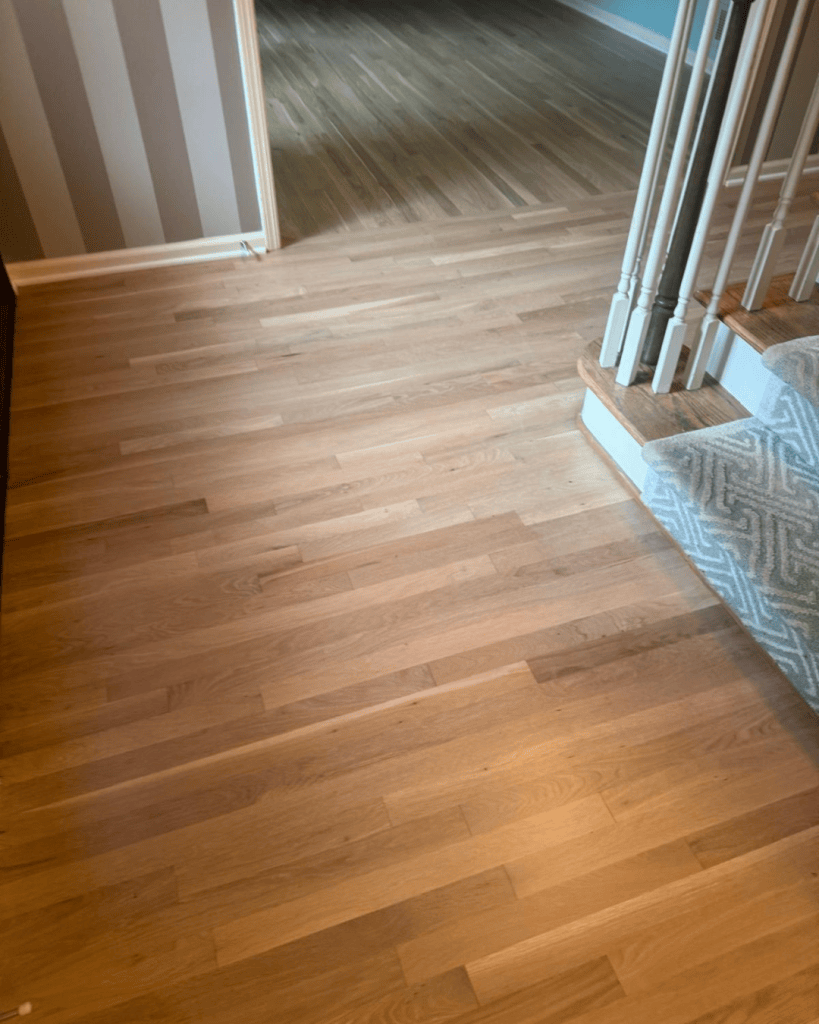
The refinished white oak reads as a close match to the red oak across the opening between the two areas. The two floors agree in tone and undertone at normal viewing distance.
A match made across species, on one floor only, is a close coordination rather than an exact copy. The grain of white oak and the grain of red oak are different, and no finish changes grain.
Client Review from This Project
Source: Google Business Profile review
“5 Star Review from Jenny Spalding
Hardwood Floor Refinishing & Color Matching — Dunwoody, GA
Claudiu and his team are incredible. They not only helped us with the preparation, but gave us comfort and confidence in having this big project done while we were out of town. They redid all of our existing hardwood floors on the main floor and matched the exact color of our new hardwood floors, done previously. They also made our original floors look brand new. They work hard to do the job perfectly. We live in Dunwoody and know they service many areas in the metro region. We highly recommend them!”*
— Jenny Spalding
Project specifications
- Location: Dunwoody, Georgia
- Completed: July 2026
- Scope: Refinishing with color matching to an existing floor
- Area refinished: 700 sq ft
- Existing floor matched to: 300 sq ft red oak, installed and finished one year
- Species refinished: White oak
- Sanding: Belt sander and edger at 40/60/80; FG Floortec Discus at 100/120; final grit 120
- Dust control: Dustless sanding, FG Floortec vacuum system with DUSTIN separator
- Sealer: LOBA EasyPrime with LOBA Whitener, 2.7 oz (80 ml) per gallon
- Finish: LOBA 2K Duo, three coats, satin
- Color correction: MIXOL No. 10 Red universal tinting concentrate in coat three of four
- Final coat: Clear LOBA 2K Duo over the tinted coat
- Between coats: No abrasion between the sealer and the first finish coat; buffed at 240 grit before the tinted coat and before the final coat
- Total coats: Four — one sealer, three finish
- Trim: New white primed shoe molding, installed after finishing, painted by the client’s painter
- Crew: 3
- Days on site: 3
- Full cure: 5 days per manufacturer TDS
Frequently asked questions
Can a hardwood floor be color matched to an existing floor in another room?
Yes. The closest result comes from sanding and refinishing both floors as one surface, because they then take the same sealer and the same finish at the same time. When the existing floor cannot be touched, as in this project, the match is built on the floor being refinished and verified by sampling against the existing floor before any finish is committed.
What if the two floors are different species?
Matching across species is harder and the limit is lower. Species differ in undertone and in grain. Grain cannot be changed by a finish; undertone can. On this project the white oak read cooler and browner than the red oak next to it, and that difference was corrected with pigment in the finish. The grain of each floor stayed as it was.
Can the color be corrected after the floor has already been sealed?
Yes, but not with stain. Stain penetrates raw wood, so once a sealer is down that route is closed. Correction after sealing is made in the coating, with pigment carried in a finish coat that sits above the wood rather than in it. That is the method used here, with MIXOL No. 10 Red in the third of four coats.
Will a tinted finish wear through in traffic areas?
Not when the tinted coat is not the top coat. On this floor the pigment is in coat three and coat four is clear LOBA 2K Duo. The film that takes foot traffic and abrasion carries no pigment, so wear does not expose a color line. A tinted final coat carries that risk, which is why the tinted coat is not the last one.
Does the existing floor need to be refinished too?
Not necessarily. If the existing floor is in good condition and the client does not want it disturbed, it can be left as it is and used as the reference for the new work. On this project 300 square feet of red oak was left untouched and 700 square feet was matched to it.
How long does a color-matched refinishing project take?
This one took three days on site with a crew of three, set by dry time rather than labor. Coats have to dry before the floor can be buffed and recoated, and a color-matched floor is checked against the reference floor between coats. The finish reaches full cure five days after the last coat.
Do you do hardwood floor color matching in Dunwoody and metro Atlanta?
Yes. Classy Flooring ATL refinishes and color matches hardwood floors in Dunwoody and throughout metro Atlanta, including Buckhead, Sandy Springs, Brookhaven, Roswell, Alpharetta, Johns Creek, Milton and Braselton.
Related work
- White oak refinishing with new floor lace-in and custom color match, Buckhead — new white oak integrated into an existing floor and color matched to it
- White oak refinishing with Bona NordicSeal, Hoschton — color correction on white oak using a whitening sealer
- Fabricated engineered herringbone entrance, Dunwoody — cut edges and bevels color matched to a prefinished factory face
About this project
This color-matched refinishing project was completed by Classy Flooring ATL, a premium hardwood flooring company serving Dunwoody and the greater Atlanta area. The work on this page is an example of our hardwood floor color matching work, which covers matching new floors to old, matching across species, and correcting a floor that already reads as two. It sits within our broader hardwood floor refinishing and restoration service, alongside dustless sanding, stair refinishing, and professional water-based finish systems.
Planning a refinishing project where a new floor has to agree with an existing one? Contact Classy Flooring ATL to discuss the scope.