White Oak Floor Refinishing in Buckhead — Rubio Monocoat Oil Plus 2C in Linen
In January 2026, Classy Flooring ATL completed the refinishing of approximately 1,500 square feet of existing white oak flooring across the main level of a private residence in Buckhead, Atlanta. The floors were finished using Rubio Monocoat Oil Plus 2C in Linen, followed by Rubio Monocoat Universal Maintenance Oil in Pure after a 72-hour cure. This page documents the project scope, process, and finish system.
This Buckhead project is one of Classy Flooring ATL’s documented hardwood refinishing and restoration projects — sanding and hardwax-oil finish systems, color-matched on the actual floor, across metro Atlanta. See the full range of our work on our Our Work page.
Project overview
The scope covered the main-level living areas of the home — approximately 1,500 square feet of existing white oak flooring. The work was a refinishing project, not a new installation. The floors were sanded to raw wood, water popped, and finished on site with the Rubio Monocoat system. Work was performed by a three-person crew over five days on site.
This project ran as the companion scope to a paneling refinishing project in the same residence. The finish direction for the floors was coordinated with the paneling to hold a consistent visual palette across the main-level architecture.
Starting condition
The existing floors were white oak in a warm, amber-leaning tone with a satin sheen carried over from a previous finish. The boards were old, with movement and gaps from years of seasonal change, which factored directly into how the sanding was staged.
Design direction
The client and the designer had already committed to a Rubio Monocoat direction on the paneling. The floor color was selected to sit correctly alongside the completed paneling and to read consistently across the different wood species in the home.
Because Rubio Monocoat reacts differently with each wood species, a color that reads correctly on white oak will not necessarily read correctly on pine. The downstairs floors are white oak; the upstairs floors are pine. For the finish direction to hold visually across the home, sampling had to be performed on both species before the final color was committed. The upstairs pine flooring was sampled for this color-coordination purpose only; it was not refinished as part of this project.
Sampling process
Sampling was staged across two rounds.
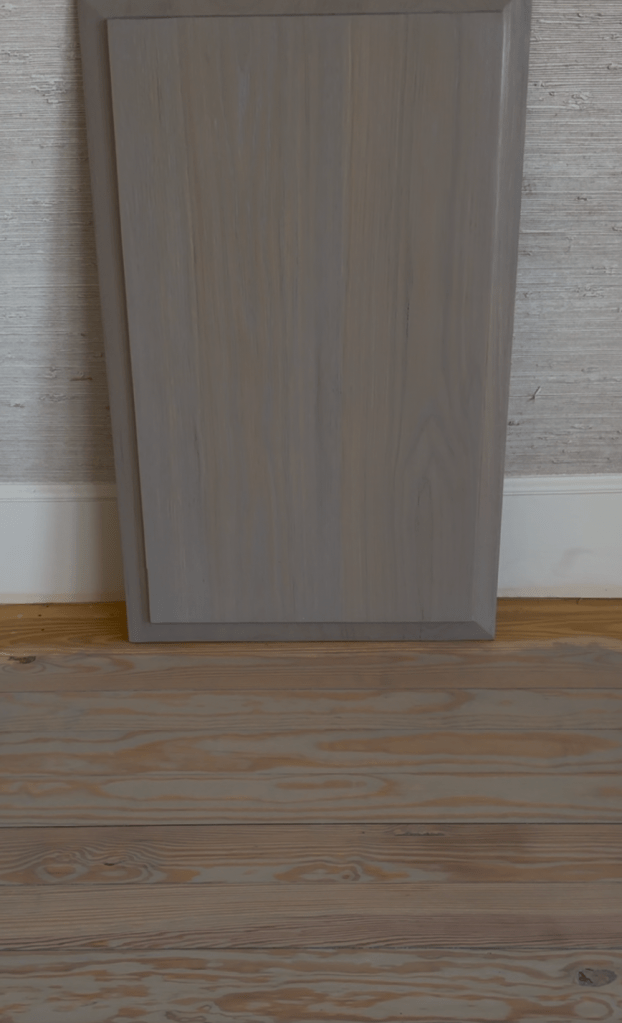
An early directional round placed a single Rubio Monocoat swatch — labeled “Mist” — on the existing floor to establish rough tonal direction before sanding was scheduled.
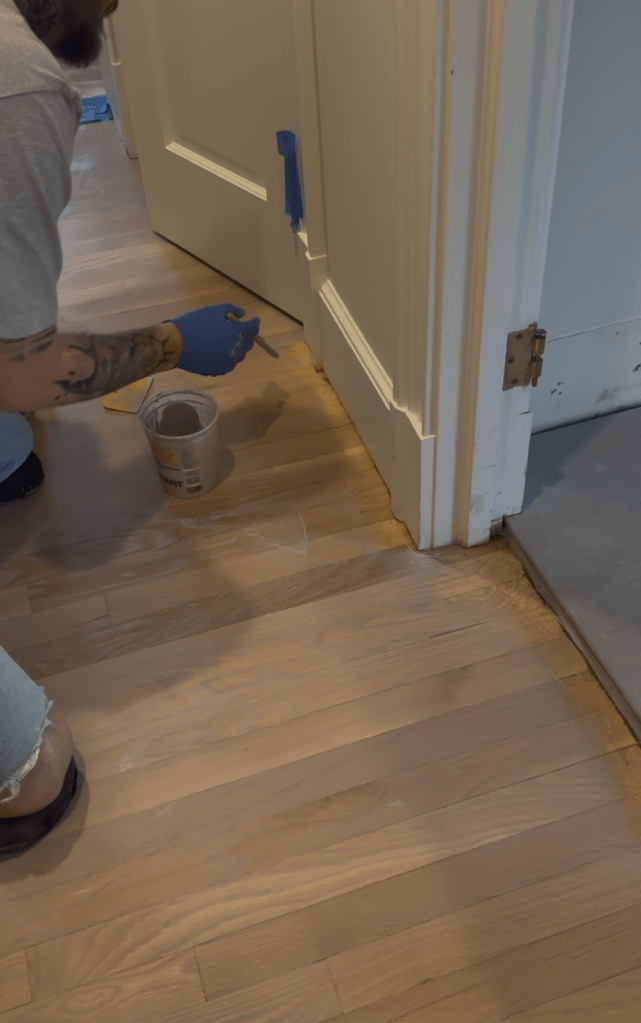
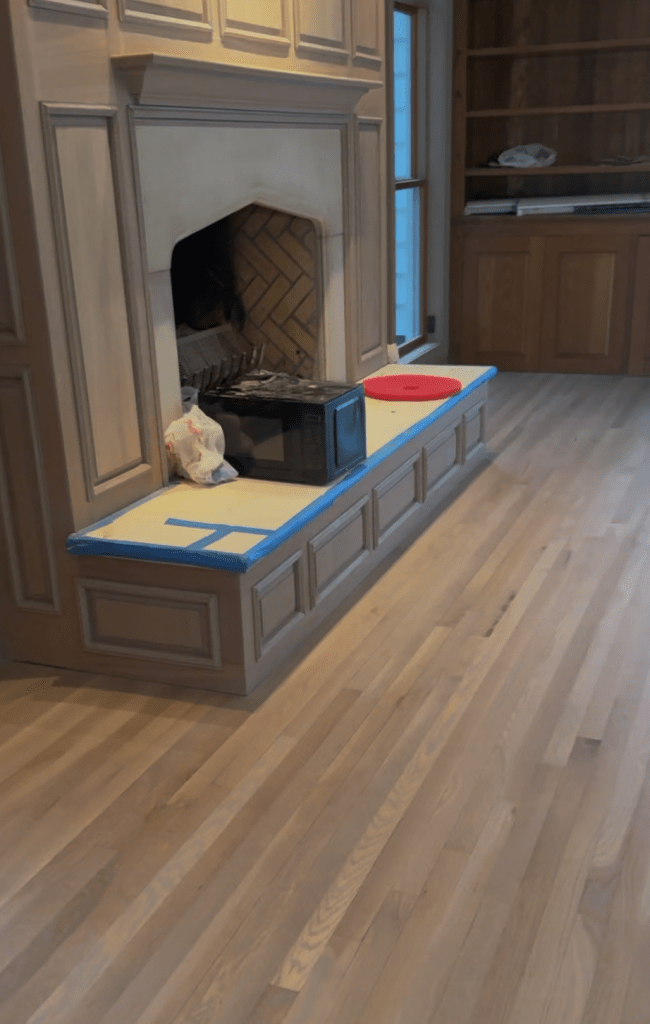
The final selection round was performed on the sanded white oak, with two candidate color treatments taped out side by side: Linen, and a custom 50% Linen + 50% Pure blend. Both were applied on the actual floor in the main-level living area, positioned adjacent to the already-finished paneling so the client could evaluate each sample in context, under the lighting conditions the finished room would see.
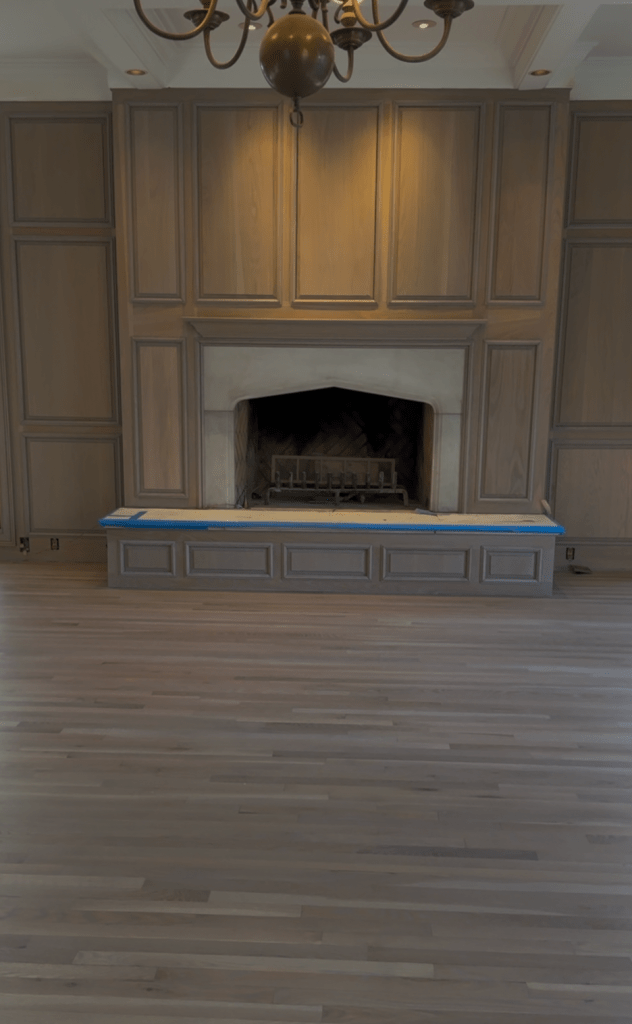
Linen was selected as the final floor color, matching the paneling direction.
Sanding and surface preparation
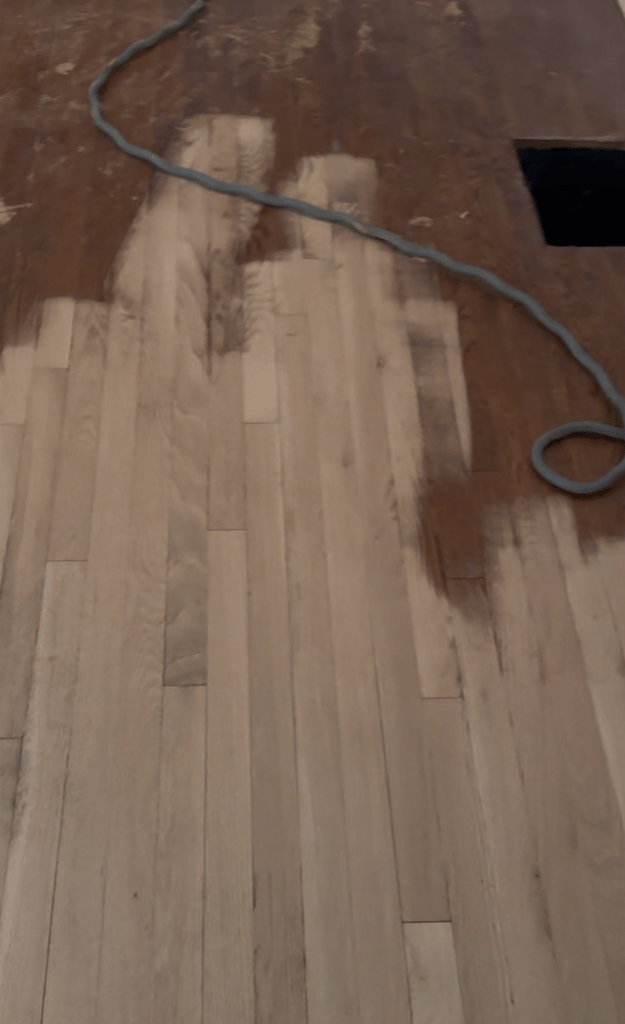
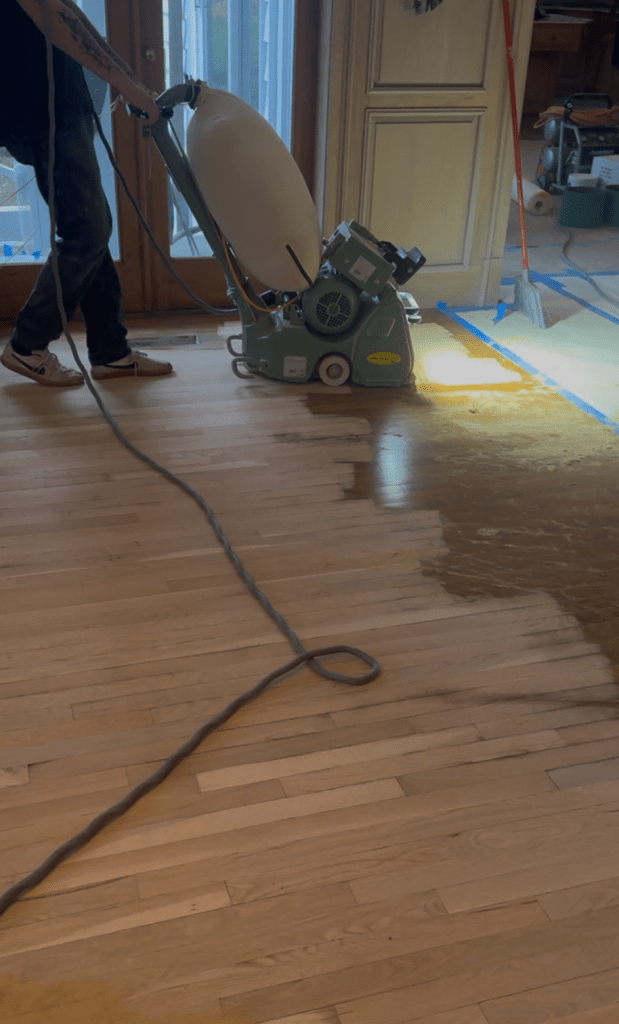
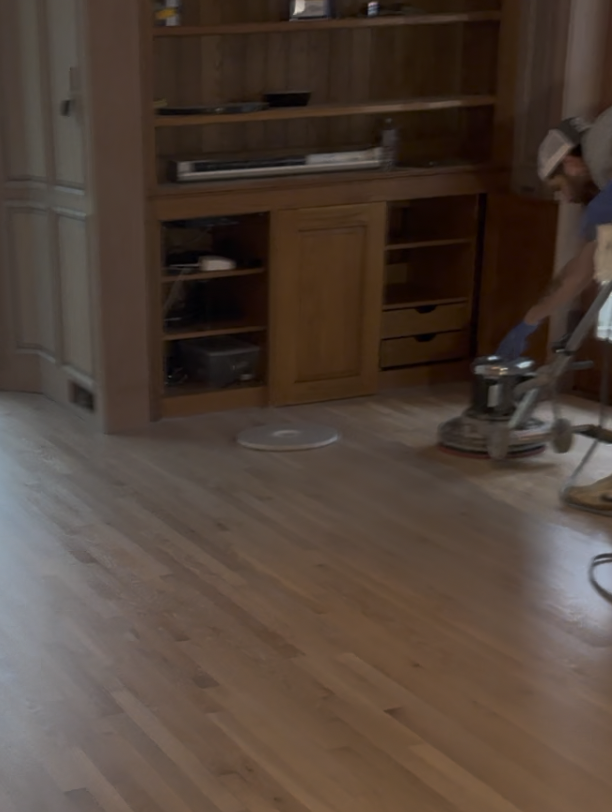
The floors were sanded through a grit sequence of 36, 50, 80, 100, and 120, which keeps to NWFA’s sanding rule of skipping no more than one grit, and none within the fine and extra-fine range. Coarse and mid-grit sanding were performed with a Lägler Hummel belt sander paired with a DUSTIN dust separator and a Super 7 edger. Final sanding was completed with the FG Discus planetary sander, which refines the surface evenly across the full floor area.
Because the existing boards were old and had noticeable movement, wood filler was applied twice during the sanding sequence rather than once. The first filler pass followed the 36-grit cut, addressing the most severe gaps. A second filler pass followed the 50-grit cut, catching gaps that only became visible once the surface had been flattened further. NWFA’s guidelines call for filling before the final sanding cut and for the filler to be fully dry before sanding continues; each filler pass here was allowed to cure before the next grit was run, and both were sanded flush by the 80, 100, and 120 passes that followed. Filling twice takes more time than a single pass, and on a floor with this much movement it let the second pass catch what the first sanding exposed.
After the final 120-grit pass with the planetary sander, the floors were water popped to open the grain and allow fuller penetration and color intensity from the oil. Rubio Monocoat directs that the wood be fully dry before Oil Plus 2C is applied and recommends checking it with a moisture meter, and NWFA’s guidelines call for a popped floor to be dry and back to its starting moisture content before anything is applied. Once the surface was dry, it was vacuumed thoroughly and cleaned per the Rubio Monocoat preparation sequence before oil application.
Finish application — Rubio Monocoat Oil Plus 2C in Linen
Oil Plus 2C was applied per the Rubio Monocoat technical data sheet. The A and B components were mixed at a 3:1 ratio, and the oil was worked into the floor in zones of 50 to 100 square feet at a time, consistent with the manufacturer specification.
Each zone was allowed the specified reaction period, then excess oil was removed with a white buffer pad within the manufacturer’s working window. A final pass with a clean white pad confirmed the surface was dry to the touch and non-sticky — the signal that the oil had fully reacted with the wood.
Cure period and Universal Maintenance Oil
After the Oil Plus 2C application, the floors were allowed to cure for 72 hours before the next step. Rubio Monocoat calls for waiting at least 48 hours after Oil Plus 2C before applying Universal Maintenance Oil; the additional cure time on this project was a deliberate conservative margin.
Rubio Monocoat Universal Maintenance Oil in Pure was then applied over the Oil Plus 2C. Per Rubio Monocoat, Universal Maintenance Oil enhances the sheen to a velvet finish, nourishes the wood, and revitalizes the surface appearance.
Per Rubio Monocoat guidance, once Universal Maintenance Oil has been applied, future maintenance of the surface should be performed using Universal Maintenance Oil. If color restoration is required, renovation is performed with Oil Plus 2C in the original color.
Rubio Monocoat sets the return to use. Oil Plus 2C is about 80% cured after 48 hours and fully cured in about five days. The Universal Maintenance Oil over it takes light use after an overnight dry, reaches full cure in five to seven days, and is not cleaned with liquid until then. Area rugs go back after the final cure, and NWFA recommends walking on a curing floor in clean, dry socks.
Custom wood floor vents
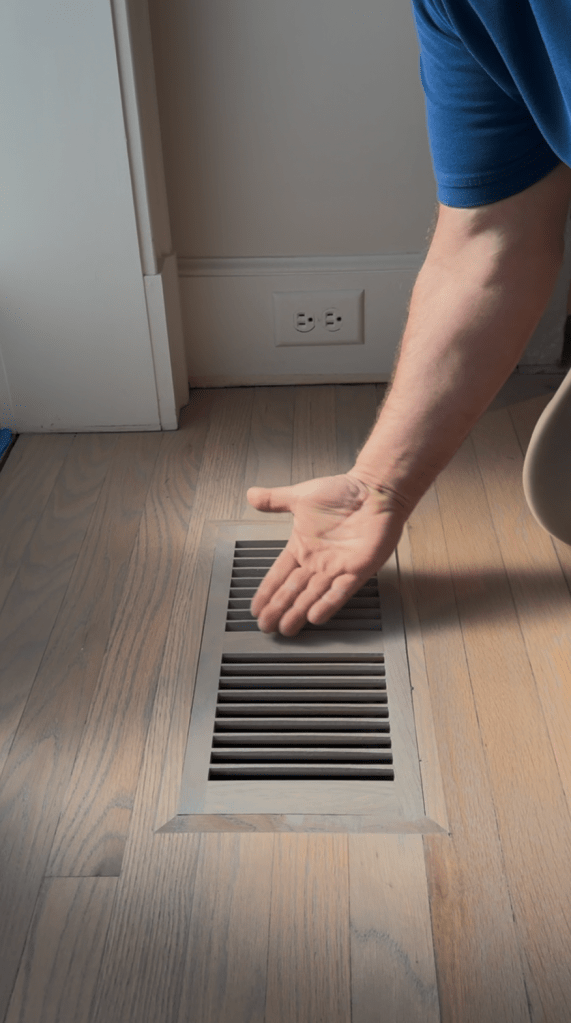
The existing metal floor vents were replaced with custom wood vents made for this project. Two vent styles were produced — a slat profile and a grid profile — sized to the exact openings measured on site, finished with the same Rubio Monocoat system used on the floor itself, and installed flush with the finished surface. This allows the vents to read as continuous with the flooring rather than as interruptions in it.
Project specifications
Location: Buckhead, Atlanta, Georgia
Completion date: January 2026
Scope: Refinishing of existing white oak flooring, main-level living areas
Approximate area: 1,500 square feet
Wood species: White oak (existing)
Project type: Refinishing (no new floor installation within this scope)
Sanding equipment: Lägler Hummel belt sander, DUSTIN dust separator, Super 7 edger, FG Discus planetary sander
Grit progression: 36 → 50 → 80 → 100 → 120
Wood filler: Applied twice — after the 36-grit pass and again after the 50-grit pass — to address gaps in older, moved boards
Preparation: Water popping after final grit
Finish system: Rubio Monocoat Oil Plus 2C, color Linen
Sheen enhancer: Rubio Monocoat Universal Maintenance Oil in Pure, applied 72 hours after Oil Plus 2C
Cure: Oil Plus 2C about 5 days; Universal Maintenance Oil 5–7 days, per Rubio Monocoat
Additional scope: Custom wood floor vents in two profiles (slat and grid), finished with the same Rubio Monocoat system and installed flush
Sampling: Staged, two rounds; performed on white oak downstairs and upstairs pine for whole-home color coordination
Crew size: 3
Days on site: 5
Contractor: Classy Flooring ATL
This Google review is from our client on this residence, where we refinished both the white oak floors and the large oak-paneled Great Room with Rubio Monocoat.
Client Review from This Project
★★★★★ 5-star review — Source: Google Business Profile
“Claudiu and his team were extremely professional and deliver high quality results. Claudiu personally oversees the work and is a pleasure to work with. My company was executing a complex and tome consuming refinishing job of a large oak paneled Great Room with Rubio monocoat. It could not have been done without Classy Flooring’s organization and attention to detail. I only hesitate to recommend because I don’t want them to het so busy they can’t take on my next project! But highly recommend :)”
— Jeff Royal
Related project
This floor refinishing project was performed in the same residence as our oak wall paneling refinishing project in Buckhead. The finish direction for the floors was coordinated with the paneling to hold one consistent visual palette across the home’s main level.
For Rubio Monocoat Oil Plus 2C on floors — how the hardwax oil bonds with the wood, how colors are sampled, and how the floor is maintained — see our Rubio Monocoat hardwax oil flooring service page.
Frequently asked questions
How to apply Rubio Monocoat to a floor?
In one coat, over wood sanded and cleaned the way Rubio specifies. Rubio sets the final sanding at 100 to 120 grit — sanding finer closes the surface and the oil penetrates less — and the floor is then vacuumed, cleaned, and left completely dry. Oil Plus 2C is mixed from its two parts, applied zone by zone, given a few minutes to react with the wood, and the excess is buffed off with a white pad within Rubio’s working window. A second coat of Oil Plus 2C isn’t applied, because the oil bonds to raw wood, not to itself. On this floor the last pass was 120 grit with the FG Discus, the floor was water popped and dried, and Oil Plus 2C in Linen was mixed 3:1 and worked in 50- to 100-square-foot zones. Universal Maintenance Oil in Pure followed 72 hours later to bring the sheen up to velvet.
Is Rubio Monocoat better than polyurethane?
Neither is better across the board — they protect the wood in different ways. Rubio Monocoat Oil Plus 2C bonds into the top fibers of the wood in a single coat and leaves a matte surface with no film, so worn areas can be re-oiled on their own without sanding the whole floor. A polyurethane builds a protective film on top of the wood, and when that film dulls, the floor is abraded and given a maintenance coat. On this Buckhead floor the client and designer wanted the natural matte look of oiled oak to match the paneling, so Oil Plus 2C was the fit; on most of our refinishing work, a two-component waterborne finish such as LOBA 2K Duo or Bona Traffic HD is.
Can I put polyurethane over hardwax oil?
No. Rubio Monocoat states that Oil Plus 2C needs no topcoat and doesn’t recommend applying one over it. To change an oiled floor to polyurethane — or to a different oil color — the floor is sanded back to raw wood first. Sheen on an oiled floor is raised within Rubio’s own system instead: Universal Maintenance Oil for a velvet finish, as on this floor, or SheenPlus for satin.
Does Rubio Monocoat fade over time?
The color sits in the top fibers of the wood rather than in a film, so it doesn’t peel, but it does wear where the floor takes the most traffic. Rubio’s answer is maintenance rather than refinishing: when the sheen dulls in high-use areas, a maintenance application of Universal Maintenance Oil, and when the surface shows excessive wear or the color needs refreshing, Oil Plus 2C in the original color — applied to the worn area without sanding the whole floor. Rubio puts the maintenance coat at roughly every three to five years, depending on traffic. Because Universal Maintenance Oil was applied over the Linen on this floor, its future maintenance is done with Universal Maintenance Oil, and color touch-ups with Oil Plus 2C in Linen.
Should hardwood floors be shiny or matte?
Matte to satin for most homes — satin is what we use on nearly all of our finish work. Lower sheens diffuse light, so everyday scratches and dust show less than on a gloss floor. An oil finish starts lower still: Rubio Monocoat Oil Plus 2C dries matte on its own, and Rubio raises it within its system — Universal Maintenance Oil to a velvet sheen, SheenPlus to satin. This Buckhead floor was finished in Oil Plus 2C in Linen and then Universal Maintenance Oil in Pure, which brought it to velvet: a soft, low sheen that keeps the look of oiled oak.
What do professionals use to finish hardwood floors?
Professional finish systems matched to the floor, not one product for every job. On most of our refinishing work that is a two-component waterborne finish — LOBA 2K Duo or Bona Traffic HD over the manufacturer’s sealer — and on some floors Berger-Seidle AquaSeal CeramicStar; where the client wants a natural matte look, a hardwax oil such as Rubio Monocoat Oil Plus 2C. NWFA’s guidelines recommend a sealer and finish from the same manufacturer, used as one system, and the finish manufacturer’s data sheet sets the sanding grit, the coats, and the cure. This floor is the oil side of that choice: Rubio Monocoat Oil Plus 2C in Linen with Universal Maintenance Oil in Pure, chosen to match the oiled paneling in the same room.
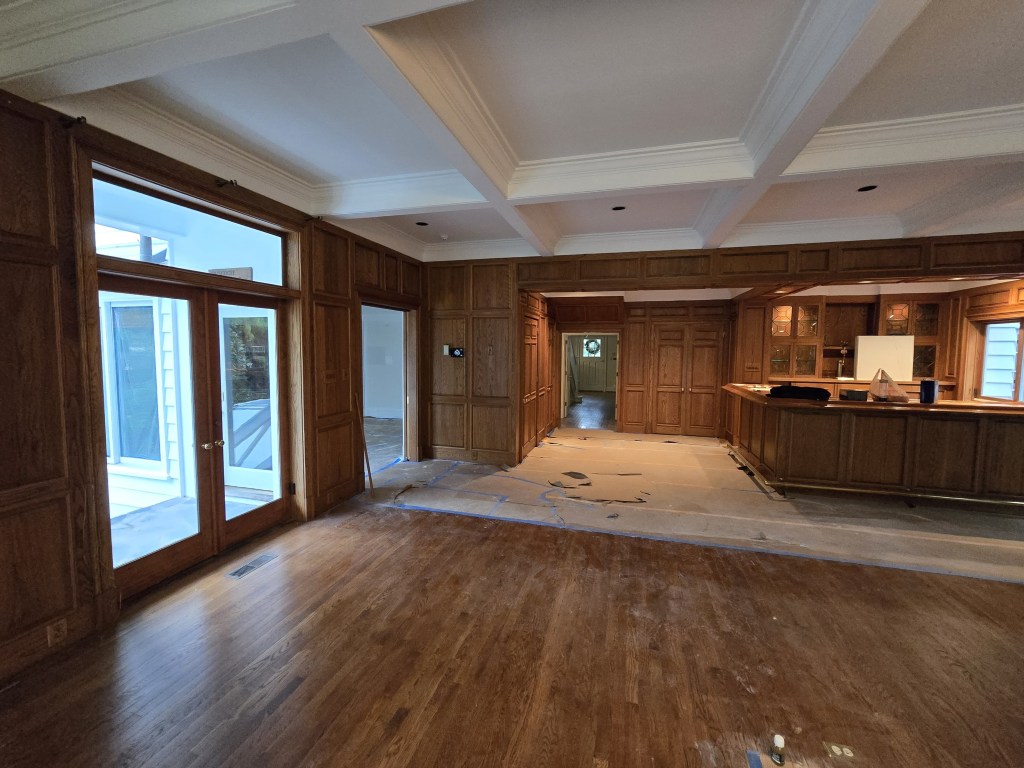
This white oak floor refinishing project was completed by Classy Flooring ATL, a premium hardwood flooring company serving Buckhead and the greater Atlanta area. The work documented on this page is an example of our hardwood floor refinishing service, which covers sanding, wood filler work, water popping, and finish application using premium systems including Rubio Monocoat.
Planning a refinishing project in Atlanta? Contact Classy Flooring ATL to discuss the scope.