
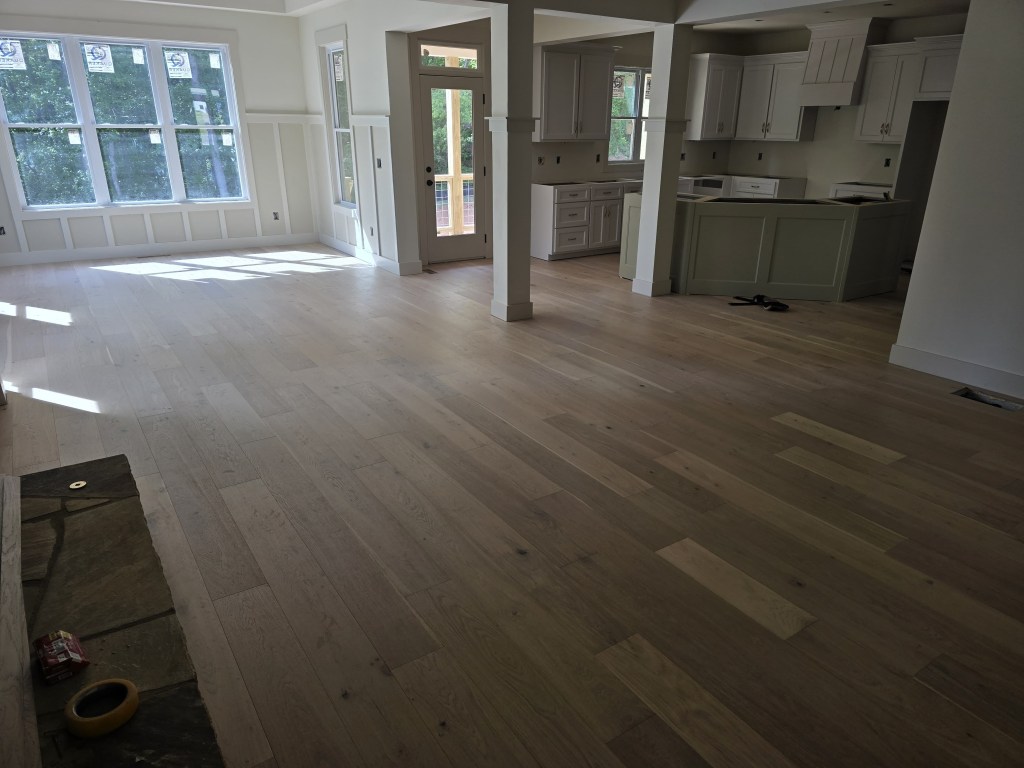

The subfloor decides first. Over plywood or OSB, hardwood is usually nailed down; over a concrete slab, it is glued, because a nail can’t hold in concrete. After that, the width and construction of the board, and the flooring manufacturer’s instructions, decide whether nails alone are enough or the floor needs adhesive working with them. Below is how Classy Flooring ATL makes that call on its own jobs across metro Atlanta, and the National Wood Flooring Association (NWFA) installation standard behind each decision.
When Hardwood Is Nailed Down
Nailing is the standard for solid hardwood over a wood subfloor. NWFA’s guidelines allow nail-down over any wood subfloor that meets their minimums except particleboard, and set the subfloor flatness at 1/4 inch in 10 feet or 3/16 inch in 6 feet. The fastener schedule follows the board. For 3/4-inch solid plank 3 inches and wider: a 15.5-gauge staple or a 16- to 18-gauge cleat, at least 1½ inches long, every 6 to 8 inches, with one placed 1 to 3 inches from each end joint. Narrower solid strip gets a fastener every 8 to 10 inches. Every board is nailed: NWFA’s minimum is two fasteners in each one.
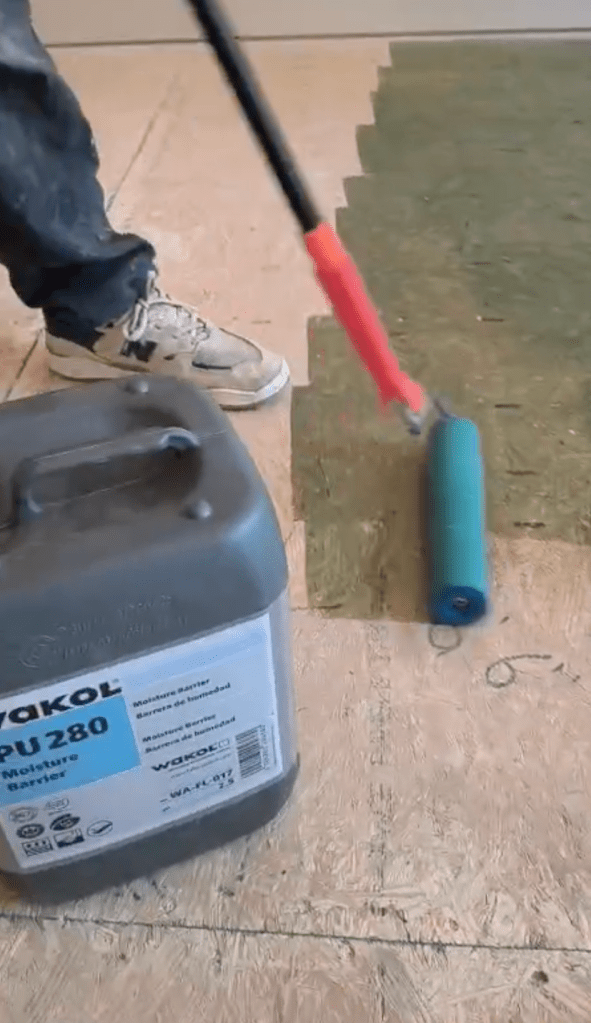
In an Alpharetta master bedroom, we converted carpet to 2¼-inch solid red oak strip. With the carpet, pad, and tack strips removed to bare plywood, we sanded the seams flush, screwed the subfloor where needed, and rolled on one coat of WAKOL PU 280 before nailing the red oak. The new floor was then sanded to 120 grit and finished on site to continue the red oak running through the rest of the home.

Do You Need Underlayment Under Nail-Down Hardwood?
Often, no. Under NWFA’s 2025 guidelines, a nail-down floor over a space kept at the same temperature and humidity as the living area needs no vapor retarder between the subfloor and the wood, unless the flooring manufacturer says otherwise. The same applies when the joists below already carry a Class I or Class II vapor retarder on their underside. Over an unconditioned space, such as a vented crawlspace, a Class II vapor retarder may be used to slow moisture moving up into the floor. A vapor retarder is never the answer to a known moisture problem; that problem is found with a moisture test and resolved first.
On plywood jobs like Alpharetta and Canton, we roll on a coat of WAKOL PU 280, a primer that also works as a moisture retarder on wood subfloors. Because it is rolled on and not laid as a sheet, adhesive can bond over it: at Canton, the flooring adhesive was troweled directly onto the primed plywood.
When Hardwood Is Glued Down
Over concrete, glue-down is the method. NWFA sets a tighter flatness standard for glue-down than for nail-down, 3/16 inch in 10 feet or 1/8 inch in 6 feet, because a glued board follows the surface it’s bonded to. The slab is moisture-tested on every job: NWFA calls for testing even when the adhesive doesn’t require it, and a slab’s age doesn’t predict its moisture. NWFA recommends an impermeable vapor retarder over every slab on or below grade. At an in-situ relative humidity above 80%, or a calcium chloride reading above 3 pounds per 1,000 square feet in 24 hours, the slab either gets that retarder, installed according to the adhesive manufacturer’s instructions, or more time to dry. Every wood flooring adhesive has to be elastomeric, meaning it stays flexible and holds its bond as the wood moves with the seasons. Coverage is checked by lifting boards during the install: unless the adhesive manufacturer says otherwise, NWFA calls for more than 95% adhesive transfer on solid wood and at least 80% on engineered, rising to 100% on solid and more than 95% on engineered when the adhesive also serves as the moisture control. Our post Hardwood Over Concrete Slab in Atlanta covers slab preparation in more detail.
At Chateau Elan, in-slab probes read 55 to 65%, under NWFA’s 80% line, and the slab still got a moisture barrier. We ground it, sealed it with two coats of WAKOL PU 280, and self-leveled it with WAKOL Z 231 where it needed it. We then glued down 2,000 square feet of 7-inch rift and quartersawn engineered white oak with WAKOL MS 260, an adhesive WAKOL approves for use directly over PU 280. The floor was then sanded flat and finished on site as one surface. On the 26th floor of The Atlantic at Atlantic Station, we bonded engineered hickory with WAKOL MS 230 over an acoustical underlayment that met the building’s IIC 54 requirement.
Glue-down isn’t limited to concrete. NWFA also allows it over a wood subfloor, held to the same 3/16-inch flatness. On the upper level of the Savannah penthouse residences, we added a 1/4-inch plywood overlay to the existing plywood as a flat, sound base, and glued the European Ash herringbone to it with the architect-specified Shaw TotalWorx LokWorx 35 MC, with no nails.
Can You Glue Down 3/4-Inch Solid Hardwood?
Yes. NWFA’s guidelines list solid strip and plank among the floors that may be glued down, as long as the subfloor, the moisture readings, and the adhesive meet the requirements above. The one limit is below grade: solid wood isn’t installed below ground level unless its manufacturer allows it.
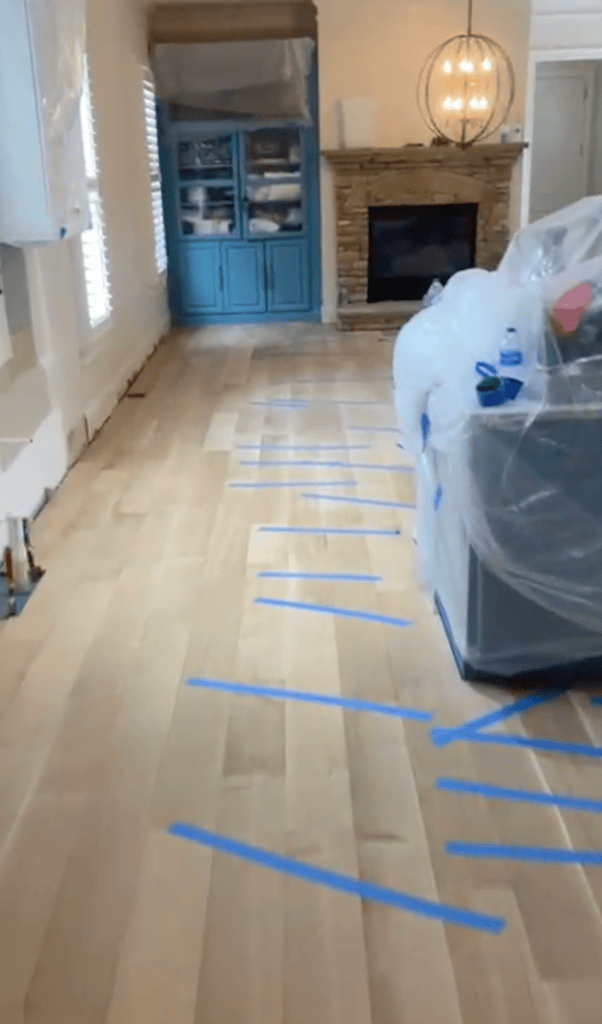
On the 21st floor of a Buckhead high-rise, we glued 4-inch by 3/4-inch solid white oak over concrete. The slab was ground and tested with in-situ RH probes at 55%, below NWFA’s 80% threshold. Roberts Natural Cork was adhered to the slab with WAKOL MS 260 to meet the building’s IIC 65 acoustic requirement, and the solid oak was glued to the cork with adhesive spread by a WAKOL B13 V-notch trowel. The raw floor was installed first, the general contractor finished the renovation over it for about a month, and we sanded and finished it last. That order also follows NWFA’s guidance to sand a glued floor only after the adhesive has cured and the wood’s moisture has returned to its pre-glue level.

Does 4-Inch Hardwood Need to Be Glued?
Not under NWFA’s guidelines. NWFA’s line is 5 inches: boards over 5 inches wide count as wide plank, and a 4-inch board is nailed on the normal plank schedule above. For wide plank, solid or engineered, NWFA recommends a glue-assisted nail-down when site conditions allow, unless the flooring manufacturer says otherwise. In a glue-assisted nail-down, the nails stay the primary fastener on their normal schedule, and adhesive adds holding power, applied in a pattern such as a serpentine bead covering each board’s length and width. With a trigger-activated nailer, the installer stands on each board as it is nailed so it can’t lift off the adhesive.
NWFA also recognizes a second combined method, nail-assisted glue-down, which works the other way around. The adhesive is spread full across the subfloor and does the primary work, and the fasteners only hold the boards while it sets, so NWFA gives this method no nailing schedule. It is a separate method, not NWFA’s wide-plank recommendation.
In Canton, we installed 2,740 square feet of 7½-inch RW Floors Kells European white oak, an engineered plank, over plywood as a nail-assisted glue-down: Bona R851 troweled full spread with the V-notch trowel its data sheet specifies, each board fastened with 1½-inch 18-gauge cleats, over a coat of WAKOL PU 280.
Should Engineered Hardwood Be Nailed or Glued?
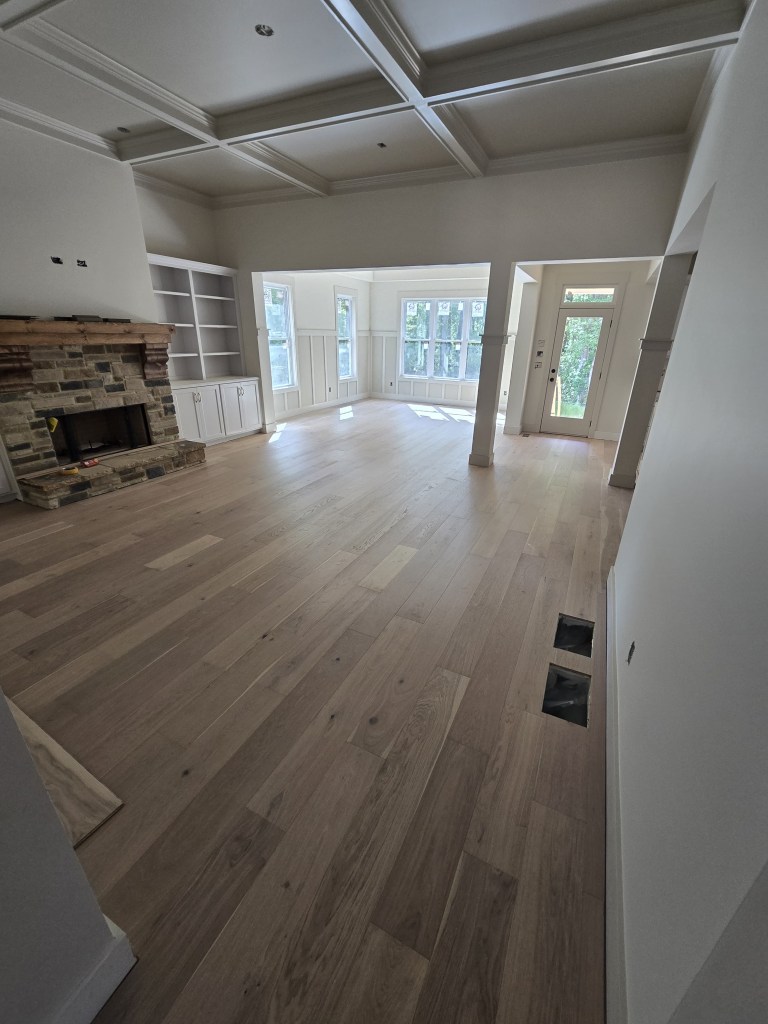
Either, depending on the subfloor and on the flooring manufacturer’s approved methods, which NWFA defers to for engineered flooring. Over plywood, engineered flooring is nailed on its own NWFA schedule unless the manufacturer says otherwise. For boards under 5/8 inch thick, that means an 18- to 20-gauge cleat or a narrow-crown 18-gauge staple, at least 1¼ inches long, every 3 to 4 inches; at 5/8 inch and thicker, the schedule matches solid plank. Over concrete, it is glued. Engineered is also the option below grade, where solid wood isn’t installed. At the Woodstock estate, we installed the same 9½-inch European white oak both ways, with MAPEI Ultrabond ECO 995: glue-down over the slab, sealed with two coats of WAKOL PU 280, and nail-assisted glue-down over the plywood, primed with one. Should You Glue and Nail Engineered Hardwood? walks through how the method is chosen on a specific project.How Long Before You Can Walk on Glued Hardwood Floors?
At least 24 hours, unless the adhesive manufacturer calls for longer. That is NWFA’s standard. On a floor that will be sanded and finished on site, the adhesive also needs time to finish curing and off-gassing before any finish is applied.
How Long Before You Can Walk on Glued Hardwood Floors?
It depends on the adhesive. NWFA’s default is at least 24 hours unless the adhesive manufacturer says otherwise, and the number that governs is the one on the adhesive’s data sheet. WAKOL MS 260, the adhesive used at Chateau Elan, allows light foot traffic after 6 to 8 hours and full traffic once it has fully cured, 24 to 48 hours depending on the room’s climate. On a floor that will be sanded and finished on site, the adhesive also needs to finish curing and off-gassing before any finish goes on.NWFA Training Behind Our Installations
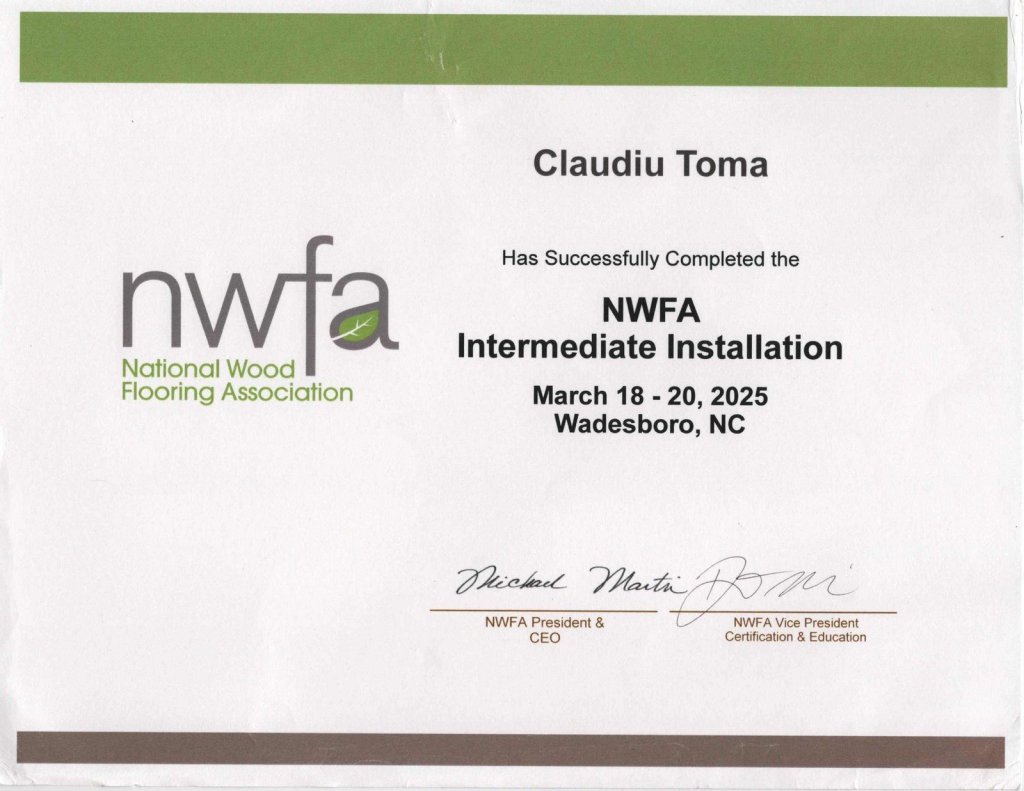
Claudiu Toma completed the NWFA Intermediate Installation course in Wadesboro, North Carolina, in March 2025. The course includes practice in nail-down, glue-down, and floating installation of solid and engineered flooring..
How Long Should Hardwood Sit Before Installing?
Acclimation is measured, not counted in days. NWFA’s guidelines have the home’s heating and cooling running at normal living conditions for at least five days before the flooring arrives. The flooring and the subfloor are then both tested with a moisture meter: at least 40 boards and 20 subfloor locations for the first 1,000 square feet. As a general rule of thumb for solid wood, the subfloor should read no more than 2 percentage points above the flooring for plank 3 inches and wider, and no more than 4 for strip under 3 inches. For engineered flooring, NWFA defers to the flooring manufacturer’s moisture requirements. When the readings line up and the home holds those conditions, the flooring can be installed right away. In Canton, the engineered flooring read 5.5% and the plywood 6.0% before installation began. For unfinished solid wood, NWFA adds 5 to 7 days after installation for the floor to stabilize before sanding and finishing, when the schedule allows.
NWFA Training Behind Our Installations
Claudiu Toma of Classy Flooring ATL completed the NWFA Intermediate Installation course in Wadesboro, North Carolina, in March 2025. The course includes practice in nail-down, glue-down, and floating installation of solid and engineered flooring.
Claudiu Toma completed the LOBA WAKOL Connected Systems course at LOBA-WAKOL in Wadesboro, North Carolina, in March 2026. The course covers WAKOL substrate preparation and installation adhesives, the product line behind the PU 280, MS 260, and MS 230 on the jobs above.

Each of these installations is documented in full on our Our Work page, with the materials, subfloor preparation, and finish system for every project. For installation over plywood or concrete in your own home, see our engineered and prefinished hardwood installation page or contact us.