
Matching New Red Oak to Existing Hardwood Floors — Installation in Alpharetta, GA
Classy Flooring ATL installed a solid red oak floor in a master bedroom in Alpharetta, Georgia, completed in June 2026. The room had been carpeted; the rest of the house was already red oak, so the work was scoped to install new 2¼-inch No. 1 Common red oak, then sand and finish it with DuraSeal Early American stain under a LOBA waterborne system so the bedroom reads as the same floor as the rooms around it. The boards were installed unfinished so the stain color could be selected and applied on site to meet the color of the existing red oak.
Project overview
The project was a single 220-square-foot master bedroom, converted from carpet to solid hardwood to continue the red oak already running through the rest of the home. Because the surrounding floors set a fixed color target, the job was handled as one continuous sequence — subfloor preparation, nail-down installation, on-site sanding, staining, and finishing — with the existing floor as the reference the new floor had to meet. Classy Flooring ATL supplied and installed the flooring, the shoe molding, and the finish, and returned after the finish had set to move the furniture back in.
Matching the existing floors
The existing floors set the target. The rest of the home is red oak, so the bedroom was installed in the same species and the same 2¼-inch boards, unfinished, so the color could be set on site. The color of a finished floor comes from the species together with the stain and topcoat, so the new red oak was stained with DuraSeal Early American, the color chosen to bring it to the existing floors, then sealed with one coat of LOBA EasyPrime and topcoated with two coats of LOBA 2K Duo in a satin sheen.
Surface preparation — subfloor
The exposed plywood was prepared as the base for a nail-down installation. The seams between the plywood sheets were sanded flush with the edger and the surface was buffed to knock down high spots, so no raised edge sits under the new floor; NWFA’s installation guidelines level high spots at panel seams the same way, with an edger or buffer. Screws were driven where needed to pull the plywood tight to the framing and secure any panel that had movement. NWFA calls for movement and noise in a wood subfloor to be addressed before installation, because a hardwood floor does not stiffen the subfloor beneath it.
One coat of WAKOL PU 280 was then applied across the prepared plywood. Over a plywood subfloor, PU 280 functions as a substrate primer and moisture retarder: the single coat conditions the plywood surface and reduces moisture exchange between the subfloor and the new red oak above it, so seasonal moisture movement in the subfloor is less likely to reach the finished floor.

Installation
The floor is solid red oak, 2¼-inch boards, No. 1 Common grade, installed nail-down. The red oak was stored in the house for a couple of days before installation. NWFA measures acclimation by moisture content rather than by days: solid flooring can be installed once its moisture content, the subfloor’s, and the room’s temperature and humidity are in line, and for solid boards under 3 inches wide NWFA’s general rule of thumb is a subfloor no more than 4 percentage points wetter than the flooring. A solid floor installed in line with the room it serves is less likely to gap or cup afterward.
Over a plywood subfloor, solid boards of this width are usually installed nail-down: each board is blind-nailed through the tongue into the subfloor, which hides the fastener in the joint and holds the board mechanically to the plywood. NWFA recommends adding adhesive to the nailing — the glue-assisted nail-down method — on solid and engineered boards wider than 5 inches when site conditions allow, unless the flooring manufacturer recommends otherwise. At 2¼ inches, NWFA’s standard nailing schedule applies on its own, so this floor was fastened by nailing alone over the primed plywood.
Sanding
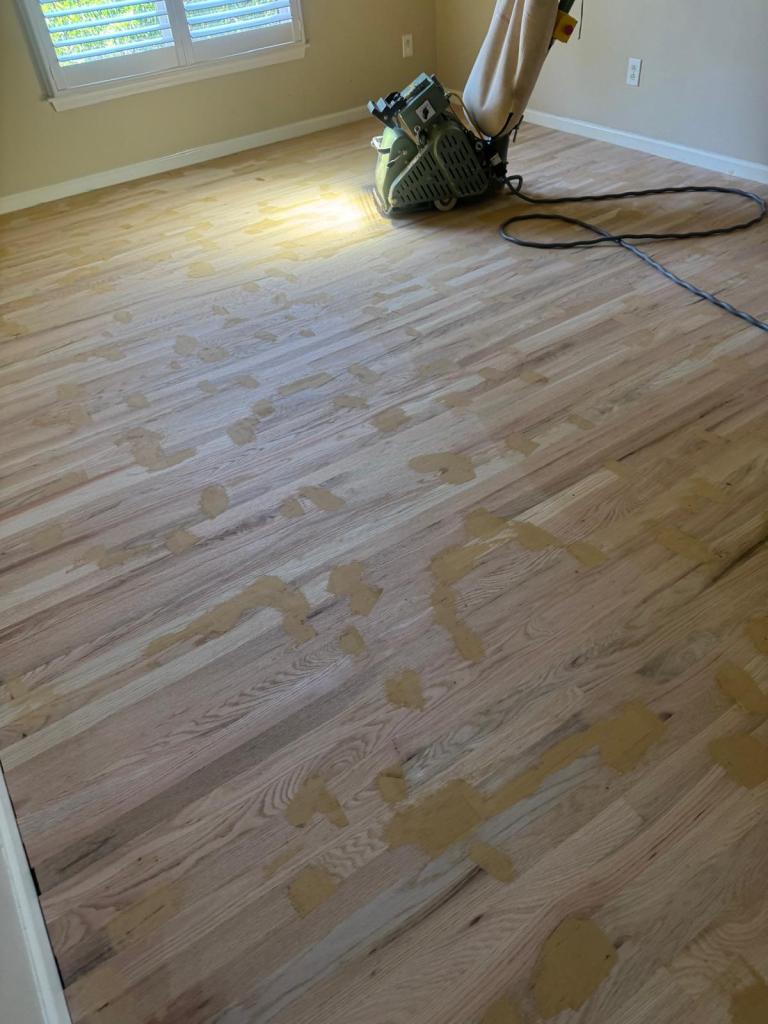
Once the floor was installed, it was sanded flat and brought to finish grit. The belt sander and edger made the first cuts at 40, 60, and 80 grit, leveling the newly installed boards and the small height differences between them that come with any nail-down floor. Wood filler was troweled across the floor during those cuts to fill the nail holes and the minor gaps between boards; NWFA calls for filling before the final sanding cut, so the filler is sanded flush and the surface finishes as one continuous plane. The surface was then refined with the FG Floortec Discus planetary sander at 100 and 120 grit, finishing at 120. NWFA’s sand-and-finish guidelines call for the final sanding sequence to be fine grit or higher, with no grit skipped in the fine and extra-fine range; 40 through 120 steps up one grit at a time. The Discus heads rotate independently of the machine and cross the boards in every direction, so the final scratch pattern is even across the room — which lets the stain absorb uniformly, and the color match depends on that.

Finish application
The floor was stained with one coat of DuraSeal Early American, the color chosen to match the existing red oak in the rest of the house. Once the stain was completely dry, as NWFA requires before any finish is applied, one coat of LOBA EasyPrime was applied as the sealer. EasyPrime is a water-based polyurethane-acrylate sealer that LOBA formulates to reduce side bonding and the white-line effect at the board joints — on 2¼-inch boards, a joint every 2¼ inches. NWFA’s guidance against side bonding is the same step: a sealer recommended by the finish manufacturer, applied before the rest of a waterborne system. Two coats of LOBA 2K Duo followed as the wear coats. LOBA 2K Duo is a two-component water-based polyurethane: the hardener is mixed into the base at 10 to 1 on site, and LOBA formulates the finish for high wear resistance.
The finish was held to a satin sheen throughout, matching the sheen of the surrounding floors. Each coat dried to its manufacturer’s data sheet before the next was applied; LOBA’s data sheet for 2K Duo sets the recoat time at 2 to 3 hours and full cure at 5 days.
Additional scope — shoe molding and reinstallation
After the floor was finished, Classy Flooring ATL installed white-primed quarter round around the perimeter and painted it to match the existing baseboard; the material and the labor for the shoe molding and painting were supplied by Classy Flooring ATL. The quarter round covers the expansion space left at the walls — the room a solid floor needs for seasonal movement, which NWFA generally sets at the thickness of the flooring — while keeping the trim line consistent with the rest of the room.
Once the finish had set, the crew returned to move the furniture back into the bedroom and placed felt pads under every piece before it was set down, so the finished floor is protected from the furniture at the point where it is most likely to be scratched.
Project specifications
| Service | Solid hardwood floor installation + sand and finish |
| Location | Alpharetta, GA |
| Scope | Master bedroom — carpet removed, new hardwood installed to match the rest of the house |
| Size | 220 sq ft |
| Material | Solid red oak, 2¼-inch boards, No. 1 Common grade |
| Installation method | Nail-down (blind-nailed), no glue |
| Subfloor | Plywood — seams sanded flush, surface buffed, screwed where needed |
| Substrate primer | WAKOL PU 280, 1 coat (substrate primer / moisture retarder over plywood) |
| Acclimation | On site in the home, a couple of days before installation |
| Sanding | Belt sander + edger at 40, 60, and 80 grit; FG Floortec Discus planetary at 100 and 120 grit; final 120 |
| Stain | DuraSeal Early American, 1 coat (color-matched to existing floors) |
| Sealer | LOBA EasyPrime, 1 coat |
| Topcoat | LOBA 2K Duo (two-component waterborne), 2 coats |
| Sheen | Satin |
| Shoe molding | White-primed quarter round, installed and painted to match baseboard (material + labor by Classy Flooring ATL) |
| Reinstallation | Furniture moved back; felt pads placed under every piece |
| Completed | June 2026 |
The finished floor
With the finish set, the new floor carries the home’s red oak into what had been a carpeted bedroom. It is the same species and the same 2¼-inch boards as the floors in the rest of the house, stained DuraSeal Early American to their color and finished with LOBA EasyPrime and two coats of LOBA 2K Duo in the same satin sheen, so the color and grain continue from the adjoining rooms into the bedroom.
Frequently asked questions
Can you match a new hardwood floor to the existing floors in the rest of the house?
Yes, when three things line up: the same species and board width, boards installed unfinished, and a stain color and sheen selected against the existing floor. The existing floor is the reference, not the stain name, because wood changes color with light exposure over time — NWFA rates red oak’s sensitivity to light as low to moderate — so the color that matches is the one that matches the floor as it looks today. NWFA’s sand-and-finish guidelines call for testing a stain for color before it is applied to the whole floor. In this Alpharetta bedroom, the rest of the house was red oak, so the new floor was 2¼-inch red oak boards, stained DuraSeal Early American, sealed with LOBA EasyPrime and finished with two coats of LOBA 2K Duo in satin to match.
Can you replace carpet with hardwood in one room and match the rest of the house?
Yes. The carpet, pad, and tack strips are removed down to the plywood, the subfloor is prepared, and new hardwood in the same species as the existing floors is installed and finished to the existing color. Here, a carpeted master bedroom was converted to 2¼-inch red oak and finished to match the red oak already running through the home.
Do the existing floors have to be refinished too, or just the new room?
Not necessarily. Sanding and finishing the old and new floors together gives the closest match, because one stain and one finish go across both at the same time — which matters most where the two floors run together through an open space. When the new floor is a separate room that meets the existing floors at a doorway, only the new room needs to be sanded and finished, as long as it is the same species and its stain color and sheen are matched to the existing floor. NWFA reserves a full sand-and-refinish for dents, wear patterns, permanent cupping, or a change of color. That is what was done here: the bedroom was sanded and finished on its own and carries the matched color across the threshold, and the rest of the home’s floors were not refinished.
Is a 2¼-inch red oak floor nailed down or glued?
Over a plywood subfloor it is usually nailed down; directly over a concrete slab it is glued. Nailed, each board is blind-nailed through the tongue into the subfloor, so the fasteners sit hidden in the joints. NWFA’s standard schedule for ¾-inch solid boards under 3 inches wide is a 15.5-gauge staple or a 16- to 18-gauge cleat at least 1½ inches long, every 8 to 10 inches and 1 to 3 inches from each end joint, with at least two per board, unless the flooring manufacturer specifies otherwise. NWFA recommends adding adhesive to the nailing — the glue-assisted nail-down method — for boards wider than 5 inches; at 2¼ inches the nailing schedule applies on its own. Glued over concrete, NWFA requires an elastomeric wood flooring adhesive. On this job the red oak was nailed over the primed plywood subfloor.
Does the sheen have to match, or just the color?
Both. Even with an identical stain color, a different sheen — satin next to semi-gloss — catches light differently and makes the new floor stand out. Matching an existing floor means matching its sheen as well as its color. This floor was finished in satin to match the surrounding floors.
Does Classy Flooring ATL install hardwood in Alpharetta and the rest of metro Atlanta?
Yes. Classy Flooring ATL installs and finishes hardwood in Alpharetta and across the Atlanta metro area, including Buckhead, Sandy Springs, Brookhaven, Dunwoody, Roswell, Johns Creek, Milton, and Braselton.
About this project
This red oak installation was completed by Classy Flooring ATL, a premium hardwood flooring company serving Alpharetta and the greater Atlanta metro area. The work documented on this page is an example of our hardwood floor installation service, which covers new solid and engineered hardwood installation, subfloor preparation, on-site sanding and finishing, and color-matching new floors to existing ones. More completed projects across metro Atlanta are collected in our work.
This Alpharetta floor is the nail-down example in Should Hardwood Floors Be Nailed or Glued?, which walks through how the installation method is chosen for each subfloor.
Planning a hardwood installation in Alpharetta or the surrounding Atlanta area? Contact Classy Flooring ATL to discuss the scope.