

Versailles parquet flooring is a wood floor laid in square panels, each made of diagonal and straight slats interwoven inside a square border. The pattern dates to 1684, when it replaced marble floors at the Palace of Versailles; the marble needed constant washing, which rotted the wood joists beneath it. Versailles panels are made two ways: in a factory, often as prefinished engineered panels, or by hand, piece by piece in a shop. This article covers handmade panels, which are installed unfinished, then sanded and finished on site.
Handmade and Factory-Made Versailles Panels
The original Versailles panels were built entirely by hand: solid oak, joined with mortises, tenons, and dowels, assembled without glue, and finished with wax. Many panels sold today are factory-made in a few stock sizes, often as engineered panels with a hardwood wear layer on a plywood base, prefinished at the factory.
A handmade panel is cut and assembled one panel at a time in a shop. Because each panel is built to order, its size and wood species can be set for the room. The panels arrive unfinished, so after installation the floor is sanded flat and finished as one surface.
How a Versailles Panel Is Built
Each panel is a square: a perimeter frame surrounding slats that cross on the diagonal and interlock at the center. In a handmade panel, every slat is cut to the same length and angle as its match in the next panel, so the pattern lines up across the whole floor. Jigs and sleds hold each cut to a repeatable dimension, which is how a shop keeps every panel in a floor identical.
Panel sizes vary. Historic panels ran from about 800 mm to 1,150 mm square (31 to 45 inches), and European panels today are commonly about 100 cm, roughly 39 inches. Panels can be laid square to the walls or on a 45-degree diagonal. A diagonal layout suits irregular rooms and produces more waste from cut panels.
What Is the Lifespan of Parquet Flooring?
A parquet floor lasts as long as its wood can be sanded and refinished. The thicker the sandable wood layer, the more times the floor can be sanded; an engineered panel’s limit is the thickness of its wear layer. The finish wears first. Hardwood finishes generally lose their luster after 10 to 15 years and are renewed by recoating or refinishing.
What Are the Downsides of Parquet Flooring?
Moisture. A parquet floor has many more joints than a plank floor, and each joint is a place where water can reach the wood. Spills get wiped up promptly, and parquet stays out of bathrooms and other wet areas.
Sanding. The grain changes direction from piece to piece. Sanding parquet straight, the way a strip floor is sanded, digs out the softer wood in the pieces running across the machine and leaves humps. Parquet is sanded at angles to the pattern, or with a multi-head machine that cuts evenly in every direction.
Repairs. A replacement piece has to match the original’s species, size, and grain direction so the pattern still reads correctly.
Can You Mop a Parquet Floor?
Yes, with a damp mop, not a wet one. Wring the mop until it is barely damp, use a pH-neutral cleaner made for wood floors, and dry any water left on the surface. Standing water and steam mops push moisture into the joints between the pieces, where it can swell the wood and loosen the bond.
Parquet Work at Classy Flooring ATL
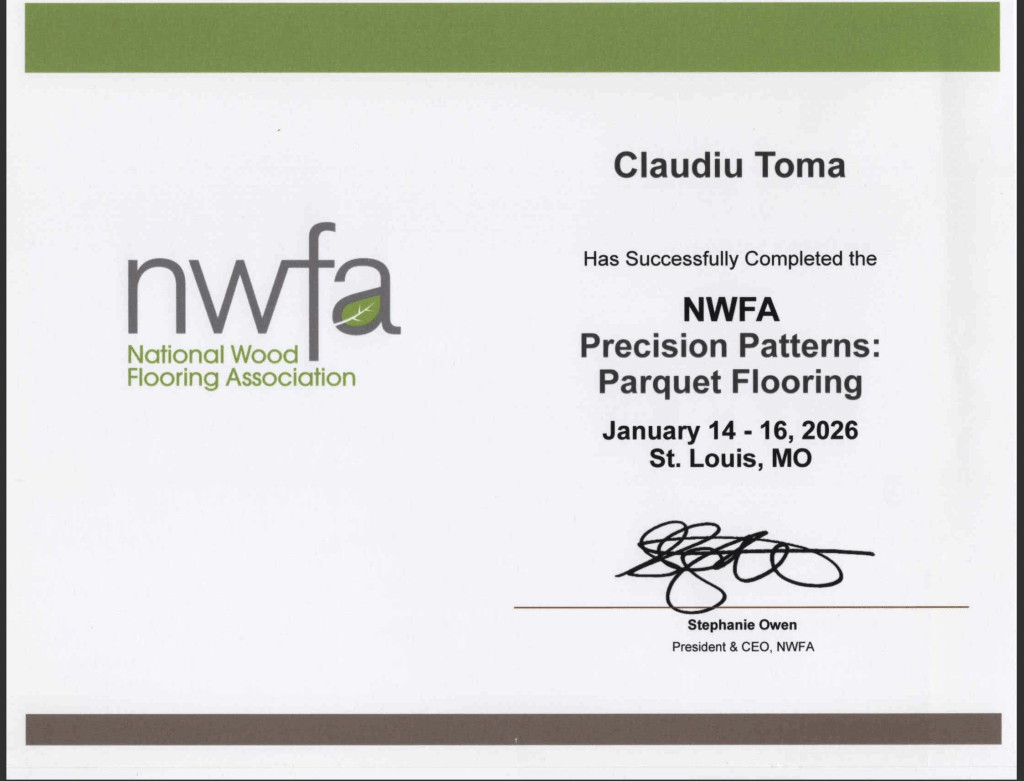
Claudiu Toma completed the NWFA Precision Patterns: Parquet Flooring course in St. Louis, Missouri, in January 2026. The course covers traditional parquet panel construction, including Versailles-style pattern work, and building the custom sleds and jigs used to cut parquet pieces to repeatable dimensions.

Classy Flooring ATL builds Versailles parquet panels by hand in its shop and installs them in clients’ homes across the Atlanta area as part of its custom pattern installations. See our custom hardwood pattern installation page, read What Is a Floor Medallion?, or contact us to discuss a parquet floor.