A floor medallion is a decorative inlay set flush into a floor to form its focal point. In a hardwood floor, the medallion is built from pieces of several wood species, fitted together into a pattern such as a star or compass, and set into an opening cut in the surrounding floor so both surfaces sit level. Floor medallions are also made from stone, tile, glass, and metal; this article covers wood.
What a Hardwood Floor Medallion Is Made Of
The color in a wood medallion comes from the wood itself. Each design is cut from species with different natural colors, so the pattern shows through the contrast between the pieces. Factory-made medallions are assembled on a plywood backing for stability. One manufacturer builds its standard medallions from a 5/16-inch solid wood top layer glued to Baltic birch plywood; another supplies its standard medallion unfinished at 3/4 inch thick.
Common Medallion Designs
Medallion designs range from geometric stars and compass roses to family crests and business logos. Round, oval, square, and irregular outlines are all used.
Hand-Built and Factory-Cut Medallions
A factory-made medallion is cut by machine, glued into a finished panel, and shipped with a router template made to match that medallion. Manufacturers typically quote four to six weeks from order to shipping for a custom design.
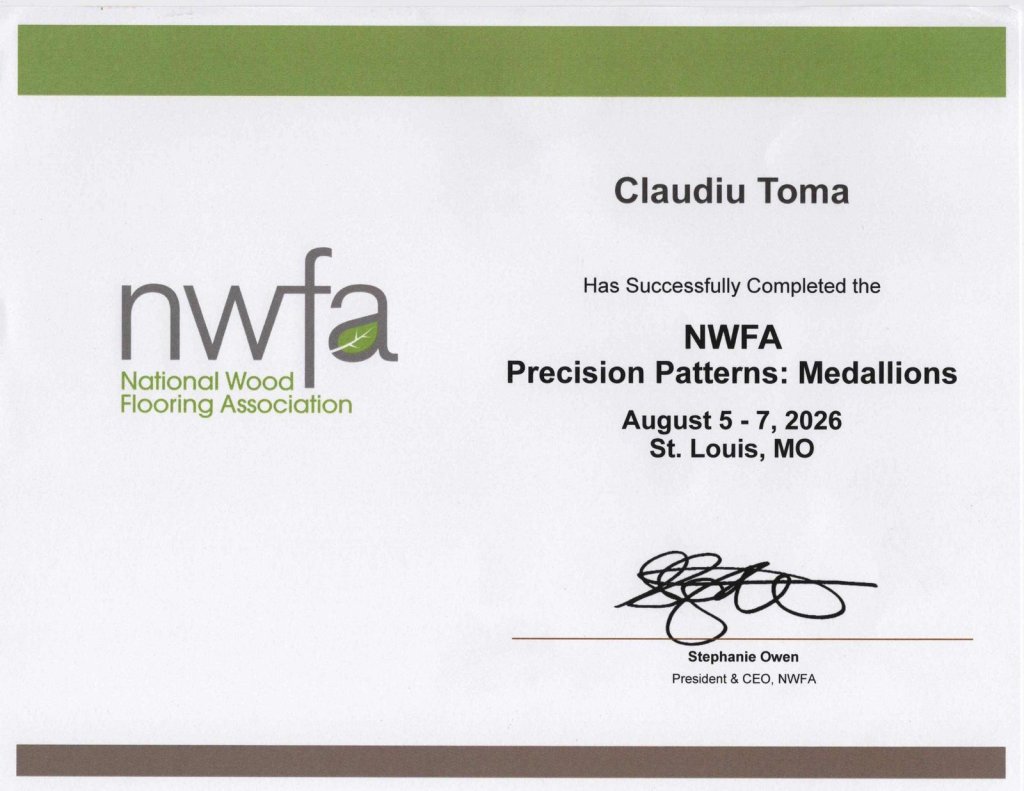
A hand-built medallion is laid out, cut, and assembled by the installer. The NWFA teaches this in its Precision Patterns: Medallions course, an in-person course for experienced wood floor professionals that covers producing medallion styles by hand, including medallion symmetry, mosaics, and other decorative elements that form the focal point of a floor design. Claudiu Toma of Classy Flooring ATL completed the course in St. Louis, Missouri, in August 2026 and built the star medallion shown below during it.
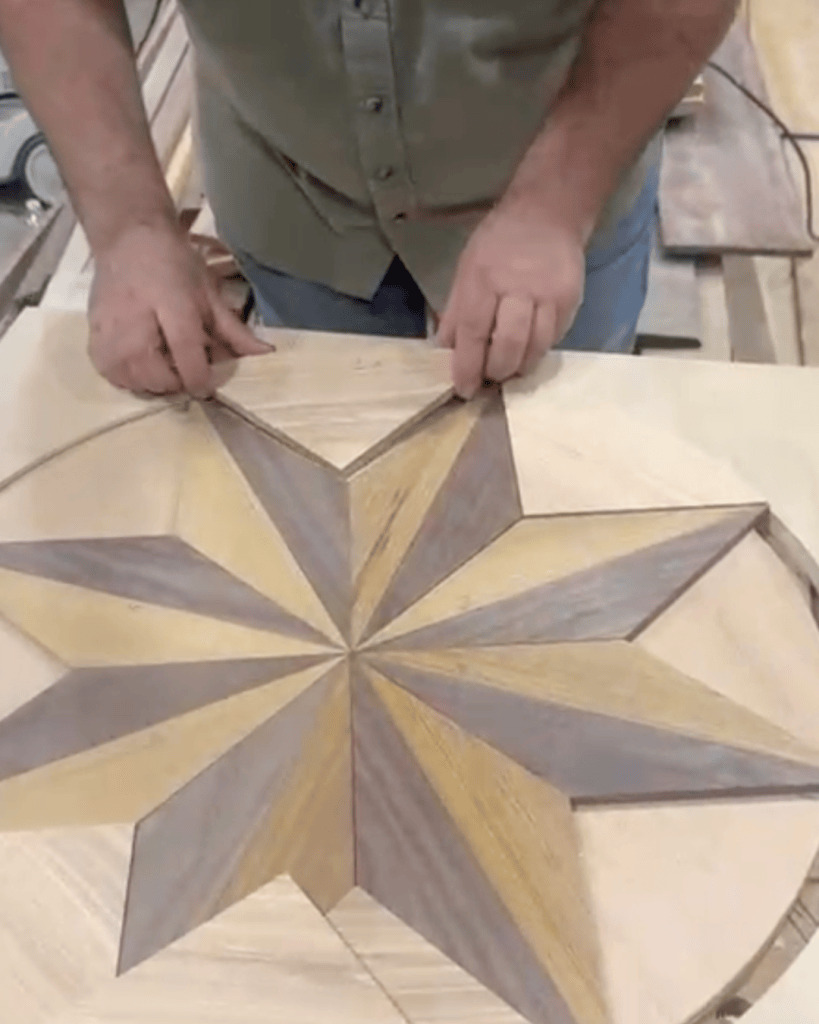
course.
How a Medallion Is Set Into a Hardwood Floor
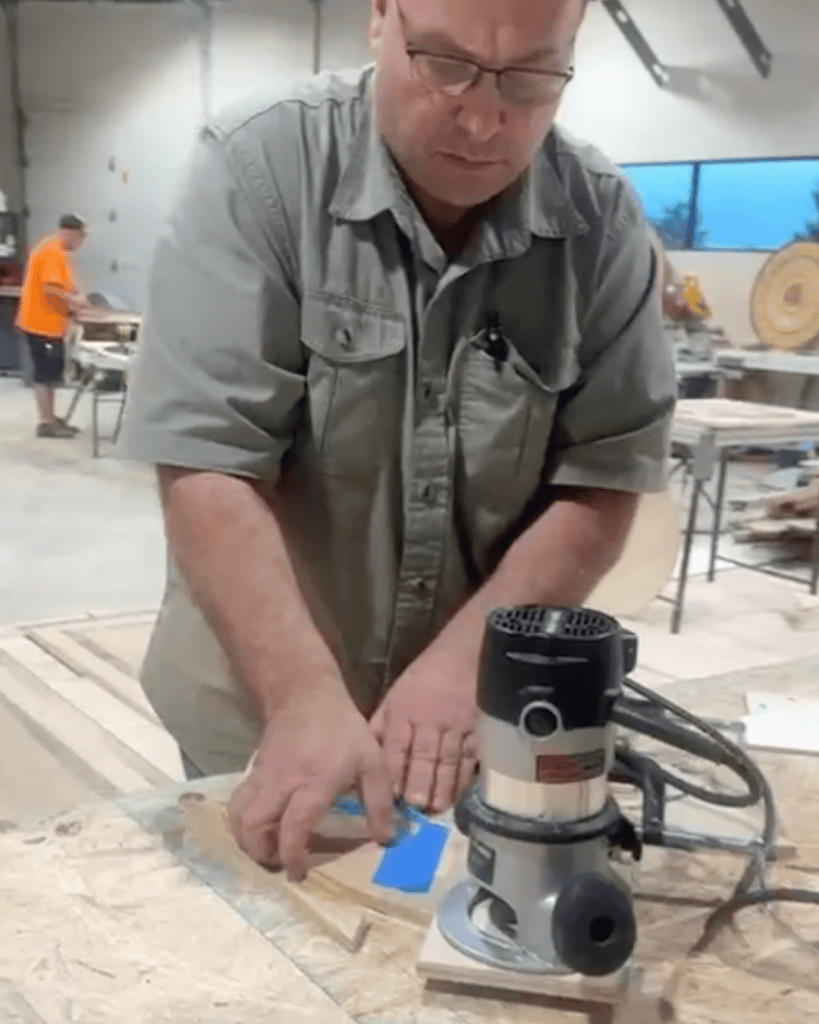
The medallion goes into an opening cut to its exact shape, down to the subfloor. A factory-made medallion is first acclimated to the home as its manufacturer directs, with the heating and cooling running at normal living conditions. In an existing floor, the nails and staples in that area are located first with a magnet. A router then follows a template fastened to the floor, or, for a round medallion, swings on a pivot arm fixed at the center point. NWFA’s ornamental guidelines start the router at 1/8 to 1/4 inch deep and take three or four passes or more down to the subfloor. The medallion goes in as soon as possible after routing, because the surrounding floor can close up around the opening. It is dry-fit to check that it sits flush, then glued down, with the adhesive spread to the thickness that brings it level with the floor, and weighted while the adhesive sets. Any small gaps are closed with slivers of wood or matching filler. The same method applies to a new floor or an existing one.
On an unfinished floor, the medallion is sanded and finished with the rest of the floor, but only once the adhesive has cured and the wood’s moisture has returned to its pre-glue level, and the finish goes on only after the adhesive has dried and off-gassed. Because a medallion’s grain runs in several directions, NWFA’s ornamental guidelines keep the drum sander off small inlay areas: they are cut with the edger, then with a hard plate or multi-disc sander. NWFA also notes that a roller can prevent streaks from the finish’s matting agents on a multidirectional pattern. On the herringbone floor in a Buckhead high-rise, the final grits, 100 and 120, were refined with the FG Floortec Discus planetary sander, whose multi-directional motion suits grain running more than one way, and LOBA EasyPrime and LOBA 2K Duo went on by roller, per LOBA’s specification.
A medallion combines several wood species that move by different amounts as humidity changes, so it reacts to humidity swings more than a plank floor does. Steady indoor humidity keeps the joints between the pieces tight after installation. When the flooring manufacturer doesn’t set a range, NWFA’s is 30 to 50% relative humidity at 60 to 80°F, with a humidifier in the dry, heated months and a dehumidifier in the humid ones. Metro Atlanta falls in NWFA’s warm-humid climate zone.
Where Floor Medallions Are Placed
Medallions are most often placed where a room already has a center of attention: an entry or foyer, the middle of a large open room, beneath a dining table, or on a stair landing. One medallion maker sizes a medallion at about a third of the room’s width. NWFA has the homeowner approve and sign off on the exact position before any cutting, checked against the walls, vents, doorways, and furniture, because once the opening is routed, the medallion can’t be moved. Every Classy Flooring ATL project starts with Claudiu’s in-person visit and a written plan for the job before anything is scheduled; our How We Work page walks through each step.
Medallion Work at Classy Flooring ATL
Classy Flooring ATL takes on medallion work as part of its custom pattern installations in the Atlanta area, alongside herringbone, chevron, and custom border work. The router work behind a medallion runs through our other inlay and border installations. At the Woodstock estate, 214 linear feet of solid brass were set flush into routed channels in the European white oak. In the Buckhead high-rise, the 7-inch border’s tongue-and-groove profile was cut with a router and its corners were mitered at 45 degrees. What Is Inlay Flooring? covers inlay work more broadly, and What Is Versailles Parquet Flooring? covers the parquet panels built in our shop. See our custom hardwood pattern installation page for completed projects, or contact us to discuss a medallion for your floor.