Classy Flooring ATL

Reclaimed Heart Pine Floor Restoration with Wide Gap Filling in Big Canoe, GA

Classy Flooring ATL restored a 1,200 square foot reclaimed heart pine floor in Big Canoe, Georgia, with board gaps measuring from approximately 1/8 inch to 5/8 inch. Every gap was filled with Berger-Seidle AquaSeal PAK-Stop, a high-elastic trowel filler that remains flexible after curing and accommodates seasonal board movement. The filler was colored on site with AquaSeal Pafuki Powder and troweled edge to edge across the full floor in two coats, 24 hours apart. No joint required a third coat, including the widest at 5/8 inch. The floor had also been sanded close to the tongue during a previous refinish, which left more than 75 locations of lifted and splintered wood. Classy Flooring ATL bonded each of those repairs with cyanoacrylate glue and spray activator. No boards were replaced anywhere on this floor. The project totaled 2,400 square feet across three species and was completed by a three-person crew in ten working days.

Project Overview

This project covered three separate hardwood floors in one home: 1,200 square feet of century-old reclaimed heart pine, 950 square feet of new southern yellow pine that had never been sanded, and 250 square feet of existing white oak herringbone. The heart pine carried the conditions that defined the project — wide board gaps, a failed oil-based polyurethane, splintering along board edges and ends, and a wear layer already reduced by more than half during a previous refinish. The southern yellow pine and the white oak were finished with a second stain color selected to bring all three floors to the same tone, so the house reads as one continuous floor across doorways where no transition strips are installed.

This Big Canoe project is one of Classy Flooring ATL’s documented hardwood restoration projects — wide-gap filling, splinter stabilization, and multi-species color matching on reclaimed heart pine. See the full range of our work on our Our Work page.

Project type: Hardwood floor refinishing and restoration — no floor installation

Location: Single-family home, Big Canoe, Georgia

Scope: 2,400 square feet — reclaimed heart pine, new southern yellow pine, white oak herringbone; basement stair treads and risers included; basement floor not in scope

Crew: Three, Classy Flooring ATL in-house

Duration: 10 working days

Year: 2026

Starting Condition

Reclaimed heart pine — 1,200 sq ft. Kitchen, dining, living room, enclosed porch, garage hallway with bathroom, and a secondary hallway. Over a century old and finished in an oil-based polyurethane that had failed. The floor was not flat. Board gaps measured from approximately 1/8 inch to 5/8 inch.

This floor had been refinished before and taken down close to the tongue. On most boards, more than half of the usable wear layer above the tongue was gone. Where the remaining material above the tongue becomes thin, the board edges lose support and begin to lift and splinter, and that condition was present across more than 75 locations on this floor.

Southern yellow pine — 950 sq ft. Master bedroom, master closet, and rear office. A new floor that had never been sanded. This area required finishing, not refinishing.

White oak herringbone — 250 sq ft. Entry hallway. Existing floor, refinished.

The subfloor was sound throughout with no structural issues found. The floors run directly into one another with no transition strips at the species changes. The home was unoccupied for the duration of the work.

The homeowner had been advised previously that the gaps in the heart pine could not be addressed.

Reclaimed heart pine flooring under failed oil-based polyurethane before refinishing, looking toward the porch doors, Big Canoe, Georgia
The reclaimed heart pine as found, looking toward the porch doors. The existing oil-based polyurethane had failed, and the floor carried surface variation across the full run.
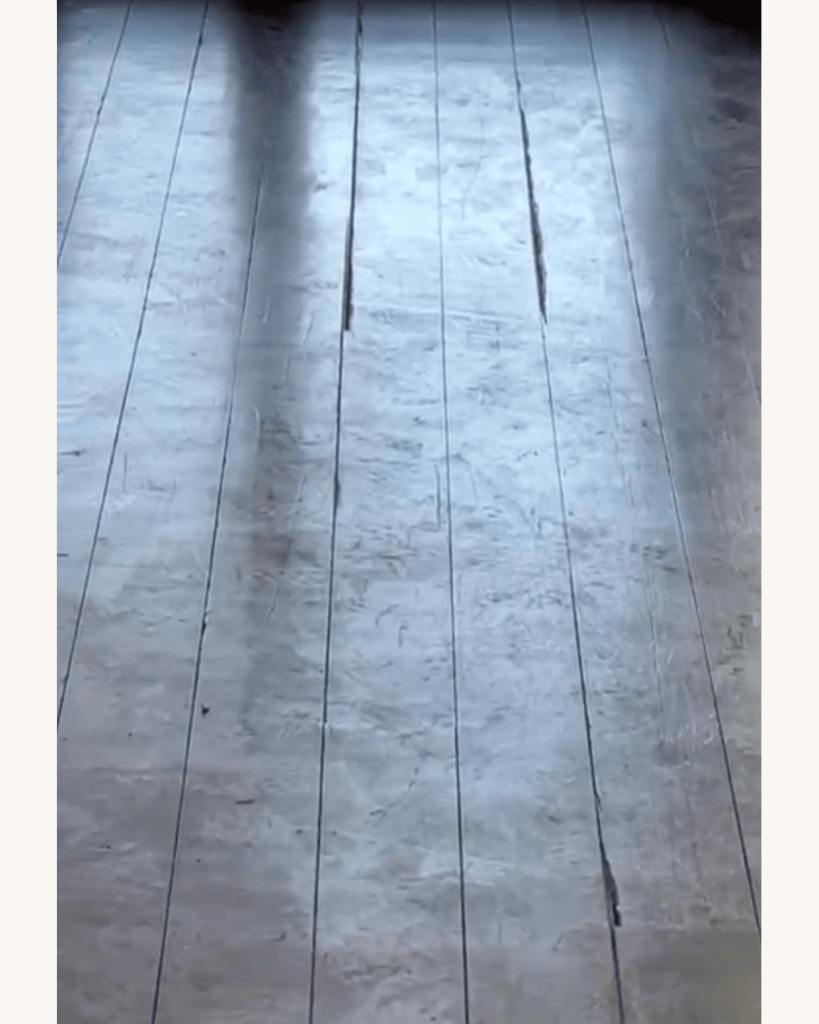
Reclaimed heart pine flooring with open board gaps and worn oil-based polyurethane before refinishing, Big Canoe, Georgia
The reclaimed heart pine as found. Board gaps across this floor measured approximately 1/8 inch to 5/8 inch, and the existing finish was an oil-based polyurethane that had failed.

Why the Gaps Were Filled on This Project

Board gaps in a plank floor are not automatically a defect. Narrow, stable, evenly distributed gaps are a normal characteristic of plank flooring and are frequently left open. Filling becomes appropriate when the gaps are wide enough to collect debris and catch furniture, when the gap widths across the floor are irregular, or when the floor is being fully refinished and the gaps would otherwise remain the one unaddressed condition.

The methods commonly used to close gaps have known limits in wide joints.

Rope or jute pressed into the gap closes the void. It does not produce a continuous surface that can be sanded and finished with the floor.

Wood slivers cut and glued into the joint are effective on a stable floor. On a floor with seasonal movement, a rigid sliver bonded to both board faces can split or transfer that movement to another point along the board run.

Sawdust mixed with glue is suited to hairline joints. In a joint measured in eighths of an inch, the mixture shrinks as it dries and can settle below the surface and release as the boards move.

Rigid commercial filler cures hard. As the boards move, it can release from one board face or fracture through the middle.

In each of these methods a rigid material is bridging a joint that moves. Wood is hygroscopic and responds to seasonal humidity regardless of what occupies the gap. On this floor, with joints from 1/8 inch to 5/8 inch across 1,200 square feet, the requirement was a filler that remains elastic after curing and absorbs that movement.

How This Project Was Executed

  1. Evaluated the floor and measured the gap widths across the reclaimed heart pine
  2. Built two pine sample pieces in the shop, filled with AquaSeal PAK-Stop and AquaSeal Pafuki Powder, and applied stain colors to them
  3. Presented the sample pieces to the homeowner for approval of the filler color and stain direction
  4. Opened the heart pine with the first cut at 36 grit
  5. Bonded 75+ splintered and lifted board sections with Stick Fast cyanoacrylate glue and spray activator
  6. Completed the sanding sequence to receive filler — 60 grit with the belt machine, then 60 grit with the planetary sander
  7. Mixed AquaSeal PAK-Stop with AquaSeal Pafuki Powder in black and troweled it edge to edge across the full floor
  8. Allowed 24 hours, applied a second full coat, allowed a further 24 hours
  9. Sanded the cured filler back — 36, 60, 80, then 100 and 120 with the planetary sander
  10. Sanded the new southern yellow pine — 40, 60, 80, then 100 and 120 with the planetary sander
  11. Sanded the white oak herringbone through the same sequence as the plank floors
  12. Placed three stain samples at the junction of the two pine floors for homeowner selection
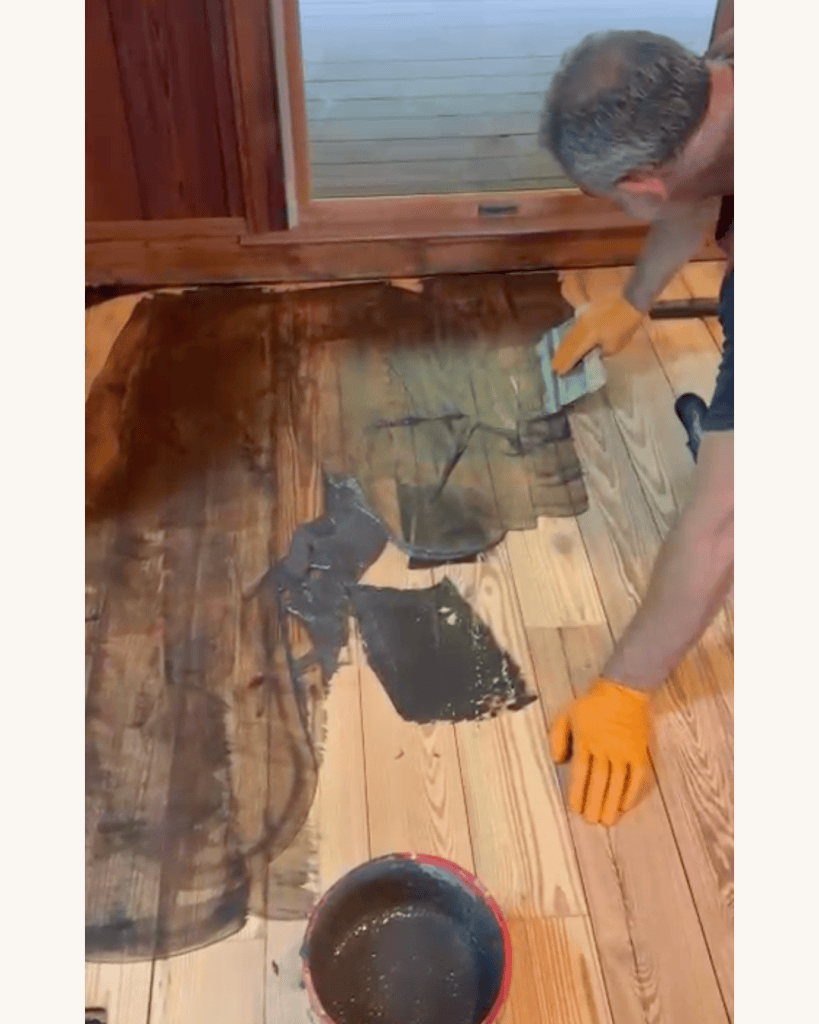
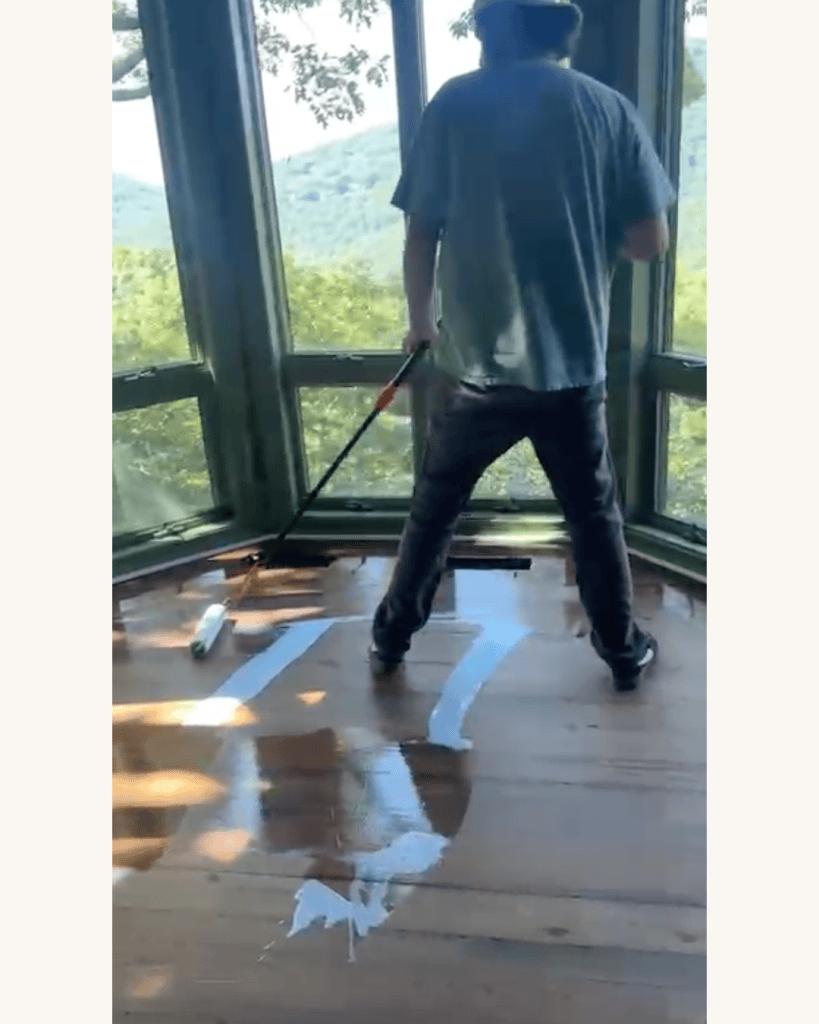
  13. Applied a thinned dewaxed shellac wash coat to the pine before staining
  14. Stained the heart pine in DuraSeal Jacobean and the yellow pine and white oak in DuraSeal Espresso
  15. Applied one coat of Berger-Seidle AquaSeal FlexSealer
  16. Applied two coats of Berger-Seidle AquaSeal CeramicStar in satin
  17. Installed new white primed quarter round throughout

Splinter Repair and Board Stabilization

The splinter repairs were carried out after the first sanding cut. The failed oil-based polyurethane concealed the condition of the board edges, and the full extent of the lifted and splintered material was only visible once that finish came off. Sequencing the repairs after the first cut also means the bonded splinters are sanded flat during the passes that follow.

A solid floor of this type begins with roughly 5 mm of usable wood above the tongue. On most of this floor more than half of that material was gone, and the board edges had begun to lift and splinter as a result.

Removing and replacing the affected boards was considered and set aside. Reclaimed heart pine of this age, grain, and color cannot be matched from current stock, and a replacement board remains visible in the finished floor. Board removal also opens new joints in a floor where the joints were the primary condition being corrected.

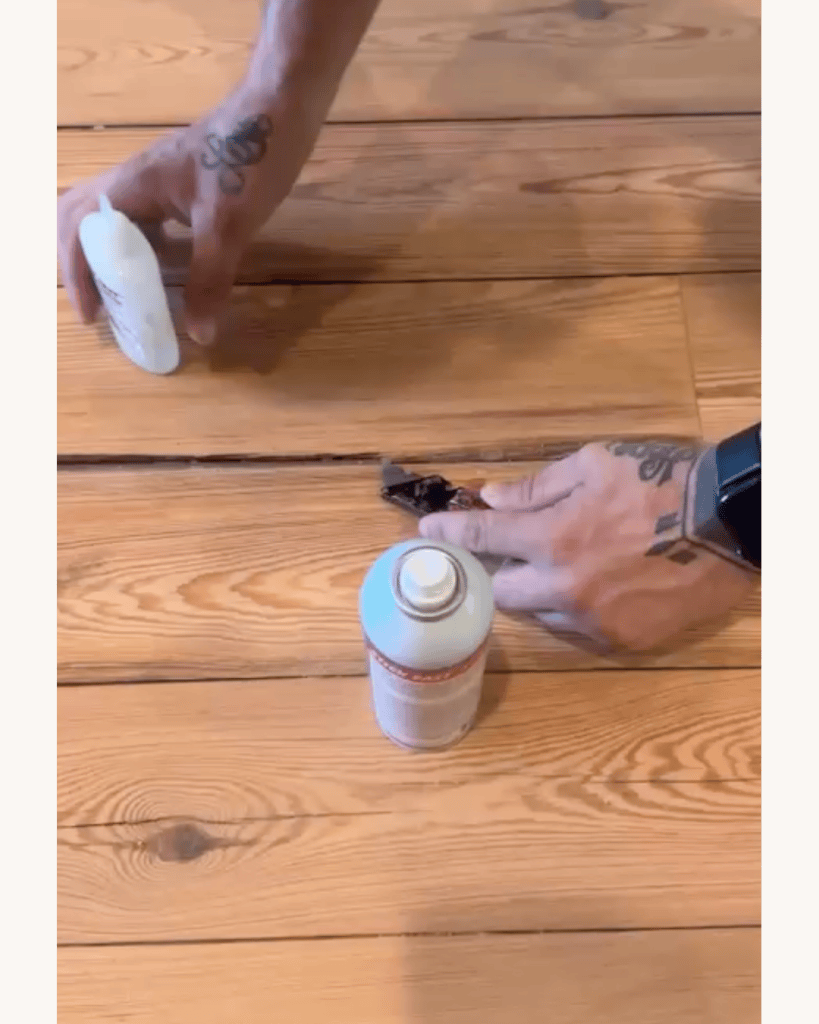
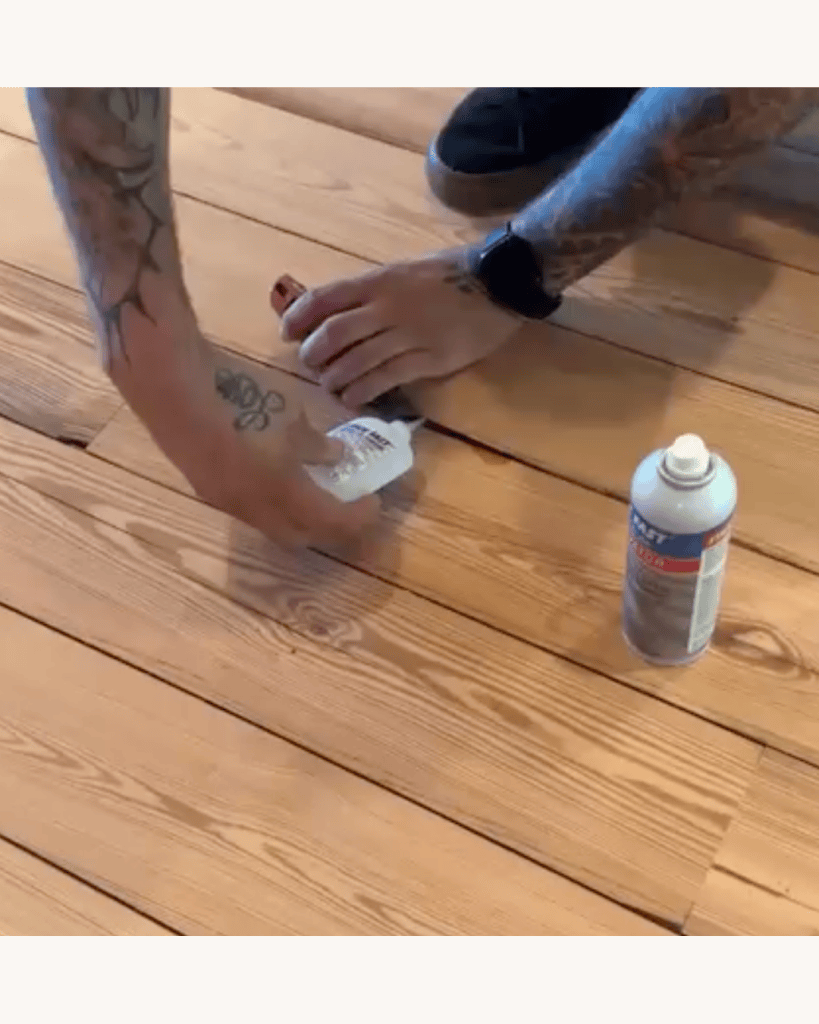
Each splinter was bonded back into place with Stick Fast cyanoacrylate glue and spray activator. Thin cyanoacrylate wicks under a lifted splinter and into the fracture. The activator cures it within seconds, so the splinter can be held in position and the crew can move to the next repair without clamping. The cured repair sands flush and takes stain with the surrounding wood.

More than 75 locations were repaired. The work occupied one full day of the ten-day schedule. No boards were replaced.

Classy Flooring ATL crew member applying Stick Fast cyanoacrylate glue and spray activator to a splinter repair in reclaimed heart pine flooring, Big Canoe, Georgia
Splinter repair on the reclaimed heart pine using Stick Fast cyanoacrylate glue with spray activator. Repairs were carried out after the first sanding cut, at more than 75 locations across the floor, over one full day.
Classy Flooring ATL crew member working glue into a splinter repair in reclaimed heart pine flooring, Stick Fast spray activator can alongside, Big Canoe, Georgia
Stick Fast cyanoacrylate glue worked into a lifted splinter on the reclaimed heart pine, with the spray activator alongside to set it. Repairs were made board by board across the floor and sanded back with the surrounding wood.

Sanding Heart Pine

Heart pine is the heartwood of longleaf pine and carries a high resin content. That resin affects the sanding in two ways. The abrasive loads with pitch and stops cutting before the paper has physically worn out. The resin also transfers onto the drum inside the machine and hardens there.

On this floor the machines were stopped, the drums disassembled, cleaned, and reassembled approximately seven times over the course of the job. This is a standard condition when sanding heart pine and it accounts for a measurable portion of the labor on a floor of this species.

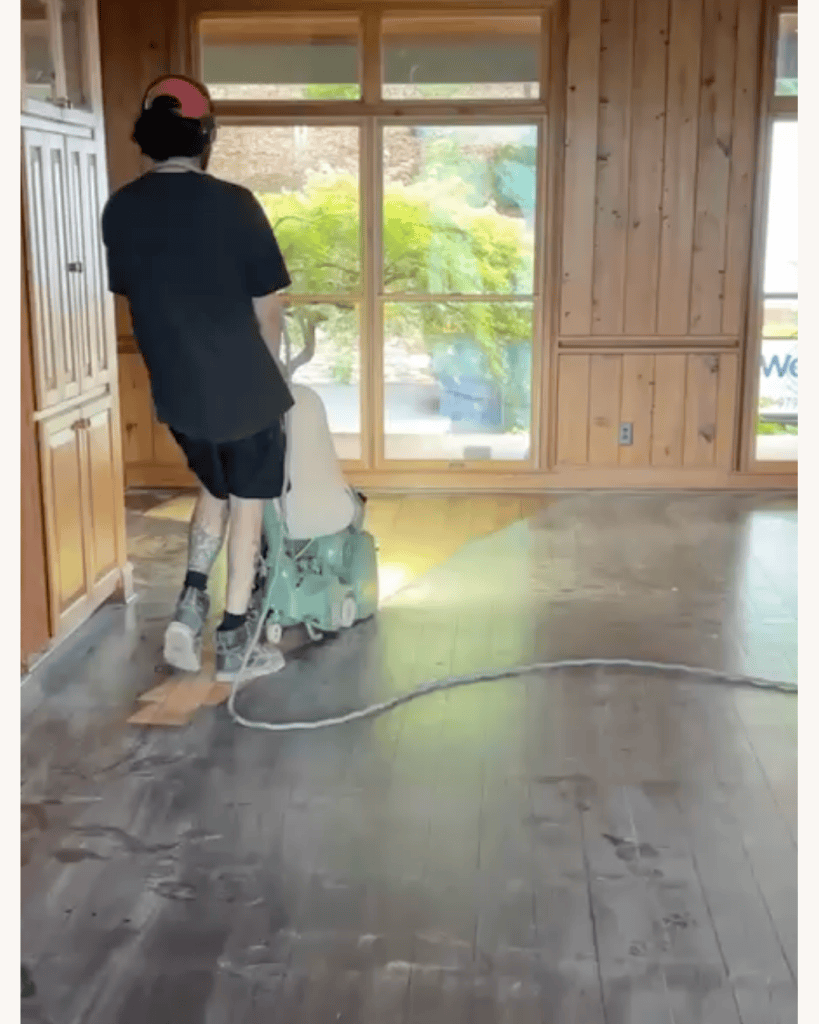
The heart pine was opened at 36 grit. Oak of comparable condition would be opened at 40. The coarser opening reflects both the surface condition of this floor and the softness of pine between its resinous grain lines. On a floor that has already been sanded thin, the opening grit is selected to remove the failed finish and the surface irregularity without taking additional material.

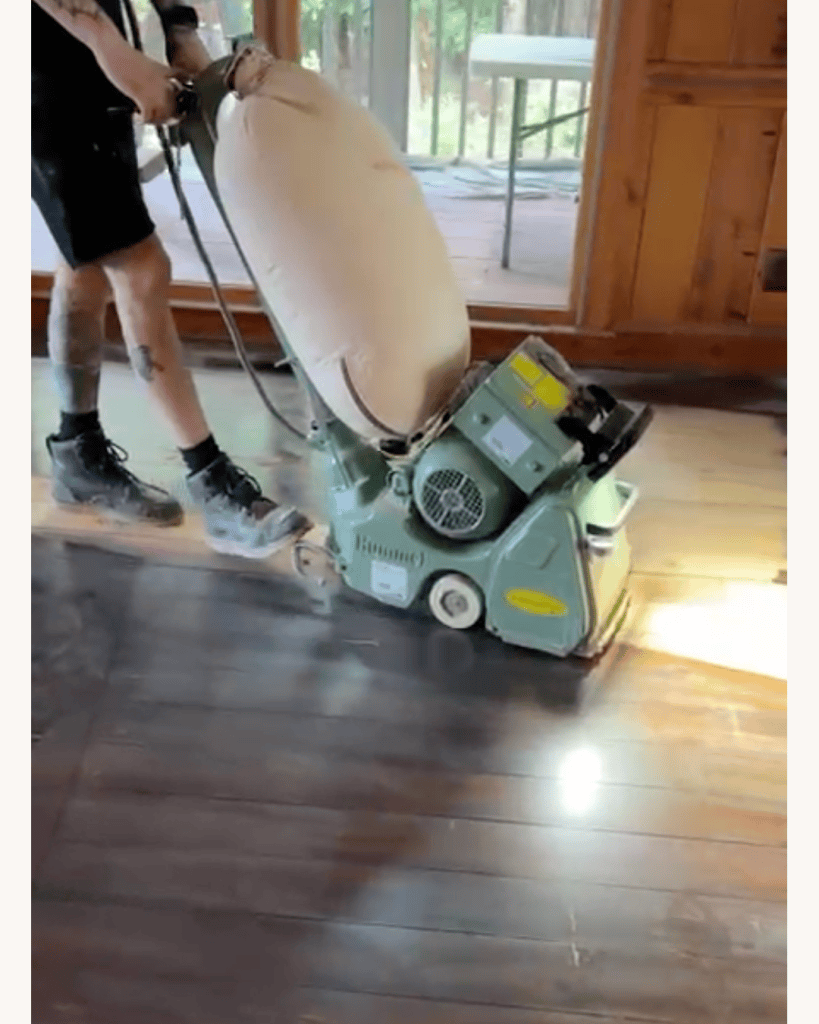
Equipment: Lägler Hummel belt machine, Lägler Flip for cabinet toe kicks and confined areas, edger for perimeters, FG Floortec Discus planetary sander for the finishing passes. All corners were scraped by hand. All sanding was dustless.

Classy Flooring ATL crew member taking the first sanding cut on reclaimed heart pine flooring with a belt sander, Big Canoe, Georgia
The first cut at 36 grit on the reclaimed heart pine. The old oil-based polyurethane comes off in this pass, and the splinter repairs follow once the surface is open.
Classy Flooring ATL crew member running a Lägler belt sander across reclaimed heart pine flooring at the first cut, Big Canoe, Georgia
The Lägler belt sander taking the first cut at 36 grit. Sanded boards run ahead of the machine and the old oil-based polyurethane remains behind it.

Gap Filling — AquaSeal PAK-Stop

Berger-Seidle AquaSeal PAK-Stop is a high-elastic trowel filler produced for closing wide joints, and the manufacturer lists plank flooring as a suitable application. It is supplied colorless and is colored on site with AquaSeal Pafuki Powder, available in seven shades: oak, beech/red oak, maple/ash/pine, wenge/smoked oak, azobe/teak, white, and black. Black was selected for this floor. The product is also certified to block polycyclic aromatic hydrocarbons emitted by historic adhesives beneath old wood floors.

Preparing the floor to receive filler. The manufacturer specifies that PAK-Stop is troweled onto a floor sanded to a 60, 80, or 100 grit profile. That requirement set a full sanding sequence before any filler was mixed: 36 grit and 60 grit with the belt machine, followed by 60 grit with the planetary sander. The planetary pass produces a uniform surface across the whole field, so that filler troweled edge to edge stays in the joints and is not driven into open grain across the face of the boards.

Mixing and application. The powder was stirred into the compound immediately before use and worked to a homogeneous, trowelable paste at one part powder to five parts liquid, the working ratio used on this floor. The manufacturer’s published mixing example uses a richer powder loading. The paste was applied with a flexible steel trowel across the entire floor surface. Edge-to-edge application produces continuous contact through every joint across the floor.

Two coats, 24 hours apart. The manufacturer states that shrinkage in very large joints during drying is normal and that a second coat is applied afterward. On this floor the first coat consolidated and settled slightly below the surface in the widest joints as it cured. The published sanding window for PAK-Stop is approximately 14 to 16 hours at 73°F and 50% relative humidity; a full 24 hours was allowed at each stage. No joint required a third coat, including the widest at 5/8 inch. Three 4.5 kg units of PAK-Stop were consumed across the 1,200 square feet.

Removing the filler. Filler applied across the whole floor is then sanded back off: 36, 60, 80, then 100 and 120 with the planetary sander. What remains is filler in the joints only, level with the surrounding boards, with the wood surface clean and open for stain.

Working the second coat of AquaSeal PAK-Stop filler into wide gaps in the reclaimed heart pine floor, Big Canoe, Georgia
The second coat brings the widest joints level with the boards after the first coat settles as it cures.
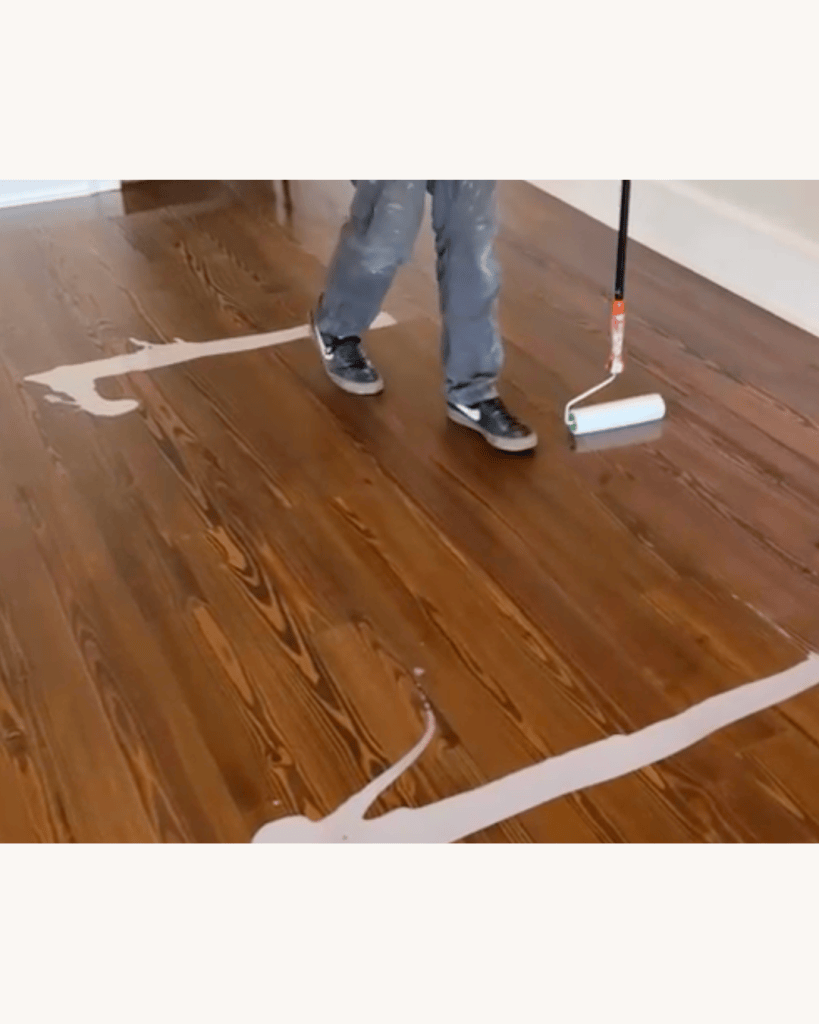
Troweling AquaSeal PAK-Stop filler colored with Pafuki Powder in black across the reclaimed heart pine floor in Big Canoe, Georgia
The filler goes on edge to edge across the whole floor, not gap by gap.

Stain Preparation on Pine

Pine has a pronounced density difference between its soft early wood and its dense late wood. Stain applied directly to unprepared pine penetrates the early wood heavily and sits on the late wood, which produces a mottled result. Dark stain colors make the effect more visible.

Before staining, the pine received a wash coat of dewaxed shellac thinned five parts denatured alcohol to one part Zinsser SealCoat. Thinned dewaxed shellac is a standard pre-stain treatment for controlling uneven stain penetration on softwoods, and the manufacturer publishes this use for pine. The cut used on this floor is lighter than the manufacturer’s general recommendation, because a heavier film on a floor restricts stain uptake past the point of regulating it. The floor was left 12 hours before stain was applied.

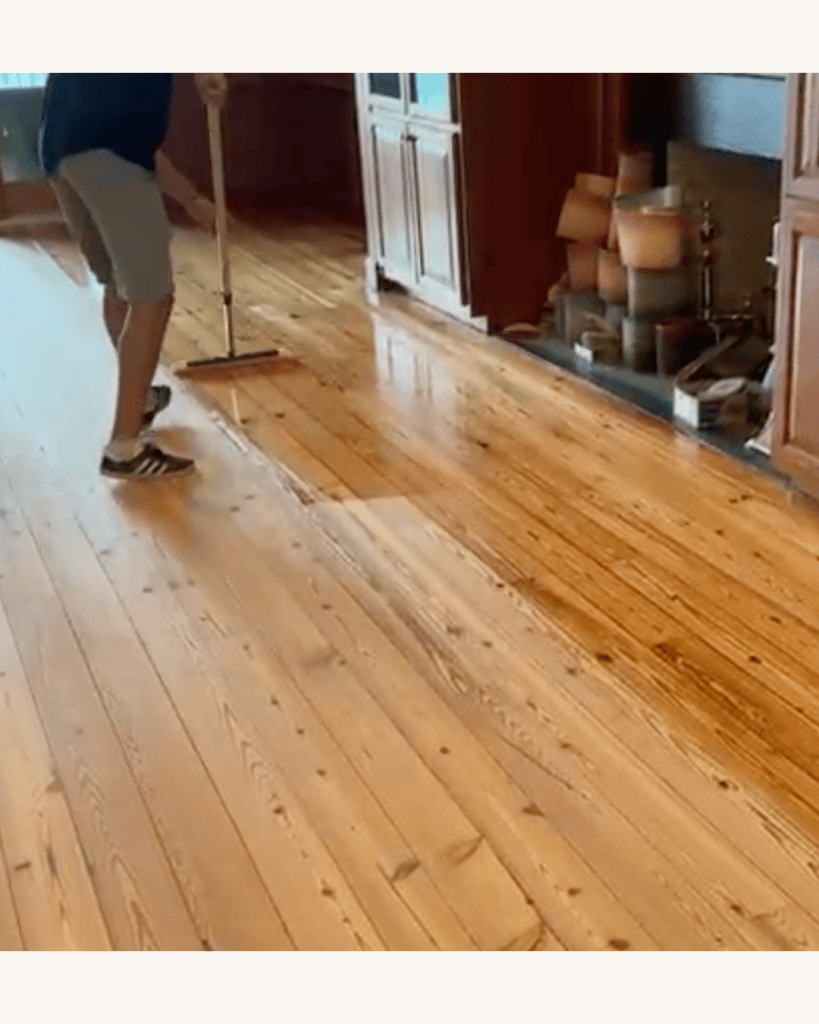
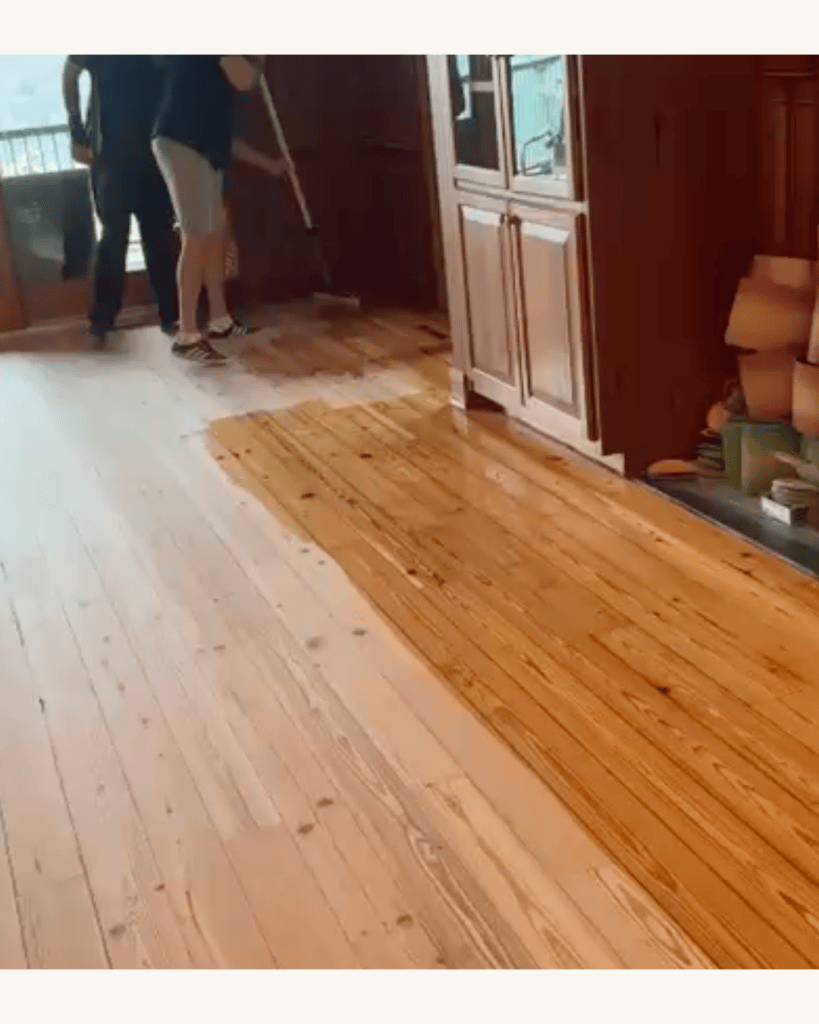
Applying the dewaxed shellac wash coat to the sanded reclaimed heart pine floor before staining, Big Canoe, Georgia
The pre-stain treatment goes on before any color, controlling how evenly the pine takes the stain.
Classy Flooring ATL crew applying a Zinsser SealCoat dewaxed shellac wash coat across the sanded reclaimed heart pine floor in Big Canoe, Georgia
The treated section reads amber against the untreated pine, showing the wash coat as it goes down.

Color Matching Across Three Species

The house contained three woods with three distinct appearances: century-old reclaimed heart pine with heavy figure and an amber undertone, new southern yellow pine that was pale and uniform, and white oak herringbone with open grain and a different figure.

A single stain color applied to all three would not have produced a match. Different species, and different ages of the same species, carry an identical stain to different results.

Two stain colors were selected to arrive at a common tone:

Reclaimed heart pine — DuraSeal Jacobean

Southern yellow pine and white oak herringbone — DuraSeal Espresso

Espresso on the new yellow pine produces the tone that Jacobean produces on the century-old heart pine. The relationship was verified on site.

Sampling

Sampling was carried out in two stages, beginning before any work started on site.

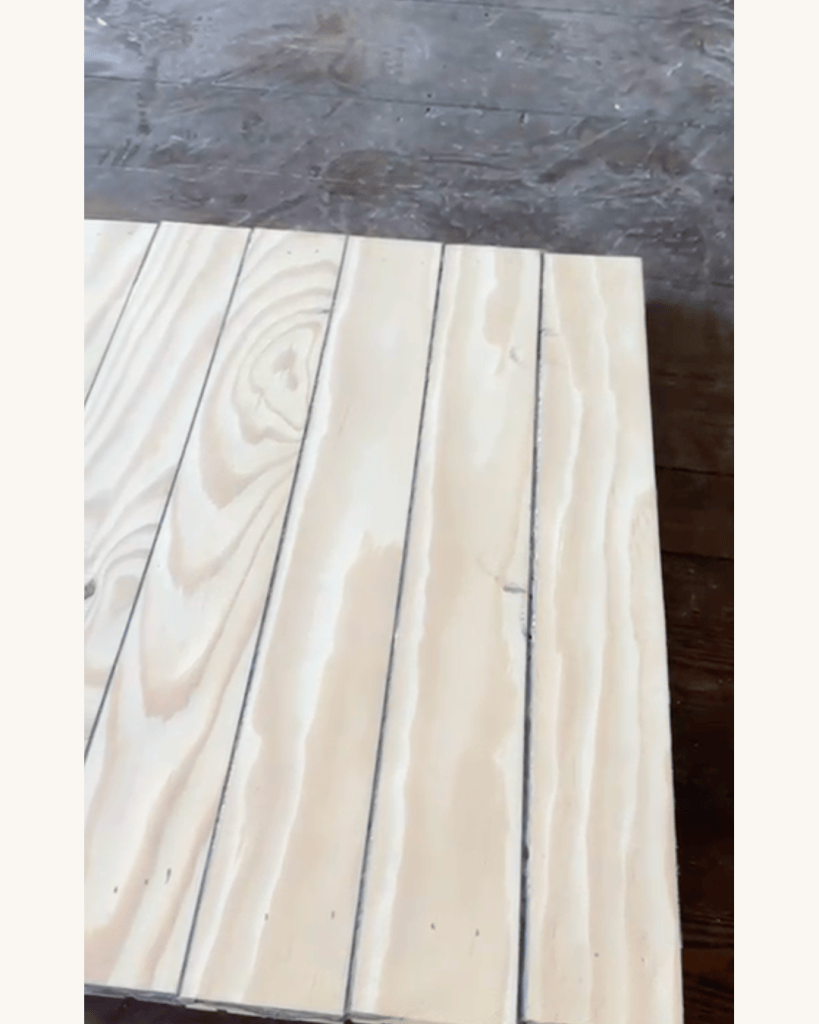
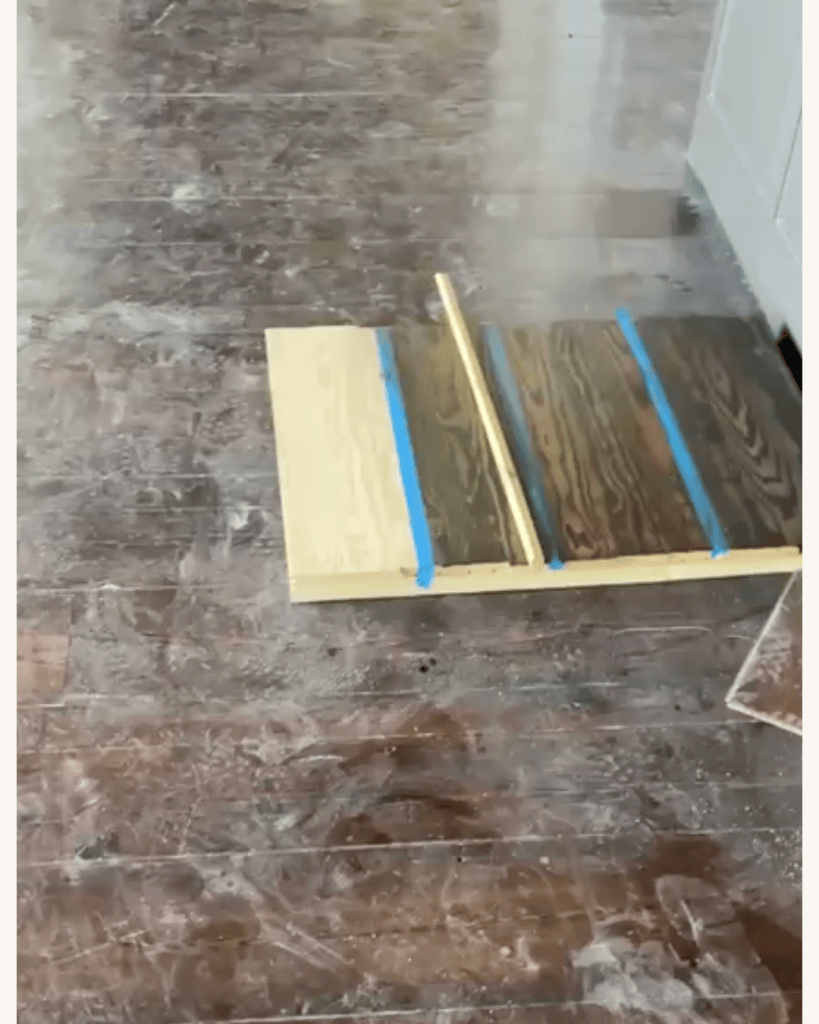
Two pine sample pieces were built in the shop. The gaps in them were filled with AquaSeal PAK-Stop colored with AquaSeal Pafuki Powder, and stain colors were applied over the filled surface. Building the samples in the shop meant the homeowner could evaluate the filler color and the stain over it on real wood, in combination, before the filler was applied across 1,200 square feet of floor.

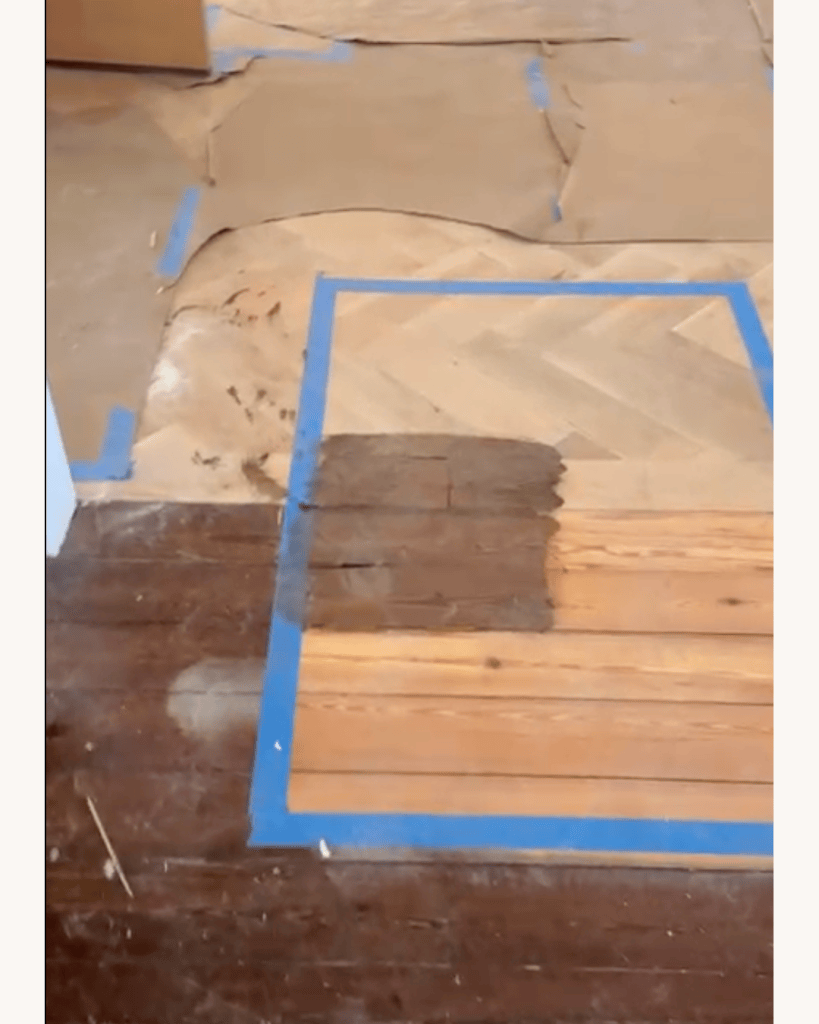
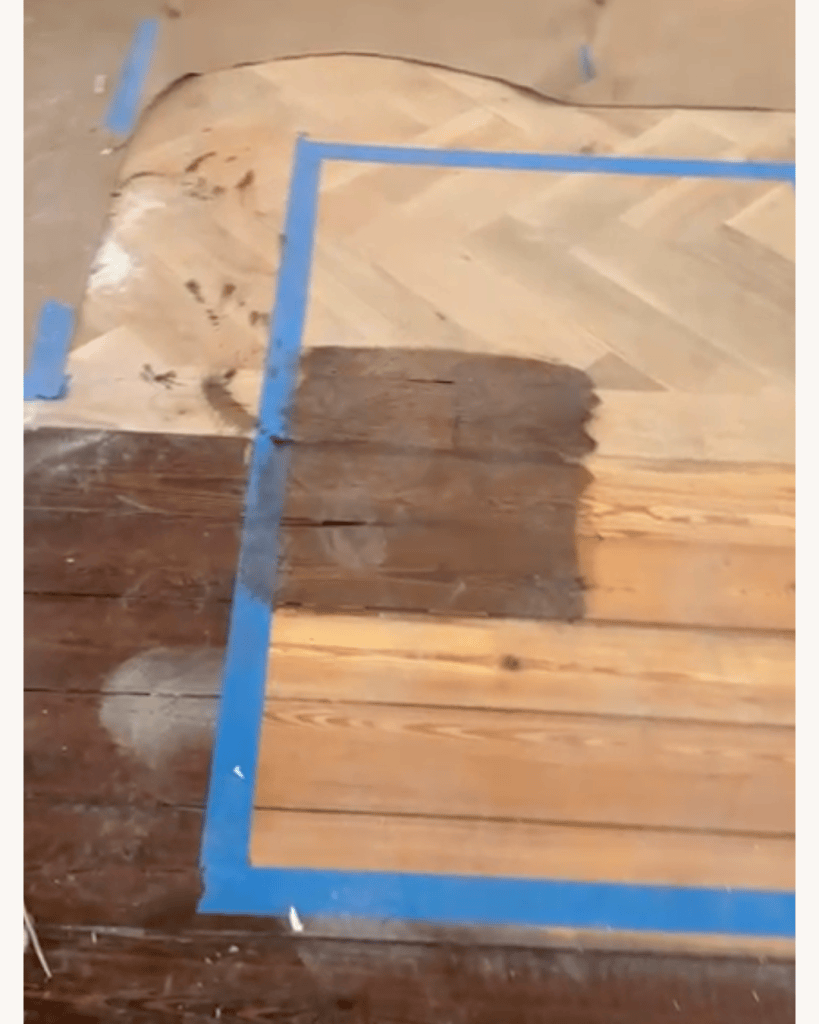
Stain was then sampled on the floor itself. Three samples were placed at the junction where the reclaimed heart pine meets the southern yellow pine, the one location in the house where both species could be evaluated side by side under the same light at the same time. The homeowner selected from those three. Because the floors run directly into one another with no transition strips, the color relationship was resolved before any stain was applied.

Pine sample piece sanded flat with board joints filled in black using Berger-Seidle AquaSeal PAK-Stop and AquaSeal Pafuki Powder, no stain applied, Big Canoe, Georgia
The second sample piece built in the shop, sanded flat with no stain applied. Berger-Seidle AquaSeal PAK-Stop mixed with AquaSeal Pafuki Powder in black fills each board joint edge to edge.
Pine sample piece with board gaps filled using Berger-Seidle AquaSeal PAK-Stop and AquaSeal Pafuki Powder in black, stain colors applied in taped sections, Big Canoe, Georgia
One of two sample pieces built in the shop before work started. Board gaps were filled with Berger-Seidle AquaSeal PAK-Stop and AquaSeal Pafuki Powder in black, then stain colors were applied over the filled gaps in taped sections for the homeowner to review.
Stain sample taped out at the junction of white oak herringbone and pine plank flooring with masking paper protecting the herringbone, Big Canoe, Georgia
The sample area taped and masked at the species junction. Paper covers the sanded herringbone so the stain lands only inside the marked square, and the surrounding floor stays clean for the next sample.
Taped stain sample applied across the junction between white oak herringbone and pine plank flooring, Big Canoe, Georgia
A stain sample taped out across the junction where the white oak herringbone meets the plank floor. Samples were applied on the floor itself so the homeowner could select colour on the actual wood, at the point where the two species meet.

The Finish System — AquaSeal FlexSealer and CeramicStar

The sealer and finish on this floor are Berger-Seidle, applied over a DuraSeal stain and a dewaxed shellac wash coat.

Sealer — AquaSeal FlexSealer, one coat. FlexSealer is a highly elastic single-component waterborne sealer formulated to reduce sidebonding and panelization, and the manufacturer recommends it for plank floors and for floors subject to movement. On this project it allows the floor to move seasonally without transferring stress into the finish film. It was applied in one uniform coat with the grain, worked richly enough to penetrate into the joints.

Finish — AquaSeal CeramicStar, satin, two coats. CeramicStar is a two-component waterborne polyurethane reinforced with ceramic components, which the manufacturer positions for the renovation of older floors. It was catalyzed with its own hardener at the specified 10:1 ratio and applied in two coats over the FlexSealer, within the manufacturer’s stated two-to-three coat range. Satin sheen throughout. The product is also produced in ultramat and semigloss.

The same sealer and finish were applied to all three floors.

Applying the final coat of Berger-Seidle AquaSeal CeramicStar satin finish to a restored reclaimed heart pine floor in Big Canoe, Georgia
The second and final coat of AquaSeal CeramicStar, applied with the grain over one coat of AquaSeal FlexSealer.
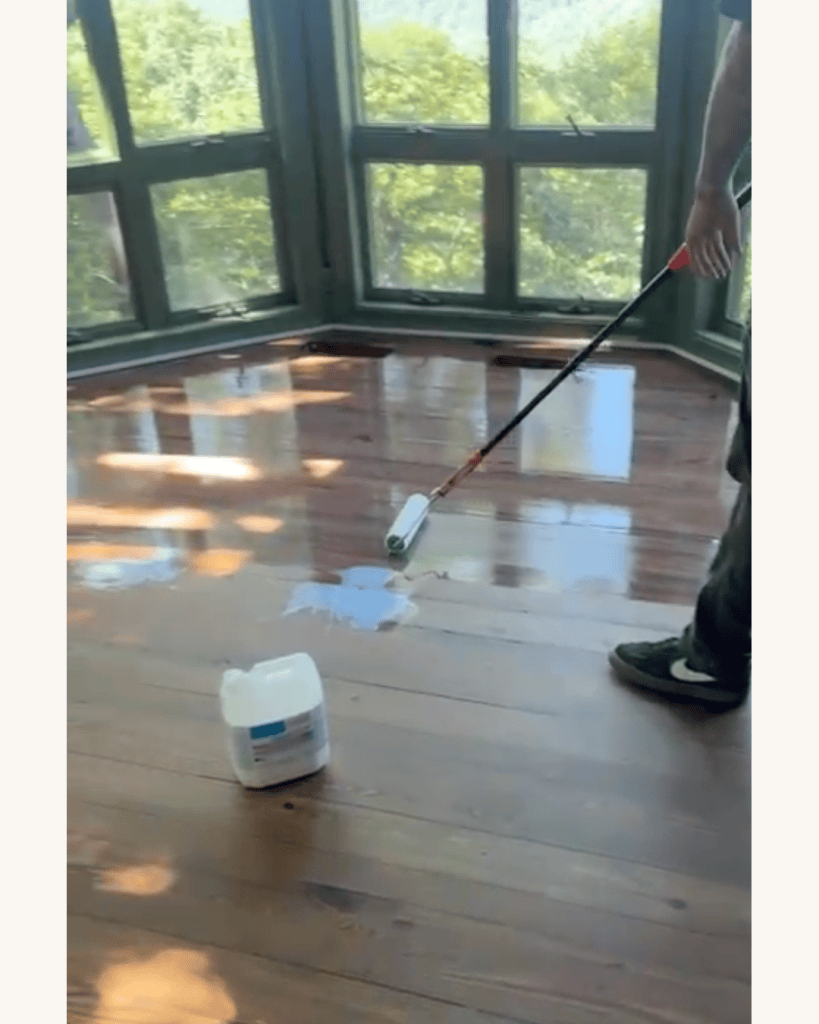
Rolling AquaSeal CeramicStar finish onto the restored reclaimed heart pine floor with the container of finish on the floor, Big Canoe, Georgia
Working in the direction of the grain across the great room, with the filled board gaps now level and invisible under the finish.
Rolling AquaSeal CeramicStar over southern yellow pine stained in DuraSeal Espresso, Big Canoe, Georgia
The grain pattern of new southern yellow pine under espresso, close range.
Applying AquaSeal CeramicStar finish to the new southern yellow pine floor stained in DuraSeal Espresso, Big Canoe, Georgia
The new yellow pine in espresso, the color selected to bring it to the same tone as the Jacobean on the reclaimed heart pine.

Quarter Round, Stairs, and Additional Scope

The existing baseboards were retained. New white primed quarter round was installed throughout, supplied primed and left uncaulked and unpainted. Finish paint was outside our scope.

The old pine treads on the basement stairway were removed and 16 new oak treads and risers were installed, stained espresso to coordinate with a prefinished engineered floor installed in the basement by a separate contractor. That stair work is documented separately.

The Result

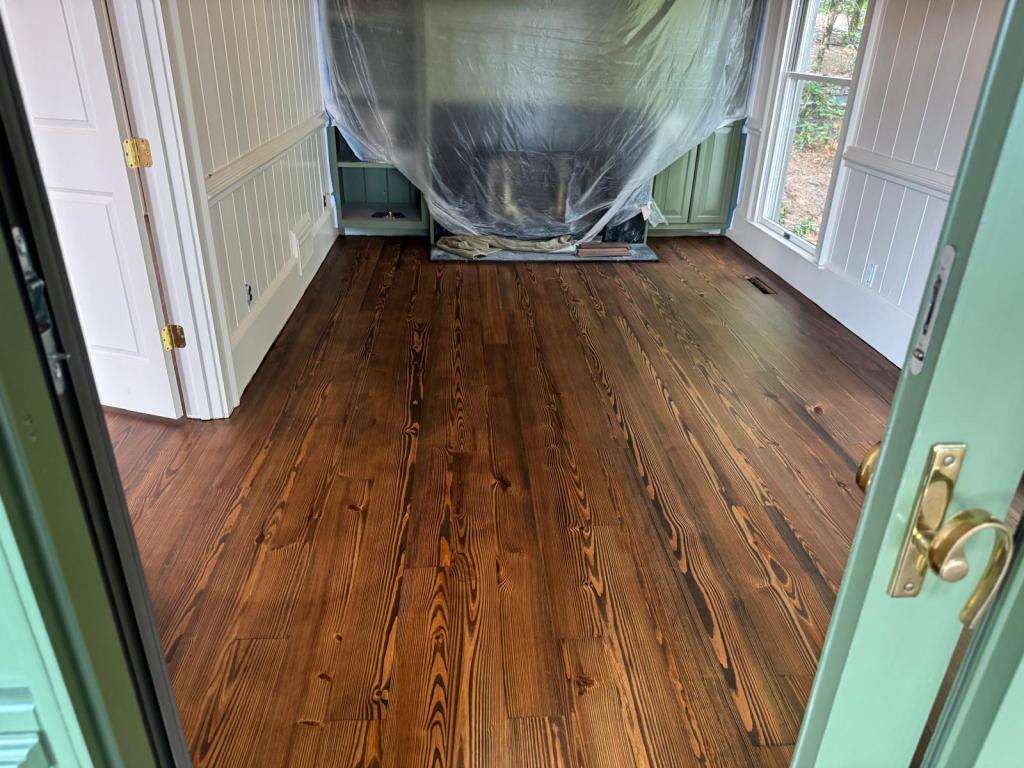
The finished floor is 2,400 square feet across three species reading as one continuous surface. Every gap in the reclaimed heart pine is filled level with the surrounding boards, including the widest at 5/8 inch, in a filler that remains elastic and moves with the floor. More than 75 splintered board sections are stabilized and invisible in the finished floor, with no replacement boards anywhere in the house. The century-old heart pine, the new southern yellow pine, and the white oak herringbone carry the same tone from room to room, across doorways where no transition strips are installed.

Reclaimed heart pine flooring in DuraSeal Jacobean across the enclosed porch with glazing on two sides, Big Canoe, Georgia
The reclaimed heart pine on the enclosed porch, finished in DuraSeal Jacobean. The floor carries in from the living room as one continuous surface with no threshold at the opening.
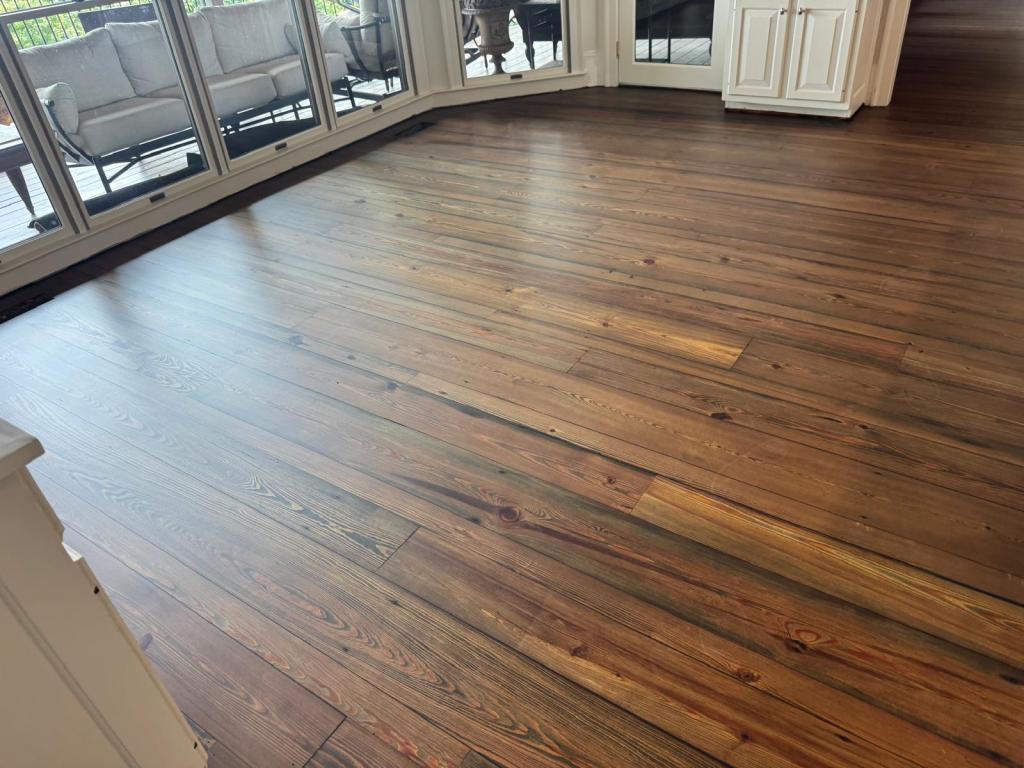
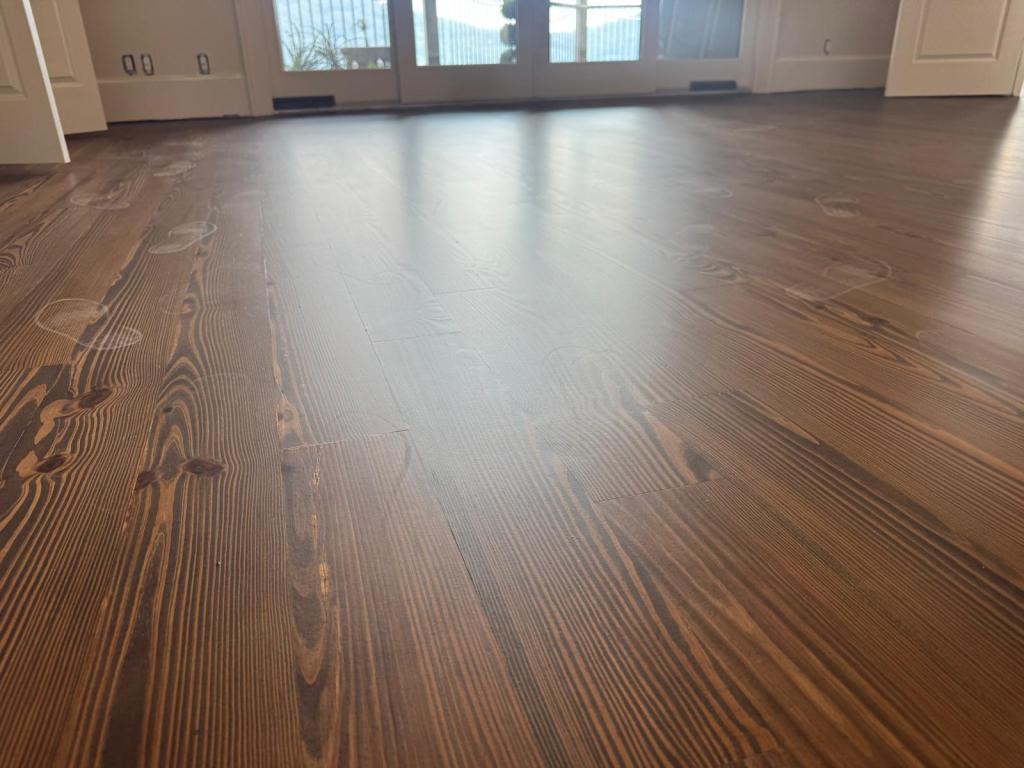
Reclaimed heart pine flooring finished in DuraSeal Jacobean with satin AquaSeal CeramicStar, wide boards running toward the window wall, Big Canoe, Georgia
Reclaimed heart pine finished in DuraSeal Jacobean. Board widths vary across the run and the filled joints hold a consistent line from wall to wall.
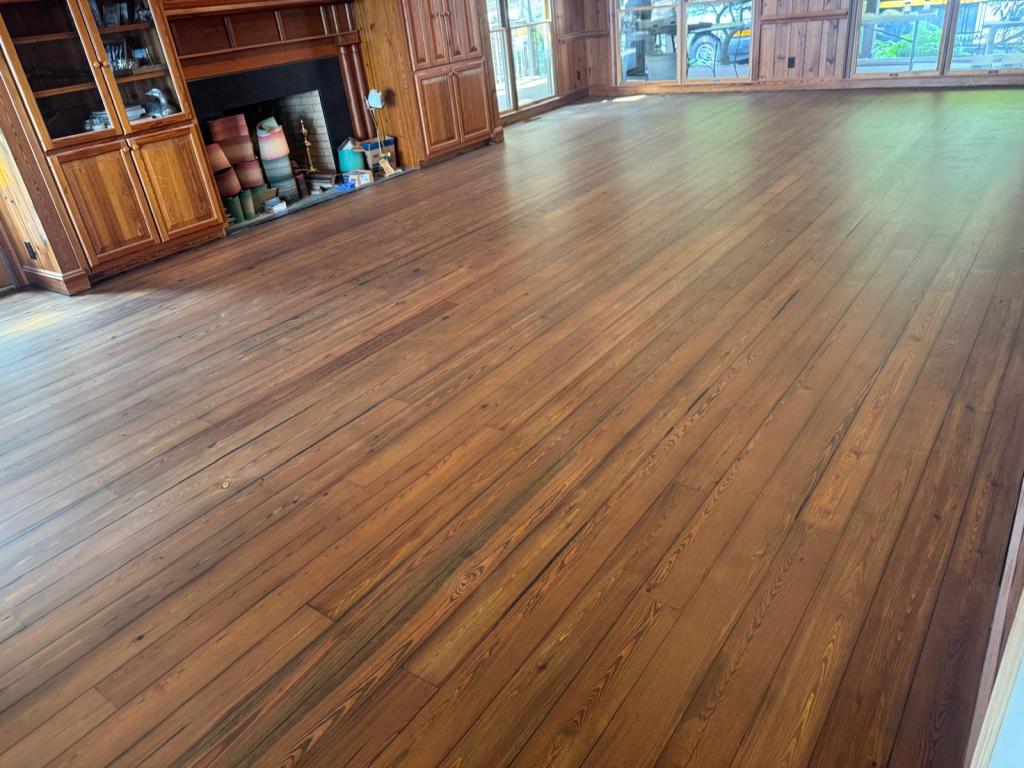
Reclaimed heart pine flooring in DuraSeal Jacobean running the full length of the living room toward the fireplace and built-in cabinetry, Big Canoe, Georgia
The reclaimed heart pine across the open living room. Colour varies board to board through the stain, which is characteristic of reclaimed stock where individual boards carry different density and grain.
Southern yellow pine flooring finished in DuraSeal Espresso with new white primed quarter round at the base of the beadboard walls, Big Canoe, Georgia
The finished southern yellow pine with new white primed quarter round set at the base of the walls. Sheeting stays over the built-in until the finish reaches handling strength.
Southern yellow pine flooring finished in DuraSeal Espresso with Berger-Seidle AquaSeal CeramicStar satin, Big Canoe, Georgia
Southern yellow pine finished in DuraSeal Espresso. This floor was new and had never been sanded, so the work here was finishing, and the grain figure carries through the colour across the full run.
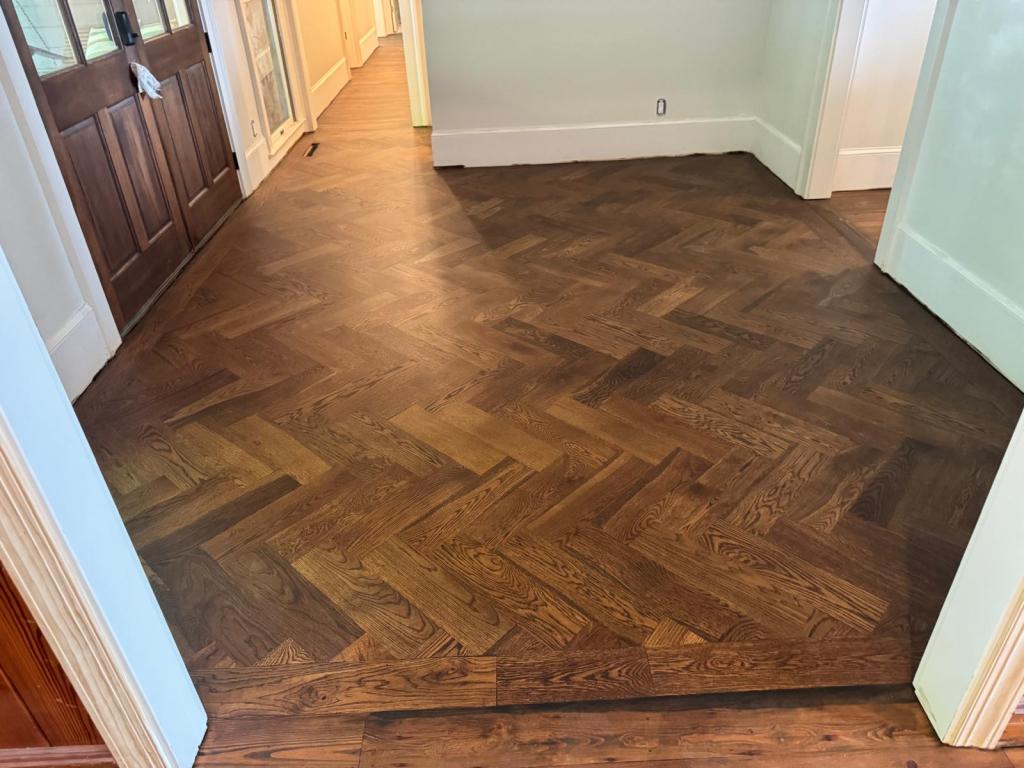
White oak herringbone in DuraSeal Espresso meeting reclaimed heart pine in DuraSeal Jacobean directly with no transition strip, Big Canoe, Georgia
The white oak herringbone in the entry hallway meets the reclaimed heart pine directly. Two species and two stain colours run into one another along a single cut line with no transition strip at the junction.

Ongoing Maintenance

The finish is a two-component waterborne polyurethane and is maintained with cleaning products formulated for waterborne urethane finishes. Wax, oil soap, and general household cleaners are not appropriate for this finish.

  • Dry sweep or vacuum regularly to remove grit that causes surface wear
  • Clean with a damp microfiber mop and a compatible waterborne-finish wood cleaner; never a wet mop
  • Place felt protectors under furniture legs and use area rugs at entry points
  • Maintain indoor relative humidity between 35% and 55% year-round to limit seasonal movement

The finish manufacturer specifies a return to traffic after 24 hours, and no rugs, carpets, or floor care products for seven days. Humidity control carries additional weight on a floor with filled wide joints, because the width of every joint responds to indoor humidity.

Project Specifications

Reclaimed heart pine: 1,200 sq ft — kitchen, dining, living room, enclosed porch, garage hallway and bathroom, secondary hallway

Southern yellow pine: 950 sq ft — master bedroom, master closet, rear office, new floor never sanded

White oak herringbone: 250 sq ft — entry hallway

Total area: 2,400 sq ft

Gap range, heart pine: approx. 1/8″ to 5/8″

Gap filler: Berger-Seidle AquaSeal PAK-Stop with AquaSeal Pafuki Powder, black

Filler mix ratio, as used on this project: 1 part powder to 5 parts liquid

Filler application: Flexible steel trowel, edge to edge, two coats 24 hours apart

Filler consumed: 3 × 4.5 kg units

Sanding to receive filler: 36, 60, then 60 planetary

Sanding after filler, heart pine: 36, 60, 80, then 100 and 120 planetary

Sanding, southern yellow pine: 40, 60, 80, then 100 and 120 planetary

Board repairs: 75+ splinter repairs, Stick Fast CA glue with spray activator

Boards replaced: None

Pre-stain treatment: Dewaxed shellac wash coat — 5 parts denatured alcohol to 1 part Zinsser SealCoat

Stain, heart pine: DuraSeal Jacobean

Stain, yellow pine and white oak: DuraSeal Espresso

Sealer: Berger-Seidle AquaSeal FlexSealer, one coat

Finish: Berger-Seidle AquaSeal CeramicStar, satin, two coats, catalyzed 10:1

Return to traffic: 24 hours per finish manufacturer

No rugs or floor care products: 7 days per finish manufacturer

Equipment: Lägler Hummel, Lägler Flip, edger, FG Floortec Discus planetary sander

Dust control: Dustless sanding throughout

Perimeter trim: New white primed quarter round

Trim finish paint: Not in scope

Stairs: 16 oak treads and risers installed, espresso, documented separately

Crew: Three, Classy Flooring ATL in-house

Duration: 10 working days

Project type: Refinishing and restoration

Location: Big Canoe, GA

Completed by: Classy Flooring ATL

Frequently Asked Questions

Should gaps in an old pine floor be filled?

Not in every case. Narrow, stable, evenly distributed gaps are a normal characteristic of a plank floor and are frequently left open. Filling is appropriate when the gaps are wide enough to collect debris and catch furniture, when the gap widths across the floor are irregular, or when the floor is being fully refinished and the gaps would remain the one unaddressed condition. The decision depends on the gap width, the consistency across the floor, and the filler selected.

What is the best filler for wide gaps in a hardwood floor?

For gaps wide enough that seasonal movement is significant, the appropriate product class is an elastic trowel filler that stays flexible after curing. The system used on this floor was Berger-Seidle AquaSeal PAK-Stop colored with AquaSeal Pafuki Powder. Rigid fillers, sawdust-and-glue mixtures, and wood slivers are suited to narrow, stable joints and have known limits in wide ones.

Why does wood filler crack and fall out of floor gaps?

The wood moves and the filler does not. Wood takes on and releases moisture seasonally, and boards expand and contract across their width. A filler that cures hard can release from one side of the joint, fracture through the middle, or transfer the movement to another point in the floor. An elastic filler absorbs the movement.

Do elastic gap fillers shrink?

In wide joints, yes, and the manufacturer states this. Shrinkage during drying in very large joints is expected, and a second coat is applied after the first has cured. On this floor two coats brought every joint level, including the widest at 5/8 inch. No joint required a third.

What is the widest gap that can be filled this way?

5/8 inch was the widest gap filled on this project, and it closed in two coats. We have not filled a wider joint with this system, so we do not state a limit above that figure.

Can an old pine floor be saved, or does it have to be replaced?

The limiting factor is the wear layer, meaning the wood remaining above the tongue. Gaps, a failed finish, and surface damage are separate questions. On this floor more than half of the remaining wear layer had been removed during a previous refinish and the board edges had begun to splinter, and it remained a restoration candidate. It was completed without replacing a single board. Whether any particular floor is a candidate depends on what is left above the tongue on that floor.

How many times can a wood floor be refinished?

It depends on the wood remaining above the tongue and on how aggressively each previous refinish was carried out. A solid floor typically begins with around 5 mm of usable material above the tongue, and each full sanding removes a fraction of a millimeter. Determining what remains on a specific floor requires measuring at a doorway, a vent cut, or a threshold where an edge is exposed.

How do you know if a floor is too thin to refinish?

The indicators are visible before sanding begins: fastener heads appearing at the surface, splintering along board edges and ends, and tongues showing at doorways or vents. This floor had reached the splintering stage. That condition did not rule out refinishing here. It ruled out an aggressive sanding and it determined how the sequence was planned.

Can splinters in a wood floor be repaired without replacing the boards?

Yes. Thin cyanoacrylate glue wicks into the fracture beneath a lifted splinter, and a spray activator cures it within seconds so the splinter can be held in position without clamping. The cured repair sands flush and takes stain with the surrounding wood. On this floor more than 75 locations were repaired over one full day with no boards replaced. On a reclaimed floor this approach also avoids two secondary problems: replacement stock cannot be matched to century-old material, and every replaced board opens new joints.

Why does pine stain blotchy, and how is it prevented?

Pine has a pronounced density difference between its soft early wood and its dense late wood, so stain applied directly penetrates one and sits on the other. A pre-stain wash coat of thinned dewaxed shellac evens out absorption before the color is applied. Dark stain colors make the underlying effect more visible, which increases the value of the preparation step.

What grit should you start with when sanding heart pine?

This floor was opened at 36 grit. Oak of comparable condition would be opened at 40. The opening grit depends on the surface condition, on the softness of the wood between the resinous grain lines, and on how much material remains above the tongue.

Why does pine clog sandpaper?

Resin. Heart pine carries a high pitch content, and that pitch loads the abrasive before the paper has physically worn out, then transfers onto the drum of the machine and hardens. On this job the machines were stopped and the drums disassembled and cleaned approximately seven times.

What is the difference between heart pine and southern yellow pine?

Heart pine is the heartwood of longleaf pine, the dense resinous core of very old, slow-grown trees. Southern yellow pine is the modern, faster-grown lumber. Heart pine is denser and more resinous, and it behaves differently under a sanding machine and under stain. Old-growth longleaf survives on a small fraction of its historic range, and most heart pine flooring available today is reclaimed material.

Can two different wood species be made to match?

They can be brought to a common tone. On this project that was achieved with two stain colors, each selected so its species arrived at the same result. Grain and figure cannot be altered, and reclaimed heart pine and new southern yellow pine remain visibly different materials at close range. Tone is what carries the floors across a room and through a doorway.

How long does an elastic gap filler last?

Our earliest installation using this system dates to January 2026. As of August 2026 it has passed the winter-to-summer seasonal transition with no gaps opening and no filler releasing. That is the extent of what we have observed to date.

Related Work

For hardwood floor refinishing and restoration using professional finish systems, including wide-gap filling, splinter stabilization, and multi-species color matching, see our Hardwood Floor Refinishing & Restoration service page. For a white oak refinishing project with lace-in repair and color matching between new and existing material, see our White Oak Floor Refinishing and Lace-In project in Buckhead. If you have a reclaimed heart pine, antique pine, or wide-plank floor with open gaps and are deciding between restoration and replacement, contact Classy Flooring ATL to have the floor evaluated. Classy Flooring ATL serves homeowners and builders in Atlanta, Canton, Alpharetta, Milton, Roswell, Johns Creek, Buckhead, Sandy Springs, Brookhaven, Dunwoody, Braselton, Big Canoe, and surrounding North Georgia communities.