
Pine and Heart Pine Floor Refinishing and Restoration in Atlanta
Classy Flooring ATL refinishes and restores pine and heart pine floors in metro Atlanta and North Georgia. The work covers old pine floors that have been sanded before, reclaimed heart pine, wide-plank floors with open gaps, and southern yellow pine — sanding to bare wood, splinter and board stabilization, color work, and finish-system selection, with wide-gap filling quoted separately.
Classy Flooring ATL is led by Claudiu Toma, an NWFA Certified Installer, NWFA Certified Sand & Finisher and NWFA Certified Sales Advisor, who completed NWFA Precision Patterns: Parquet Flooring and NWFA Precision Patterns: Medallions. Every project is carried out by our in-house crew.
Pine and heart pine refinishing starts at $6.00 per square foot for projects of $4,500 and up; smaller projects are priced by the job. Dustless sanding is included in every project.
Is It Worth Refinishing an Old Pine Floor?
Usually, yes. The limiting factor is the wood remaining above the tongue, and that is the condition that decides it.
Gaps, a failed finish, color that came back wrong, surface damage, and splintering along the boards are all conditions corrected during the work. What determines whether the floor is a candidate is how much material is left to sand.
NWFA’s sand-and-finish guidelines put the general limit at 3/32 of an inch, about 2.4 millimeters, of wood above the tongue: below that, a floor generally should not be sanded. What matters is what remains on your specific floor, and that is measurable rather than a matter of opinion.
How to check the wear layer yourself
Find a place where the edge of a board is exposed — a doorway, a cut for a floor vent, or a threshold. The wood visible above the tongue is what remains to work with.
Three conditions are visible before any sanding begins and indicate a floor near its limit:
- Fastener heads appearing at the surface
- Splintering along board edges and ends
- Tongues showing at doorways or vents
A floor showing these is close to NWFA’s limit, and whether it can be refinished again depends on what the exposed board edges measure. The reclaimed heart pine on our Big Canoe project had been sanded thin by a previous refinish — on most boards, more than half of the wood above the tongue was gone — and edges had splintered at more than 75 locations. It was refinished with every original board kept in place. What that condition changes is the sanding plan: it calls for a conservative cut and it determines how the sequence is built.
Pine and Other Softwood Species Found in Older Floors
Older floors are made from several different softwoods, and the differences between them change how a floor sands, how it takes stain, and what color it holds.
Heart pine
Generally the heartwood of longleaf pine — the dense, resinous core of very old, slow-grown trees. NWFA’s species guide lists heart pine at 1,225 lbf on the Janka hardness scale. Heavy figure, tight grain, and an amber undertone that deepens over decades.
Southern yellow pine
The modern, faster-grown lumber. NWFA’s species guide lists longleaf, one of the southern yellow pines, at 870 lbf on the Janka scale, against 1,225 for heart pine. Paler and more uniform than heart pine, and it behaves differently under a sanding machine and under stain.
Eastern white pine
Softer and lighter in color than either, and it appears frequently in older floors.
Douglas fir
Not a pine — Douglas fir is a separate species — but it turns up often enough in older floors to be worth identifying. It carries a pronounced contrast between its early and late wood, which shows strongly under a clear finish.
Can you still get heart pine?
Most of the original old-growth longleaf pine forests were logged, so historic heart pine of this age and density is now sourced primarily as reclaimed material.
That fact carries directly into a repair decision. A replacement board is matched from current stock, which reads differently from century-old material and stays visible in the finished floor. Board removal also opens new joints in a floor where the joints are often the condition being corrected. On a reclaimed heart pine floor, stabilizing the original board is generally the stronger result.
Why Pine Sands Differently from Oak
Two properties of pine set the sanding apart, and both shape the sanding plan.
Resin
Heart pine carries a high pitch content, and NWFA’s species guide notes that the resin clogs sandpaper. The loaded abrasive stops cutting while the paper is still physically intact, and the resin transfers onto the drum inside the machine and hardens there. On the Big Canoe floor the machines were stopped, the drums disassembled, cleaned, and reassembled approximately seven times over the job. This is a standard condition on heart pine and it accounts for a measurable portion of the labor.
Softness between the grain lines
Pine is soft between its resinous grain lines, and NWFA’s species guide calls for reduced drum pressure on heart pine. The opening grit follows the resin: NWFA notes that higher-resin heart pine may require a lower starting grit and a steeper first cut, since resin loads finer paper before it cuts through the old finish. The Big Canoe heart pine was opened at 36 grit, where oak of comparable condition would be opened at 40. On a floor already sanded thin, the opening grit follows NWFA’s rule — the finest grit that removes the existing finish and flattens the floor — so as little wood as possible is taken.
Flattening
Flattening builds across the whole sequence. The belt cuts remove material and take out the bulk of the variation. The finishing passes are then taken with a planetary sander. Its heads rotate independently of the machine’s own rotation, so the abrasive crosses the boards in every direction instead of following the grain, refining the surface and reducing the directional marks left by the earlier cuts. That sequence is how a floor left uneven by a previous refinish is brought back flat.
Equipment: Lägler Hummel belt machine, Lägler Flip for cabinet toe kicks and confined areas, edger at the perimeters, and planetary sanders — the American Sanders Epoch and the FG Floortec Discus — for the finishing passes. Corners scraped by hand. Every machine runs connected to an FG Floortec dust-control vacuum with a DUSTIN separator.
Why Pine Stains Blotchy, and What Prevents It
Density. Pine carries soft early wood and dense late wood inside the same board. Stain applied to unprepared pine penetrates the soft bands more deeply and sits on the dense ones, so the finished color maps the wood’s density rather than reading as color. NWFA’s species guide treats this uneven stain acceptance as a property of pine, not a defect. On an old floor the effect compounds, because boards differ from one another as well as within themselves. Dark colors make it more visible.
The preparation is a wash coat of dewaxed shellac, thinned heavily with denatured alcohol, applied before the stain.
At that dilution the shellac partially seals the porous early wood while staying well below the point of building a film. Stain then absorbs at a more even rate across early wood, late wood, and boards of differing density.
The dilution governs the result. Zinsser publishes a general one-to-one cut for SealCoat. The working dilutions on our pine floors are lighter — six parts denatured alcohol to one part sealer on the Roswell floor, five to one at Big Canoe — because a lighter film regulates stain uptake while leaving the wood open to take color.
Dewaxed shellac also carries a waterborne finish over the top cleanly, since wax in the shellac would interfere with the bond.
Sampling on the floor
NWFA’s sand-and-finish guidelines call for testing stain for color before the whole floor is stained. Stain samples are applied directly to the sanded floor, in bands separated by strips of bare pine so each color can be read against raw wood. The samples sit in the room’s light, on the actual wood, at the grain and density of that specific floor. Six samples were applied on the Roswell floor. Three were placed at Big Canoe at the junction where two species meet, the one location where both could be evaluated side by side under the same light at the same time.
Color on a Pine Floor
Color can often be moved a long way on a floor with enough wood left to sand, within the limits the species sets. NWFA’s species guide notes that heart pine’s age and sun color runs deep and normally can’t be sanded out, so an old heart pine floor keeps the wood’s own aged color after sanding, and that sets how light it can go.
Why a pine floor loses its amber after refinishing
Two things build amber on an old pine floor. An oil-based finish ambers as it ages, and that color sits on top of the wood. The wood darkens too, and in heart pine that age and sun color runs deep. Sanding removes the ambered finish, so the floor comes back much paler than it was, even with the wood’s own color still in it.
What goes back on decides whether the amber returns. Some clear finishes are formulated to stay clear and hold the wood close to its freshly sanded appearance; others are made to amber, including waterborne polyurethanes built to give the warm look of an oil-based finish. A clear, non-ambering finish over freshly sanded pine produces a pale floor, and on a light floor or a cool-toned stain that is the intended result. On an old pine floor valued for its warmth, the color has to be put back deliberately.
On our pine floors the warmth is built in the stain, chosen from samples on the floor, and a clear waterborne finish holds it where it was set. The color decision belongs at the start of the project, alongside the choice of finish system.
Finding the color a floor used to be
Look for a section the previous refinish never reached — under a refrigerator or a built-in, behind a threshold, or under trim. Where the old finish is still intact, it shows the floor as it looked before: aged wood under its old finish. On the Roswell floor the refrigerator had stood in one position for years, shielding the pine underneath from light and from the previous refinish, which put the color as it was directly beside the color as it had become, in the same wood and the same room.
Areas shielded only from light read differently. NWFA’s species guide records that pine ambers with light exposure, and NWFA notes that rugs leave color differences on a floor, so wood under a rug that never moved can read lighter than the rest of the floor rather than showing its earlier color.
Where no protected area exists, an old photograph gives a useful direction, though lighting and camera processing both shift the color it shows.
Can a pine floor be made to look like oak?
Tone can be moved a long way. Grain and figure stay pine.
Stain and tinted finish coats bring a pine floor to an oak-like tone, and tone is what carries a floor across a room and through a doorway. Figure is what the floor is seen as up close — pine’s knots, its density banding, and its old nail holes read through the color, and on an old floor that variation is part of its character.
Where two species need to arrive at the same tone, the answer is usually two different colors rather than one. At Big Canoe, DuraSeal Espresso on new southern yellow pine and white oak produced the tone that DuraSeal Jacobean produced on century-old reclaimed heart pine, so three floors read as one continuous surface across doorways where no transition strips are installed.
Gaps in a Pine Floor
Board gaps are not automatically a defect. NWFA’s diagnostic guide treats seasonal gaps as normal, and narrow, stable, evenly distributed gaps are a normal characteristic of a plank floor that are frequently left open.
Filling becomes appropriate when the gaps are wide enough to collect debris and catch furniture, when the widths across the floor are irregular, or when the floor is being fully refinished and the gaps would otherwise remain the one unaddressed condition.
NWFA’s sand-and-finish guidelines set the conditions for any filling: the gaps are vacuumed out first, the boards have to be tight, because a loose floor won’t hold filler, and seasonal gaps aren’t filled in the dry season, because the wood swells back and damages the floor.
Why wide joints need an elastic filler
Wood is hygroscopic. Boards take on and release moisture seasonally and move across their width regardless of what occupies the gap. In a wide joint, a rigid material bridging that movement will release from one board face, fracture through the middle, or transfer the movement to another point along the board run.
Sawdust mixed with glue suits hairline joints; in a joint measured in eighths of an inch it shrinks as it dries and settles below the surface. Rope and jute pressed into a gap close the void and produce a surface separate from the floor. Wood slivers, which NWFA lists for larger gaps, work on a stable floor. Rope, jute, and slivers are established methods in the trade. The approach Classy Flooring ATL uses on wide joints is an elastic trowel filler.
The method used on wide joints
A high-elastic trowel filler stays flexible after curing and absorbs the seasonal movement. On the Big Canoe heart pine, gaps measured approximately 1/8 inch to 5/8 inch and were closed with Berger-Seidle AquaSeal PAK-Stop colored on site with AquaSeal Pafuki Powder.
The filler is troweled edge to edge across the whole floor rather than gap by gap, over a surface sanded to the profile the manufacturer specifies, so continuous contact is made through every joint. The manufacturer states that shrinkage in very large joints during drying is normal and that a second coat follows. On that floor two coats brought every joint level, including the widest at 5/8 inch. The filler is then sanded back off, leaving material in the joints only, level with the boards, with the wood surface clean and open for stain.
One property of the system governs the sequence: the filler is colored by the powder selected at mixing, so the color is committed before the floor is filled. Sample pieces are built and approved first.
Gap filling is quoted separately from the refinishing, and whether a floor’s gaps are closed is the client’s decision.
Splintered and Damaged Boards
Where the wood above the tongue has been reduced, board edges lose support and begin to lift and splinter. It is one of the visible signs that a floor has been sanded thin, and it is repairable.
Thin cyanoacrylate glue wicks under a lifted splinter and into the fracture, and a spray activator cures it within seconds, so the splinter can be held in position and the crew can move to the next repair without clamping. The cured repair sands flush and takes stain with the surrounding wood.
The repairs are carried out after the first sanding cut, for two reasons: an old finish conceals the true condition of the board edges until it comes off, and repairs made at that stage are sanded flat by the passes that follow.
More than 75 locations were repaired this way across the Big Canoe heart pine, over one full day of a ten-day schedule, with every original board kept in place.
Finish Systems for Pine
The finish system is selected against the color goal, the traffic the floor takes, and how the color is meant to behave over time.
The central mechanism is color stability. The warmth of the floor is built into the stain color, chosen on the floor, and a clear waterborne finish holds it where it was set.
Systems used on our pine work include LOBA EasyPrime under LOBA 2K Duo, and Berger-Seidle AquaSeal FlexSealer under AquaSeal CeramicStar, each applied to the manufacturer’s specification, with the two-component topcoats catalyzed at the published 10:1 ratio.
Waterborne finishes can glue groups of boards together at their edges, which NWFA calls sidebonding and prevents with the sealer the finish manufacturer recommends. Both sealers are made for it: LOBA lists EasyPrime as reducing side bonding, and Berger-Seidle formulates FlexSealer, a highly elastic sealer, to reduce sidebonding and panelization on plank floors and floors subject to movement.
Satin sheen throughout, unless a project calls for something else.
When a recoat is the right call on a pine floor
A recoat bonds new finish to the existing finish. It applies where the finish film is still continuous across the whole floor: surface wear and light scuffing, scratches that stay within the finish, traffic lanes that still carry finish rather than exposed wood, and a floor free of wax, oil soap, and acrylic polish. Where those conditions hold, it adds a protective layer and keeps every millimeter of wood in place.
Pine is soft, so traffic marks reach bare wood earlier than they do on oak. A scratch you can catch a fingernail in has reached the wood, which is one of the conditions the assessment reads.
A recoat holds the floor at its current color and current surface. Dents, wear patterns, and permanent cupping stay after a recoat, and NWFA notes they may show more. Color changes, flatness correction, gap filling, and board repair each begin with sanding to bare wood.
On price, the two sit closer together than most people expect. A recoat runs around 70 percent of the cost of a full refinish. A recoat is one coat where a full refinish is a sealer, two topcoats, and stain where stain is specified — and the coating is the highest-cost material on the job. Two-component waterborne systems such as LOBA 2K Duo and Bona Traffic HD carry a high material cost, and a single coat still covers the same square footage.
We test adhesion in several locations before recommending a recoat on any floor, as NWFA’s sand-and-finish guidelines direct. Where the tests pass, we say so.
What Pine Floor Refinishing Costs
Pine floor refinishing starts at $6.00 per square foot for projects of $4,500 and up; smaller projects are priced by the job. Dustless sanding is included.
What moves the number on a specific floor:
- Species and condition — heart pine consumes more abrasive and more machine time than oak or new pine
- Wear layer remaining — a thin floor calls for a sequence planned around the wood that remains
- Gap filling — quoted separately; an elastic trowel filler is applied across the whole floor, then sanded back off, and that removal stage carries the largest share of the labor
- Board repair — splinter stabilization and any lace-in work
- Color — natural, a single stain, a custom blend, or matching across species
- Finish system — the number of coats and the product specified
- Stairs, treads, and risers, where they are in scope
Claudiu visits every project in person before it is scheduled, assesses the floor and the surface condition, and produces a written estimate with a project-specific scope of work.
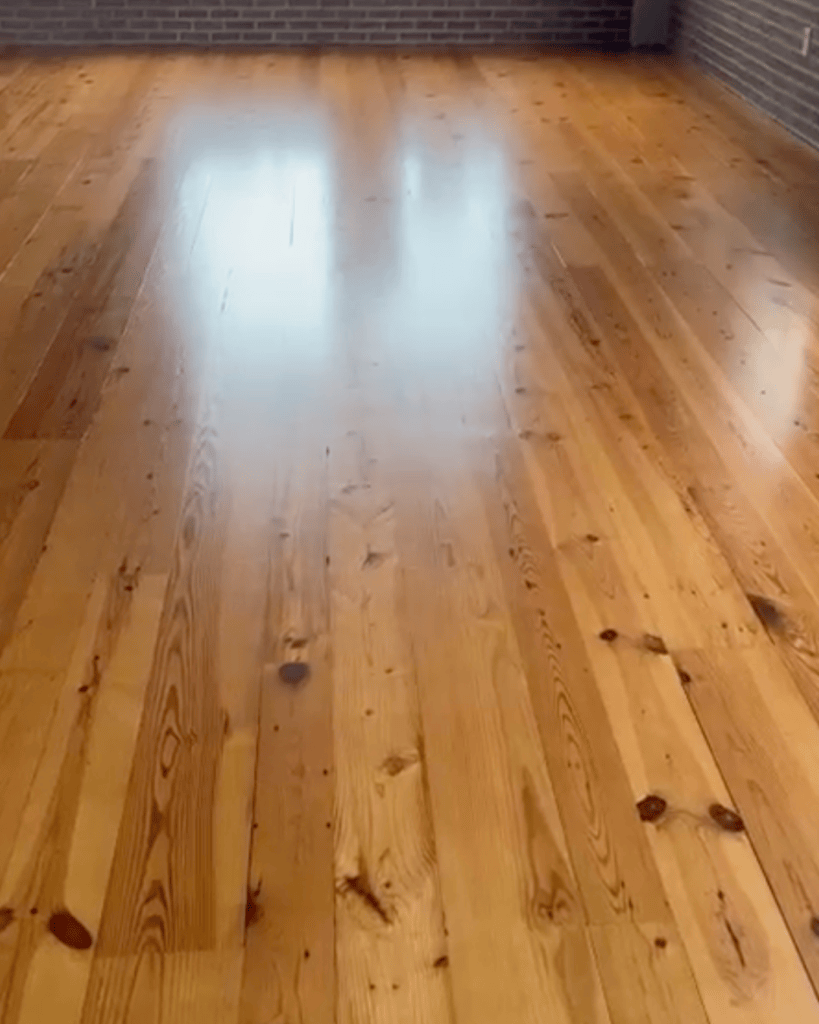
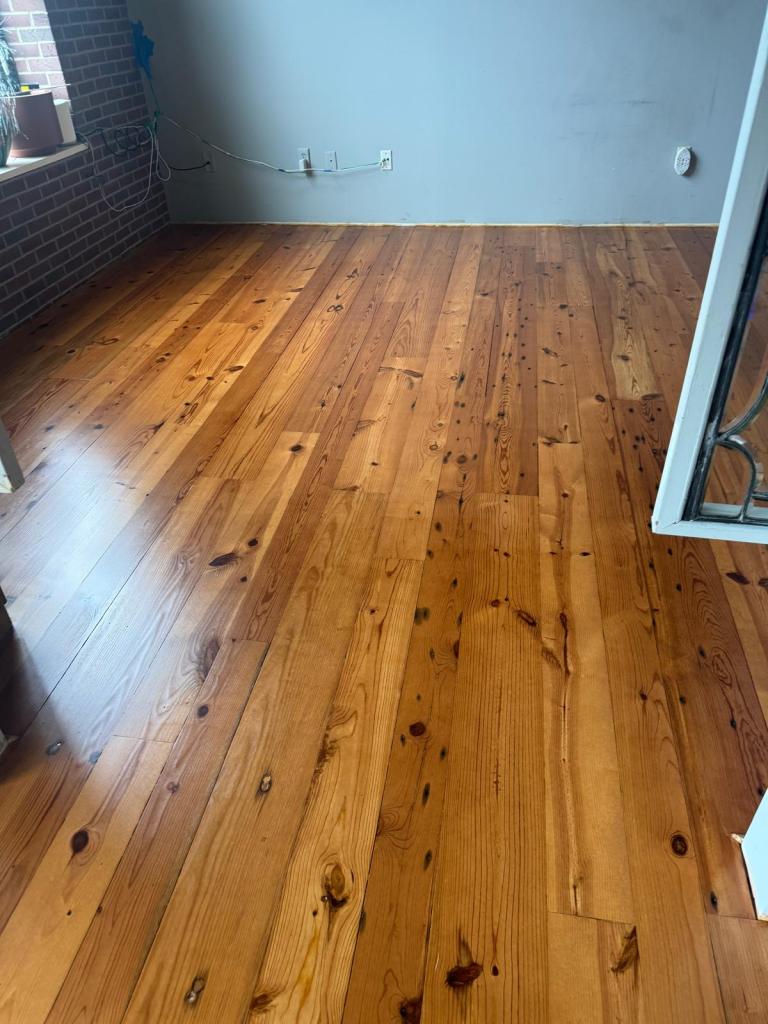
Featured Project — Heart Pine Color and Flatness Correction, Roswell, GA
Service: Refinishing with color rebuilding and surface correction
Wood: Heart pine, wide plank, existing
Stain: DuraSeal Quick Coat — 2 parts Nutmeg to 1 part Chestnut
Finish: LOBA EasyPrime, then two coats LOBA 2K Duo, satin
Scope: Approximately 1,250 sq ft — two bedrooms, living room, kitchen, entry hallway
The floor had been refinished shortly before and came back pale, without the amber tone the pine had carried, and the previous refinish had left the surface sanded unevenly. The reference for the original color was still on the floor: the pine beneath the refrigerator had never been exposed to light and had not been touched by the previous refinish, so it held the original amber. Six stain samples were applied directly to the sanded floor for the homeowner to select against her own wood.
See the full project — including finding the original color, the sampling, and the flatness correction — on our Heart Pine Floor Refinishing project in Roswell.
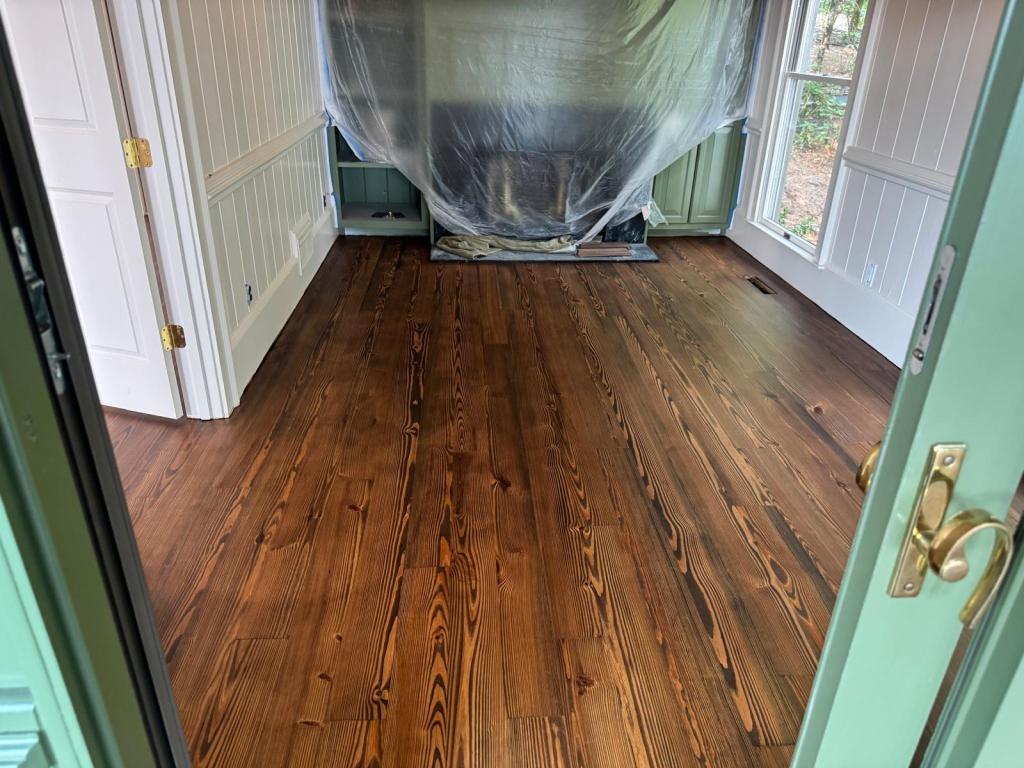
Featured Project — Reclaimed Heart Pine Restoration with Wide-Gap Filling, Big Canoe, GA
Service: Restoration — wide-gap filling, splinter stabilization, multi-species color matching
Wood: Century-old reclaimed heart pine, new southern yellow pine, white oak herringbone
Stain: DuraSeal Jacobean on the heart pine; DuraSeal Espresso on the yellow pine and white oak
Finish: Berger-Seidle AquaSeal FlexSealer, then two coats AquaSeal CeramicStar satin
Scope: 2,400 sq ft across three species
Gaps in the reclaimed heart pine measured approximately 1/8 inch to 5/8 inch, the floor had lost more than half its wear layer during a previous refinish, and board edges had begun to splinter in more than 75 locations. Every gap was closed with an elastic trowel filler, every splinter was stabilized, and every original board stayed in place.
See the full project — including the gap-filling sequence, the splinter repairs, and the color matching across three species — on our Reclaimed Heart Pine Restoration project in Big Canoe.

Client reviews
Client Review
★★★★★ 5-star review — Source: Google Business Profile
“Claudiu Toma and the team at Classy Flooring ATL were absolutely brilliant! They took care of a custom refinish of 100 year old heart pine flooring in Roswell for me. There was nothing easy about this job. They implemented a dustless refinishing process, which included hepa vacs, to ensure that everything stayed clean throughout the process. They took their time to ensure a perfect, quality outcome, communication was second to none and their customer service was superior. I will continue to use Claudiu and the team from Classy Flooring ATL in the future. Job well done!”
— Jason Finck
Heart Pine Floor Refinishing — Roswell, GA
Frequently asked questions
Is it worth refinishing old pine floors?
Usually, yes, as long as enough wood remains above the tongue. Refinishing keeps the original boards, and historic heart pine of that age and density is now sourced primarily as reclaimed material, so a matching replacement floor is hard to come by. NWFA’s sand-and-finish guidelines put the general limit at 3/32 of an inch, about 2.4 millimeters, of wood above the tongue: below that, a floor generally should not be sanded. That can be checked at an exposed board edge, such as a doorway, a vent cut, or a threshold. Gaps, a failed finish, color that came back wrong, and surface damage are all corrected during the work. On the Big Canoe reclaimed heart pine, more than half of the wood above the tongue was gone on most boards, and the floor was refinished with every original board kept in place; the Roswell heart pine had come back pale from a previous refinish and was sanded, flattened, and stained back to a warm amber.
What are the downsides of pine flooring?
Pine is softer than oak, its resin slows the sanding, and it takes stain unevenly — and each of these shapes how the floor is worked. NWFA’s species guide lists heart pine at 1,225 lbf on the Janka hardness scale, close to northern red oak at 1,290 and below white oak at 1,360, with longleaf pine at 870, so pine dents and marks more easily than oak, and longleaf more than heart pine. The same guide notes that heart pine’s resin clogs sandpaper and can extend finish dry times, and that pine accepts stain unevenly as a property of the species, which is why a dewaxed shellac wash coat is applied before the stain. Pine also ambers with light exposure, so its color deepens over the years. One property runs the other way: NWFA’s dimensional-change figures show pine moving less across its width than red or white oak for the same change in moisture content. Whether pine or oak is the better floor comes down to the room and the look: oak takes more wear before it marks, and pine carries a figure and color of its own. On the Big Canoe heart pine, the resin stopped the machines about seven times to clean the drums, and the floor finished with every original board in place.
Can pine floors be sanded?
Yes, with a sequence set for the species. NWFA’s species guide notes that heart pine is soft, so the drum runs at reduced pressure, and that its resin clogs sandpaper, so higher-resin heart pine may require a lower starting grit and a steeper first cut. The machines are a belt sander for the cuts that remove the old finish and flatten the floor, an edger at the perimeter, hand scraping in the corners, and planetary sanders — the American Sanders Epoch and the FG Floortec Discus — for the finishing passes, which cross the board direction and refine the surface. Our pine floors have opened at 36 or 40 grit depending on the species and the surface, then run through 60 and 80 on the belt machine, with the finishing passes at 100 and 120 on the FG Floortec Discus. On the Big Canoe heart pine, opened at 36 grit, the resin stopped the machines about seven times to clean the drums; the Roswell heart pine opened at 40.
How long do pine wood floors last?
Many decades, and the limit is the wood above the tongue rather than the age of the floor. Each full sanding removes some of that wood, and NWFA’s sand-and-finish guidelines put the general limit at 3/32 of an inch, about 2.4 millimeters, below which a floor generally should not be sanded again. Care spaces those sandings out: a maintenance coat when the finish loses its luster, the cleaner the finish manufacturer recommends, and the house held at 30–50% relative humidity and 60–80°F, NWFA’s range when the flooring manufacturer gives none. The heart pine in Big Canoe is century-old reclaimed wood that a previous refinish had already sanded thin, and it was restored with every original board kept in place.
What is the best finish for old pine floors?
The one that holds the color the floor is meant to have. On our pine floors the color is built in the stain, chosen from samples on the floor, and a clear two-component waterborne finish holds it where it was set. The finish is applied over a sealer made to reduce sidebonding — the gluing of boards together at their edges that NWFA associates with waterborne finishes and prevents with the sealer the finish manufacturer recommends. The systems we use on pine include LOBA EasyPrime under two coats of LOBA 2K Duo, and Berger-Seidle AquaSeal FlexSealer under two coats of AquaSeal CeramicStar, in satin. On the Roswell heart pine, a DuraSeal Quick Coat blend set the amber and LOBA 2K Duo holds it; in Big Canoe, CeramicStar was applied over DuraSeal Jacobean and Espresso across three species.
Why is pine so hard to stain?
Because each board carries soft early wood and dense late wood. Stain penetrates the soft bands more deeply and sits on the dense ones, so the finished color maps the wood’s density, and on an old floor the boards also differ from one another. NWFA’s species guide treats this uneven stain acceptance as a property of pine, not a defect. A dewaxed shellac wash coat, thinned heavily with denatured alcohol and applied before the stain, partially seals the porous early wood so the stain absorbs at a more even rate, and samples on the sanded floor show how each color reads on that wood before the whole floor is stained, as NWFA’s guidelines call for. On the Roswell heart pine, the wash coat was cut six parts denatured alcohol to one part Zinsser SealCoat, and six stain samples were applied to the sanded floor.
Should gaps in an old pine floor be filled?
Not in every case. NWFA treats seasonal gaps as normal, and narrow, stable, evenly distributed gaps are a normal characteristic of a plank floor that are frequently left open. Filling is appropriate when the gaps are wide enough to collect debris and catch furniture, when the widths are irregular across the floor, or when the floor is being fully refinished and the gaps would remain the one unaddressed condition. NWFA’s sand-and-finish guidelines add that the boards have to be tight, because a loose floor won’t hold filler, and that seasonal gaps aren’t filled in the dry season, because the wood swells back and damages the floor. In wide joints the filler has to stay elastic after curing, because the boards keep moving seasonally. On the Big Canoe heart pine, joints from about 1/8 inch to 5/8 inch were closed with Berger-Seidle AquaSeal PAK-Stop, an elastic trowel filler. Gap filling is quoted separately from the refinishing.
How much does it cost to refinish pine floors?
Pine floor refinishing starts at $6.00 per square foot for projects of $4,500 and up; smaller projects are priced by the job, and dustless sanding is included. At that starting rate, 1,000 square feet starts at $6,000. The figure for a specific floor moves with the species and its condition, the wood remaining above the tongue, board repair, the color work, the finish system, and stairs where they are in scope; gap filling is quoted separately. Every project is quoted after Claudiu sees the floor in person, with a written estimate and a project-specific scope of work.
Related pages
For refinishing on oak and other hardwood species — sanding, color changes, and finish systems — see our Hardwood Floor Refinishing & Restoration service page.
For matching a refinished floor to an existing floor, including across species, see our Hardwood Floor Color Matching service page.
For a heart pine floor with its amber color rebuilt and a surface left uneven by a previous refinish brought back flat, see our Heart Pine Floor Refinishing project in Roswell.
For reclaimed heart pine with wide gaps filled, splintered edges stabilized, and three species brought to one tone, see our Reclaimed Heart Pine Restoration in Big Canoe.
For refinishing cost, cure time, and whether you can stay in the house during the work, see our article Refinishing Hardwood Floors: Cost, Cure Time, and Can You Stay in the House?
Have Your Pine Floor Evaluated
If you have a pine or heart pine floor and want to know what it can take — how much wear layer is left, whether the gaps should be filled, what the color can be brought back to — you can contact Classy Flooring ATL to have the floor assessed in person. Claudiu Toma walks every project before it is scheduled, reads the wear layer and the surface condition, and sets the options out in a written estimate with a project-specific scope of work. Classy Flooring ATL serves homeowners and builders across metro Atlanta and North Georgia, including Atlanta, Buckhead, Sandy Springs, Brookhaven, Dunwoody, Roswell, Alpharetta, Johns Creek, Milton, and Braselton.