

To soundproof under a hardwood floor, an acoustic underlayment is installed between the subfloor and the wood: a resilient layer that absorbs part of the impact of footsteps and dropped objects before it reaches the room below. It reduces the sound rather than stopping it. In a condo, many buildings set the sound rating a hard-surface floor has to meet and approve the underlayment before any work starts.
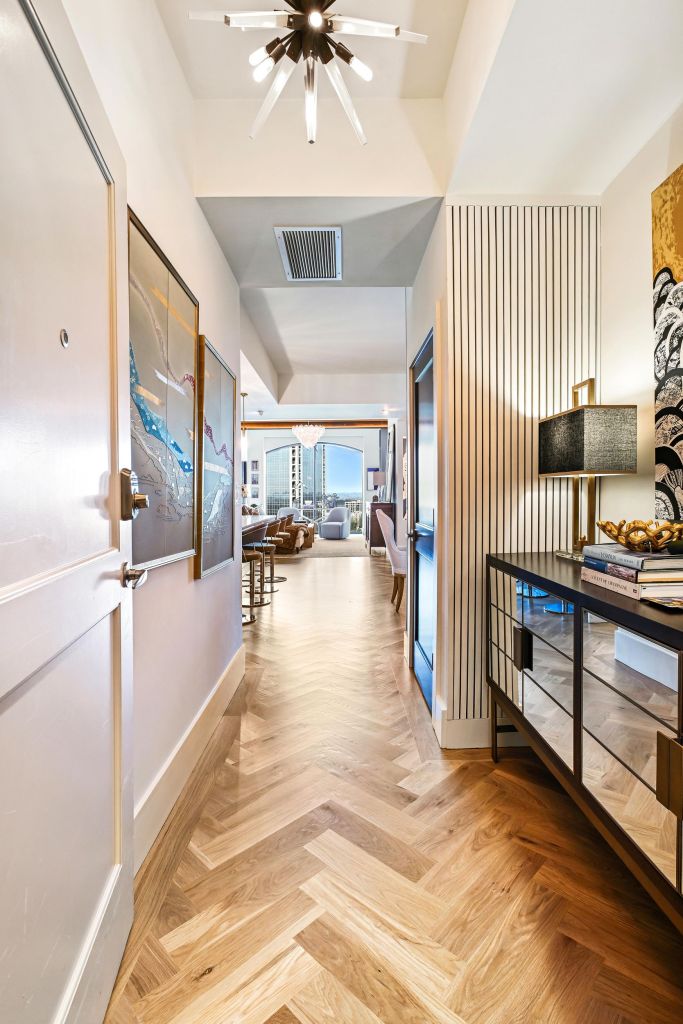
Classy Flooring ATL installs hardwood over acoustic underlayment in Atlanta condos and high-rises. The answers below come from three of those floors: white oak herringbone on the 24th floor of a Buckhead high-rise and 4-inch solid white oak on the 21st floor of the same building, both glued over 6 mm cork, and an engineered hardwood replacement on the 26th floor of The Atlantic in Atlantic Station, glued over a 2 mm acoustic underlayment.
Does soundproof underlay work?
Yes. An acoustic underlayment reduces the sound that reaches the room below, and how much it reduces depends on the whole floor and ceiling, not on the underlayment alone. Impact Insulation Class (IIC) rates impact sound, such as footsteps and dropped objects; Sound Transmission Class (STC) rates airborne sound, such as voices and music. Both are rated in a test lab on a complete floor-ceiling assembly, and a higher number means less sound passes through.
That is why a rating has to be read with its test setup. Roberts rates its 6 mm Natural Cork at IIC 74 and STC 70, measured under ceramic tile on a 6-inch concrete slab with a suspended ceiling. The product listing for ECO-Ultra Quiet, the 2 mm underlayment we used at The Atlantic, gives IIC 73 under laminate and engineered wood and IIC 58 under hardwood. A different slab, ceiling or floor on top can give a different number, which is why the approval package we prepare for a building includes the manufacturer’s acoustic test data.
At Gallery Condominiums in Buckhead, the rules require an acoustic underlayment rated IIC 65 or better beneath any hard-surface floor. We submitted the cork with its acoustic test data, and the HOA approved it before the work began. An underlayment also adds its own thickness to the floor, 6 mm for the cork and 2 mm for ECO-Ultra Quiet, plus a second layer of adhesive. We price it as its own line on condo estimates.
What is the best sound-reducing underlayment for hardwood floors?
The one whose tested rating meets your building’s requirement, and that the flooring, underlayment and adhesive manufacturers approve together. An acoustic underlayment is a resilient sheet, such as cork, rubber or foam, installed between the subfloor and the wood; under a glue-down floor, it is glued to the subfloor and the wood is glued to it. NWFA’s installation guidelines have a glue-down follow the flooring and adhesive manufacturers, with the adhesive manufacturer setting how the slab or subfloor is prepared.
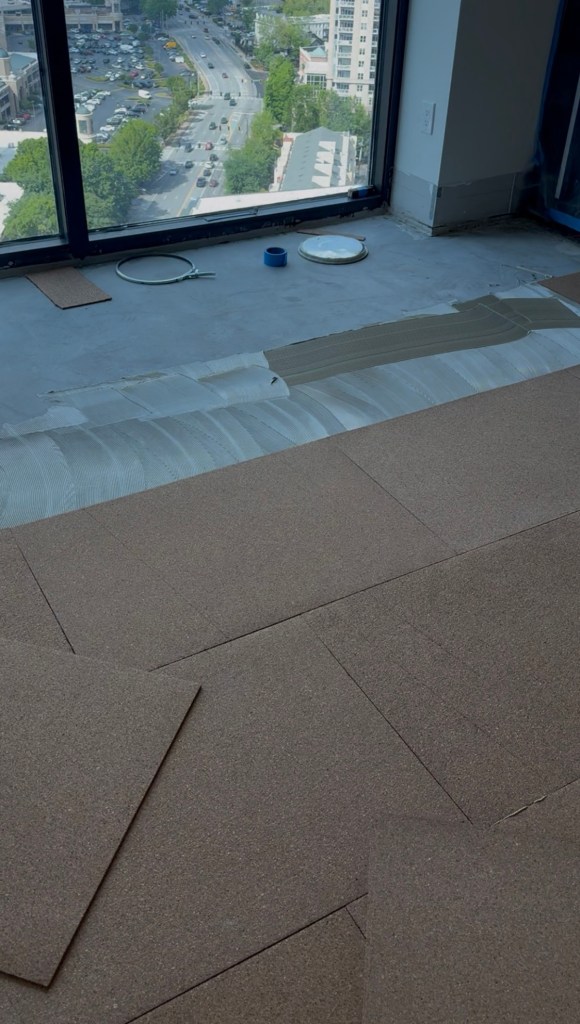
On both Buckhead floors, the white oak was glued over Roberts Natural Cork, 6 mm, with WAKOL MS 260, and WAKOL’s data sheet lists cork underlay among MS 260’s approved uses. On the 24th floor, the cork itself was set into MS 260 on the slab after grinding. At The Atlantic, the building requires an underlayment rated IIC 54 or better when hardwood replaces hardwood over its 7.5-inch concrete slab; the engineered floor was glued over ECO-Ultra Quiet with WAKOL MS 230 at both layers.
Which product fits depends on the building’s required rating, whether the floor on top is solid or engineered, and the moisture in the slab. Under a glue-down, NWFA has the adhesive manufacturer set the moisture limits: on the 21st floor, the slab read 55% relative humidity against WAKOL MS 260’s 80% limit.

How can I reduce the noise from my hardwood floor?
On a floor that is already installed, rugs and furniture glides reduce the impact sound of footsteps and moving chairs. NWFA’s care guidelines call for breathable rugs and note that some non-skid rug pads can imprint the finish, with natural-fiber pads transferring less than some synthetics; fabric-faced glides under furniture protect the floor as well. On a floor finished on site, NWFA has area rugs wait at least 7 days after the final coat, unless the finish manufacturer says otherwise.
If the noise is the floor itself, squeaks or creaks as you walk, that is a different problem from sound passing to the room below. NWFA’s guidelines have a subfloor’s movement and noise corrected before a new floor is installed, and our post on squeaky subfloors under new hardwood floors explains how.
When the floor is replaced, the acoustic underlayment is installed under the new floor. On the 24th floor in Buckhead, the existing engineered floor had been refinished twice and had no wear layer left for another sanding, so it was removed down to the slab and replaced with solid white oak herringbone glued over cork. At The Atlantic, about 800 square feet of engineered floor damaged in a water event was replaced over ECO-Ultra Quiet.

Planning a hardwood floor in a condo or high-rise
Classy Flooring ATL is led by Claudiu Toma, an NWFA Certified Installer, NWFA Certified Sand & Finisher and NWFA Certified Sales Advisor, who completed NWFA Precision Patterns: Parquet Flooring and NWFA Precision Patterns: Medallions. Every project is carried out by our in-house crew.
Our condo and high-rise hardwood floor installation page covers how we work in Atlanta high-rises, from the HOA approval package to slab preparation and pricing. Tell us about your building and the floor you have in mind through our contact form; we typically reply within one business day.