
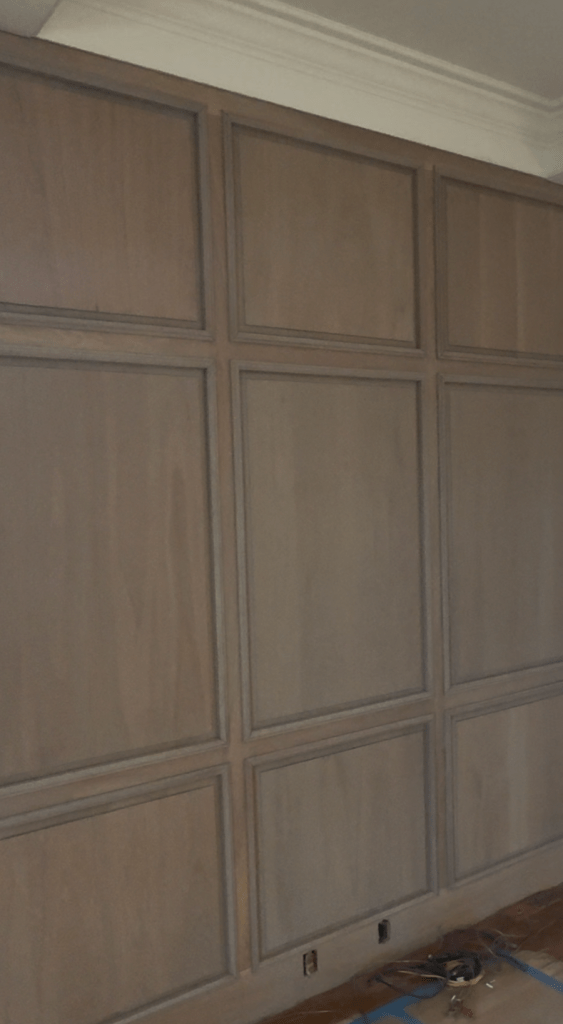

Solid oak wall paneling installed between the 1960s and the 1990s was typically finished in a warm amber or orange-toned stain. In many homes, the wood itself is still in excellent condition. It’s the color that reads dated, not the paneling.
Most homeowners are offered two options: paint the paneling or remove it and replace it with drywall. Both are difficult to reverse, and both change the architecture of the room permanently.
A third option exists that’s less commonly discussed because it requires a specialist to execute well: refinish the paneling with a color-correcting hardwax oil system. The existing finish and its color are sanded off, and a new finish is applied in a different color direction. The grain stays visible. The original millwork geometry stays intact. The color shifts without flattening the architecture.
This post covers when that approach fits, how the color correction works, and what a full-room refinish actually involves. The example throughout is a Buckhead, Atlanta home where we refinished a complete solid oak paneled system in January 2026 — 153 panels, 612 original trim pieces, finished in Rubio Monocoat Linen in place of the original warm orange.
When existing oak paneling is worth preserving
Not every paneled wall benefits from refinishing. In many homes, though, the paneling is one of the strongest architectural features in the room, and preserving it produces a better result than removing it.
Paneling is generally worth preserving when:
- It’s solid wood rather than veneered MDF. Solid oak typically has enough material depth to sand through an existing finish, though this depends on the panel’s construction and how many times the surface has been sanded previously. Thin veneer paneling requires careful evaluation before any sanding — in many cases, veneer is too thin to refinish safely. A specialist can tell the difference by inspecting a trim edge or panel back in person.
- The architectural profiles are original and detailed. Raised panels, stacked trim, integrated doors, fireplace surrounds, and built-in millwork represent craftsmanship that’s difficult and expensive to replicate today. Replacing that geometry with flat drywall permanently changes the character of the room.
- The wood is sound and the issue is the finish. If the existing paneling is structurally intact and the concern is color, sheen, or a dated amber stain, refinishing addresses the actual problem directly.
On the Buckhead project, all three conditions applied. The paneling was solid oak. The system extended through the full room — wall paneling, a fireplace surround, a panel-faced bench enclosure, paneled interior doors, and bar millwork that all read as one architectural language. The wood was in good structural condition. The only issue was the warm orange-toned finish that no longer worked with how the client wanted the house to read.
Why refinishing is often the more reversible choice
Painting is frequently recommended for oak paneling because it appears faster and less involved upfront. It’s also more difficult to reverse than refinishing.
Once paneling has been painted, the grain is covered permanently. Returning a painted surface to a natural wood finish is possible but labor-intensive, and results on grainy wood like oak can be inconsistent — paint tends to settle into the grain and release unevenly during stripping.
Refinishing, by contrast, keeps the option open. A refinished paneled wall can be refinished again in ten or fifteen years if tastes change. The wood itself remains accessible as a finished surface, not hidden beneath a pigmented coating.
For homeowners who value the grain and texture of real wood but want a lighter or cooler palette than the original finish provides, refinishing is usually the path that produces the intended result without foreclosing future options.
How color direction changes without hiding the grain
The technique is straightforward in principle: the existing finish is sanded off, and a new finish with different color direction is applied to the raw wood underneath.
On the Buckhead project, the existing amber-toned finish was removed through a three-stage sanding progression — 80, 100, and 120 grit — with flat surfaces worked by palm sanders and every trim profile worked by hand using card scrapers, sanding sponges, sanding blocks, and wire brushes in the corners and channels that sanders can’t reach. Once the old finish was fully removed, the raw oak was ready for a new finish system.
The finish specified for the project was Rubio Monocoat Oil Plus 2C in Linen — a plant-based hardwax oil that colors and protects the wood in a single layer. Linen is a cool, neutral tone that reads as a light driftwood color on oak, with none of the amber or orange that characterized the original finish. The oil bonds with the wood rather than sitting on the surface, so the grain and the natural texture of the oak remain fully visible. After the oil cured for 72 hours, we applied Rubio Monocoat Universal Maintenance Oil in Pure to raise the sheen from matte to a soft velvet.
The result is the same paneling — every panel, every trim profile, every architectural detail preserved — in a different color direction. The room reads as current without losing what was original.
Why sampling in the actual room matters
Paneling color decisions are difficult to make from a swatch book.
Oak reads differently in different light conditions. The ambient color temperature in a room shifts how a finish appears. And adjacent materials — floors, furniture, stone, trim — affect perceived color noticeably. A finish that looks correct in a supplier’s sample display can read differently in the room where it will live.
On the Buckhead project, we prepared sample sections directly on the paneled wall in the main room. Three candidate Rubio Monocoat colors in the gray-greige family were applied side by side. The client and the interior designer evaluated the samples in the actual light of the room, at different times of day, against the floor, the fireplace stone, and the furnishings. Linen was selected in one session because the sample proved it in context.
The same sampling process was carried out simultaneously on the floor, which was being refinished in the same scope. Both surfaces were sampled together so the final color direction worked across the whole main level — paneling, floor, and upstairs pine trim — as one coordinated palette.
What a full-room paneling refinish involves
A professional paneling refinish on a full-room system is a significant scope. On the Buckhead project, the work involved a four-person crew on site for approximately three weeks, driven primarily by the hand-tool work required to preserve 612 original trim profiles.
The process, in sequence:
- Component survey and numbering. Every removable panel and trim piece is numbered on the back so each component returns to its exact original position during reassembly.
- Dual-method setup. Removable panels and trim are refinished off the wall on sawhorses. Fixed frames and built-in components are refinished in place. Both streams run in parallel, and the finished surfaces read as one uniform result.
- Sanding through grit progression. 80-grit to remove the existing finish, 100-grit to refine, 120-grit as the final pass. Flat surfaces with palm sanders, every trim profile by hand.
- Surface preparation. Raw wood is cleaned with Rubio Monocoat Raw Wood Cleaner. Any dust remaining on the surface would bond with the oil instead of the wood and compromise the finish.
- Finish application. Rubio Monocoat Oil Plus 2C is applied in zones sized to stay within the manufacturer’s reaction-time window. Excess oil is worked off with a white pad and terry cloth within the specified time.
- Cure period. 72 hours before any second product is applied. The manufacturer specifies 48 hours minimum.
- Universal Maintenance Oil. Applied after cure to raise the sheen from matte to velvet.
- Reassembly. Every numbered panel and trim piece is returned to its original location.
The complete documentation of the Buckhead paneling refinish — including process, materials, and finished result — is available on the project page. A companion white oak floor refinishing project was completed in the same residence in a coordinated color direction.