
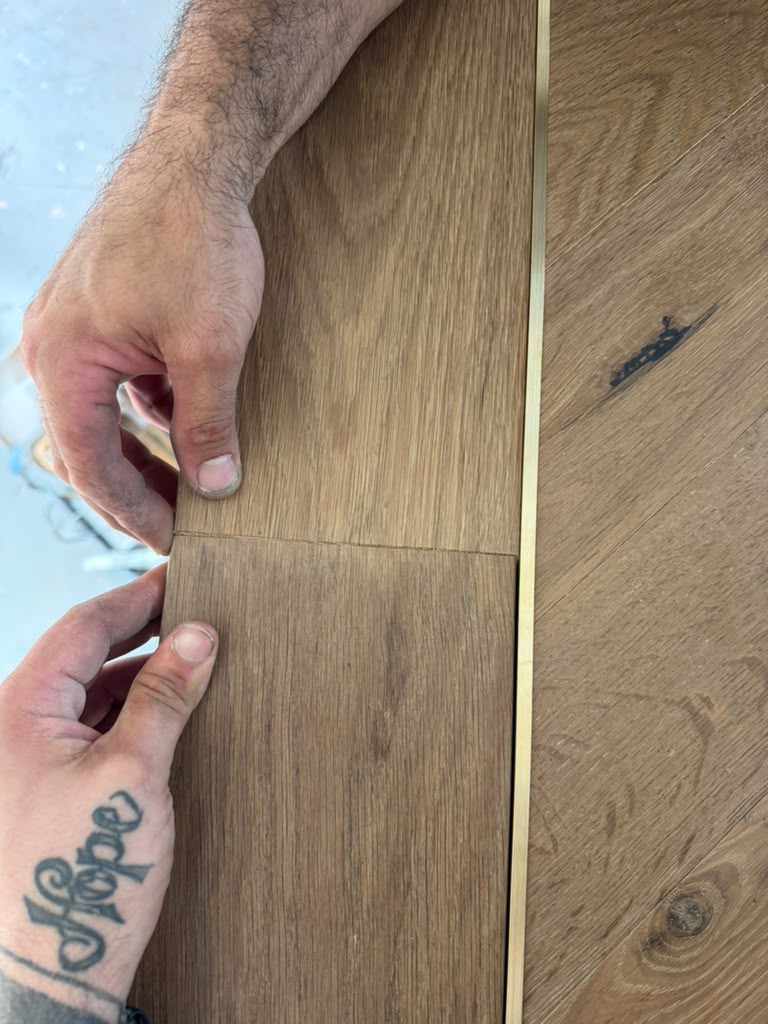

Classy Flooring ATL installs brass and metal inlay in hardwood floors across metro Atlanta.
Brass inlay sets a solid metal bar into the floor itself. The approach Classy Flooring ATL uses is a channel routed to the profile of the bar, the brass bedded in adhesive along that channel, and the metal brought level with the wood face so the two read as one surface underfoot.
How is brass inlay done?
The line is settled before anything is cut. The channel goes into the floor itself, so the run is set against the room’s measured dimensions and the layout is fixed at that point.
The channel is routed to the profile of the bar going into it. The brass is bedded in adhesive along that channel and brought level with the surrounding wood.
The floor type shapes how that level is reached. A site-finished floor is sanded after installation, and the sanding sequence brings the whole surface into one plane. A prefinished floor arrives with its factory finish already on it, so the brass has to come level with a face that stays as it is.
The Woodstock estate is a prefinished floor. The brass runs 214 linear feet across two houses, through the European white oak herringbone fields, along a catwalk, and across the doorway thresholds. The bar is solid C360, 1/4 inch by 1/2 inch.
How can I attach brass to wood?
In a floor, the bond has two jobs. It holds a metal bar that stays dimensionally stable inside wood that expands and contracts with seasonal humidity. And it keeps that bar level over time.
On the Woodstock estate the brass is bedded in MAPEI Ultrabond ECO 995, the same adhesive carrying the wood itself. That ties the metal into one bond system with the floor around it, so the brass and the boards are held by the same material. Metal inlay can be set several ways; this is the approach Classy Flooring ATL uses for its long-term hold.
Does brass react with wood?
Brass is a copper and zinc alloy. The change people see over time is patina, which is the brass surface responding to air, moisture, and handling. It happens on the exposed face of the metal.
Brass comes two ways. Unlacquered brass patinas and deepens in color as the floor is lived on. Lacquered brass carries a clear coating on the metal face and holds the finish it arrived with.
The Woodstock estate brass is mill finish and unlacquered, so the line takes a natural patina.
What are the disadvantages of using brass?
Brass inlay fixes the layout early. The channel is cut into the floor, so the run is settled at the planning stage and carried through installation. The layout drawing is the most important part of the preparation.
It is fitted work, measured and cut to the run. Brass inlay work starts at $24 per linear foot and moves with the complexity of the run.
Unlacquered brass changes appearance as it patinas. Where a homeowner wants the arrival finish held, lacquered brass is the specification to ask for.
Classy Flooring ATL installs brass and metal inlay, custom borders, and pattern work in hardwood floors across metro Atlanta. Our brass and metal inlay page covers the work in full, and the Woodstock estate is documented on its own project page.
Classy Flooring ATL is led by Claudiu Toma, an NWFA Certified Installer, NWFA Certified Sand & Finisher and NWFA Certified Sales Advisor, who completed NWFA Precision Patterns: Parquet Flooring and NWFA Precision Patterns: Medallions. Every project is carried out by our in-house crew.